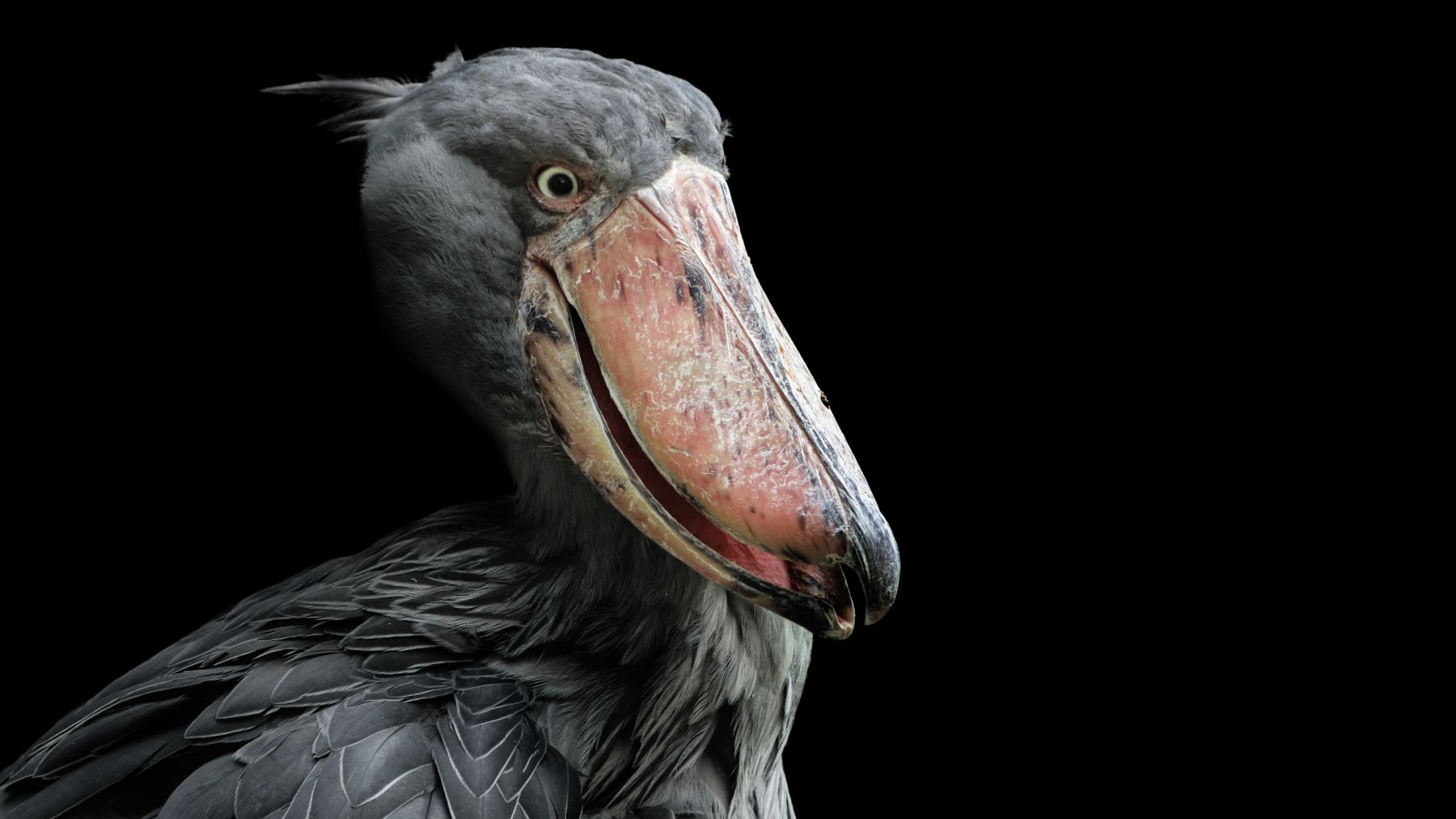
The human-sized African bird, also known by people and scientists as the shoebill, is renowned for its hunting style. It can grow to a height of five feet and forage for fish and reptiles in East African swamps. It can kill its siblings and consume young crocodiles thanks to its enormous bill. Standing five feet (1.5 meters) tall, this menacing, dinosaur-like bird boasts the third-largest bird beak in the world, a one-foot (0.3-meter) long, sharp-edged bill.
The Shoebill is known for hunting baby crocodiles and engaging in sibling rivalry
With its large beak and long, slender legs, it is a strong ambush predator that can hold its victim still for an extended period of time before capturing and consuming it whole. Catfish accounted for about 71% of its diet, according to a 2015 study that was published in the Journal of African Ornithology. But it’s also known that the shoebill will eat snakes, eels, and even young crocodiles. Although shoebills are primarily solitary, breeding pairs are monogamous and can lay up to three eggs in a clutch; however, only one of them often makes it to adulthood because of sibling rivalry. Usually the larger firstborn either outcompetes its siblings for food or kills them.
In essence, the second or third chicks are backups in case the first one doesn’t make it. The adult chick was spotted attacking its little sister in a moment from the BBC’s David Attenborough show, Africa. The mother does not provide any care for the younger child when it returns to the nest. Moreover, the shoebill, which is frequently mistakenly called a stork, is the sole member of the genus Balaeniceps and the larger family Balaenicipitidae; pelicans are its closest surviving relatives. Near the end of the Cretaceous period, between 145 and 66 million years ago, their ancestors in the order Pelecaniformes first arose.
Why is the shoebill so amazing for human understanding?
Shoebills are unique in their evolutionary family, with their nearest extant relatives being the Pelecaniformes order, which formed some 65 million years ago, during the end of the Cretaceous Period. The shoebill order includes species like pelicans, hammerkops, ibises, spoonbills, herons, egrets, and bitterns. The shoebill’s bill broadens due to the need for a large gape to catch and swallow large fish.
Consequently, they can swallow their prey whole because they do not chew their meal. Unlike most other birds, which have eyes on the sides of the head, these have both eyes on the front of the head, giving them a more severe look. Furthermore, they can sense depth more clearly thanks to their so-called binocular vision, which is an adaptation to hunting. The majority of predators, such as carnivorous mammals and birds of prey, can see with both eyes to better assess distance. That look’s sternness is something that humans typically associate with front-facing eyes.
What do biologists know so far about shoebill parenting?
Despite the large number of eggs they hatch, shoebills are also known for what some may consider to be cruel parenting practices: they will only raise one chick, with the other birds serving as a kind of backup in the event that the primary chick dies. For example, because of the intense pressure of predation on the young (consider all the little turtles that hatch on a beach and have a very small chance of making it to the sea), many species generate more young than they can raise. Does the mother turtle have savage tendencies? Because of their tough living conditions, shoebills essentially use the second chick as a “backup plan” in case something were to happen with the first one.