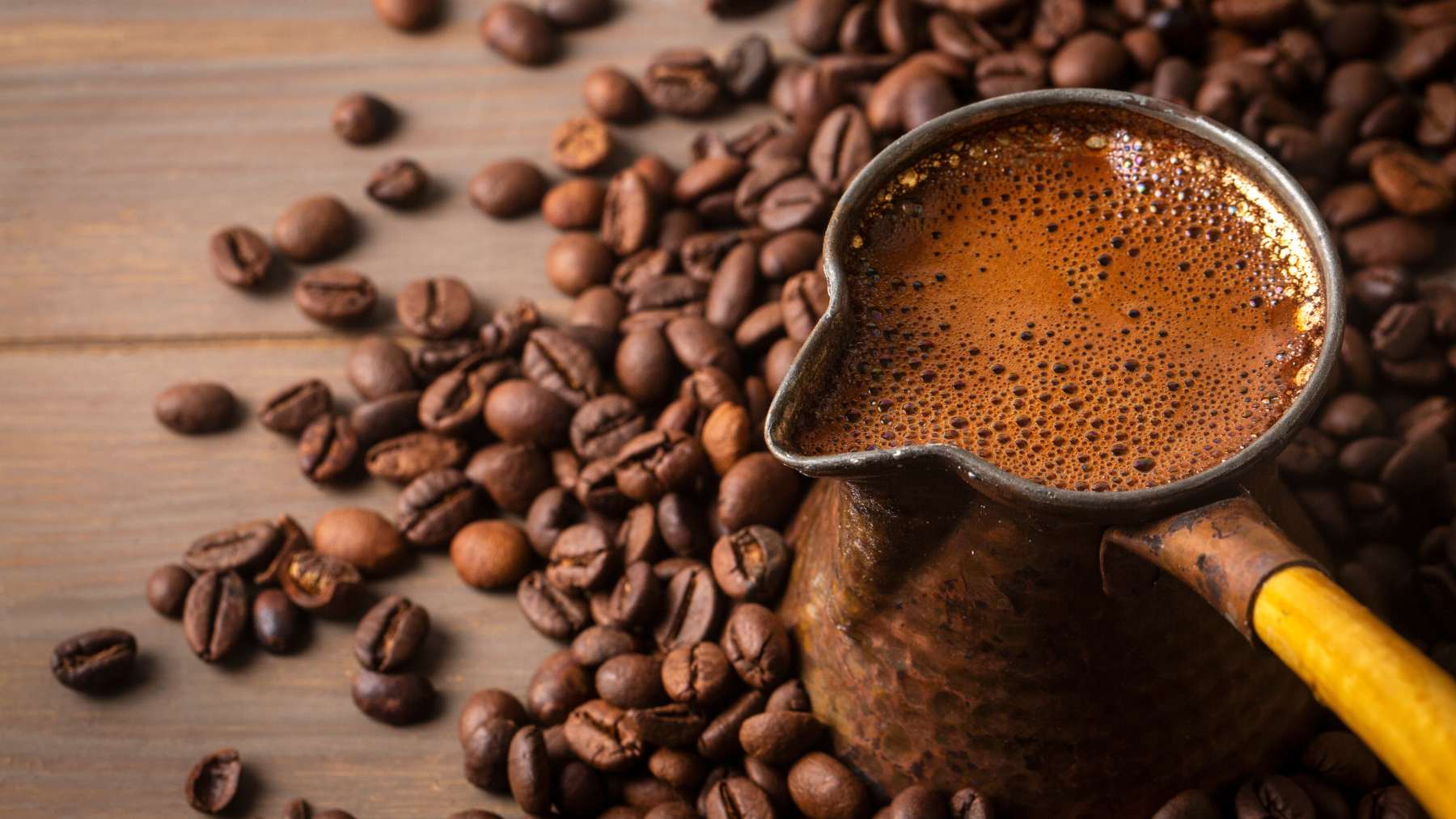
Researchers in Australia found that by processing and adding burnt coffee grounds to the mix, we could be creating concrete that is 30% stronger. Their ingenious formula could simultaneously address several issues. An astounding 10 billion kilos (22 billion pounds) of coffee waste are produced worldwide each year. The majority wind up in landfills. Organic waste disposal is an environmental problem because it releases significant amounts of greenhouse gases such as carbon dioxide and methane, which contribute to climate change, according to RMIT University engineer Rajeev Roychand.
This is the reason why you shouldn’t throw away coffee
In addition to the growing demand for resource-intensive concrete brought on by the world’s expanding building industry, there are other environmental issues. RMIT engineer Jie Li stated that the continuous global extraction of natural sand, usually from riverbeds and banks, to satisfy the ever-increasing needs of the building sector has a significant effect on the environment. Because resources are limited and sand mining hurts the environment, there are significant and enduring obstacles to ensuring a sustainable supply of sand. We may better maintain our natural resources, such as sand, and prevent organic waste from ending up in landfills by adopting a circular economy strategy.
It is important to note that coffee grinds and other organic materials can’t be mixed directly with concrete because they release chemicals that reduce the strength of the construction material. Thus, despite denying it oxygen, the scientists used low energy levels to heat coffee waste to above 350 °C (about 660 °F). We refer to this process as pyrolysis. It decomposes the organic molecules to produce biochar, a porous, carbon-rich charcoal that can attach itself to the cement matrix and integrate. Roychand and colleagues also pyrolyzed the coffee grounds at 500 °C, however, the biochar particles that were produced were weak. The researchers issued a warning, saying they still need to evaluate how long their cement product will last.
The hybrid coffee-cement is currently being tested for its performance under abrasions, water absorption, freeze-thaw cycles, and numerous other stressors. In addition, the team is focused on producing biochars from wood, food waste, and agricultural waste, among other organic waste sources. Although our study is still in its early phases, these promising results present a novel approach to significantly lowering the quantity of organic waste that ends up in landfills, according to Shannon Kilmartin-Lynch, an engineer at RMIT. From an Indigenous perspective, the inspiration for my research comes from Caring for Country, making sure that all materials have a sustainable life cycle, and preventing items from ending up in landfills to reduce their negative environmental effects.
Follow these scientists’ tips to prepare a cup of coffee
Due to poor weather, coffee production has decreased over the last four years, resulting in a sharp increase in costs. Growing tariffs on nations that produce coffee, such as Brazil and Colombia, make that cup of coffee increasingly a luxury in the morning. However, a rather overzealous team of physicists and fluid mechanics specialists at the University of Pennsylvania has developed a recently published method that will extend the life of your coffee grinds.
A year or so ago, as they were sitting around the coffee table in Arnold Mathijssen’s lab, staff members began to wonder how to extract the most coffee with the fewest beans. Their results were recently published. Following dozens of tests and analyses, Park, Mathijssen, and lab partner Margot Young developed a method that yields the most coffee from the fewest number of beans.
Pour hot water over the coffee grounds gradually to increase contact time and maximum extraction. Pouring too slowly can result in either too much or too little extraction. To maximize exposure to the boiling water, raise the pour height to increase the water velocity and create an “avalanche” in the grounds. This method avoids under- or over-extraction and guarantees appropriate extraction. To ensure a smooth, laminar pour of water into the coffee, pour the water in a stream rather than droplets. Too slow or too high can cause the stream to break, stopping the avalanche. The simplest way to do this is with a thin trickle of water, usually from a gooseneck kettle, however, a narrow stream can be produced with a standard kettle.