
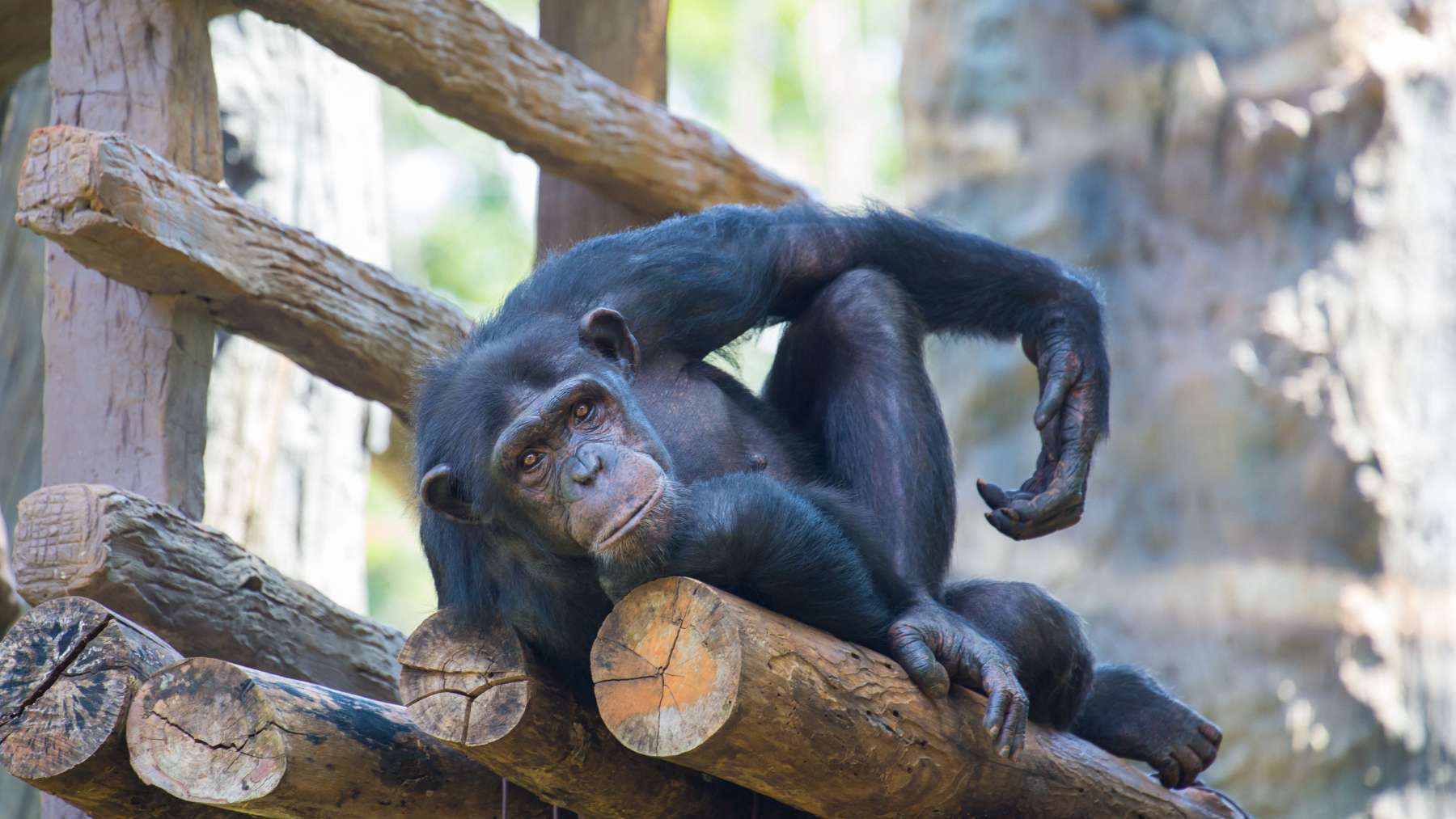
According to recent research, bonobo communication has revealed amazing facts. With the ability to form sentences out of words, humans can converse about a vast array of subjects, from neurobiology to pink elephants. The capacity to integrate significant elements into more expansive structures whose meaning is determined from the meaning of its parts and how they are combined is known as compositionality. It was long thought by scientists that compositionality was only widely employed by humans. Animal communication was believed to consist primarily of a random collection of calls with infrequent compositional occurrences. Our latest research, which was just released in the journal Science, contradicts this.
Human speech and Bonobo communication have unexpected similarities
Through a thorough investigation of bonobo vocal communication in the Kokolopori Community Reserve in the Democratic Republic of the Congo, we discovered that, similar to human language, bonobo vocal communication depends heavily on compositionally and they are our closest living relatives. Understanding the meaning of individual calls and their combinations is crucial before delving into animal compositionality. This has long been a problem since it’s hard to get into animals’ heads and accurately interpret what they’re calling.
To address this issue, researchers developed a novel method for accurately interpreting bonobo vocalizations, and we applied it to determine the meaning of each call and combination of calls. A bonobo call can have a variety of meanings, including a command to run, an announcement of upcoming actions, an expression of internal states, or a response to external events, such as a predator. Researchers employed more than 300 contextual characteristics to characterize the emission environment of each vocalization to prevent human bias and correctly evaluate each vocalization’s meaning. Whether the caller was feeding, traveling, resting, or experiencing other environmental events, such as the presence of another bonobo or a troop of monkeys nearby, was one example of what we recorded.
In addition, they coded the actions of the caller and the audience during the two minutes following the production of the call. To give meaning to the calls, meaning being the contextual features associated with the emission of the vocalization, we used this extremely thorough contextual description. For instance, the call probably indicates “I will travel” if the caller always begins to travel after making a specific call. As a result, a thorough collection of bonobo terminology and their definitions could be created. Since this dictionary is the first to carefully identify the meaning of all animal cries, it marks a significant breakthrough in the understanding of animal communication.
Is bonobo communication compositional?
To investigate compositionality in animal combinations, the study created a method that revealed many call combinations with meanings associated with their parts, which is a crucial aspect of compositionality. Moreover, a number of these call combinations exhibited a remarkable similarity to the more intricate compositional patterns found in human language. There are two ways that compositionality can appear in human language. In its simplest (or trivial) form, the combination is interpreted by the total of its parts, with each component independently adding to the meaning of the whole.
For instance, the term “blond dancer” describes someone who is both blond and a dancer. We can assume that this individual is a blonde doctor if they are also a doctor. The units of a combination in complicated (or nontrivial) grammar interact with one another to change one another rather than contributing isolated meanings. The term “bad dancer” does not, for instance, describe a nasty person who also dances. We cannot assume that someone is a lousy doctor just because they are a doctor. Only “dancer” is associated with “bad” in this context.
The understanding this research offers into the evolutionary foundations of language’s compositional character is a significant implication. Our last common ancestor probably relied heavily on compositionality, if our bonobo cousins do the same. This implies that our predecessors could create complex meanings from smaller vocal components at least 7 million years ago, if not earlier. According to these recent discoveries, compositionality was likely present long before humans and is not unique to human language.




