
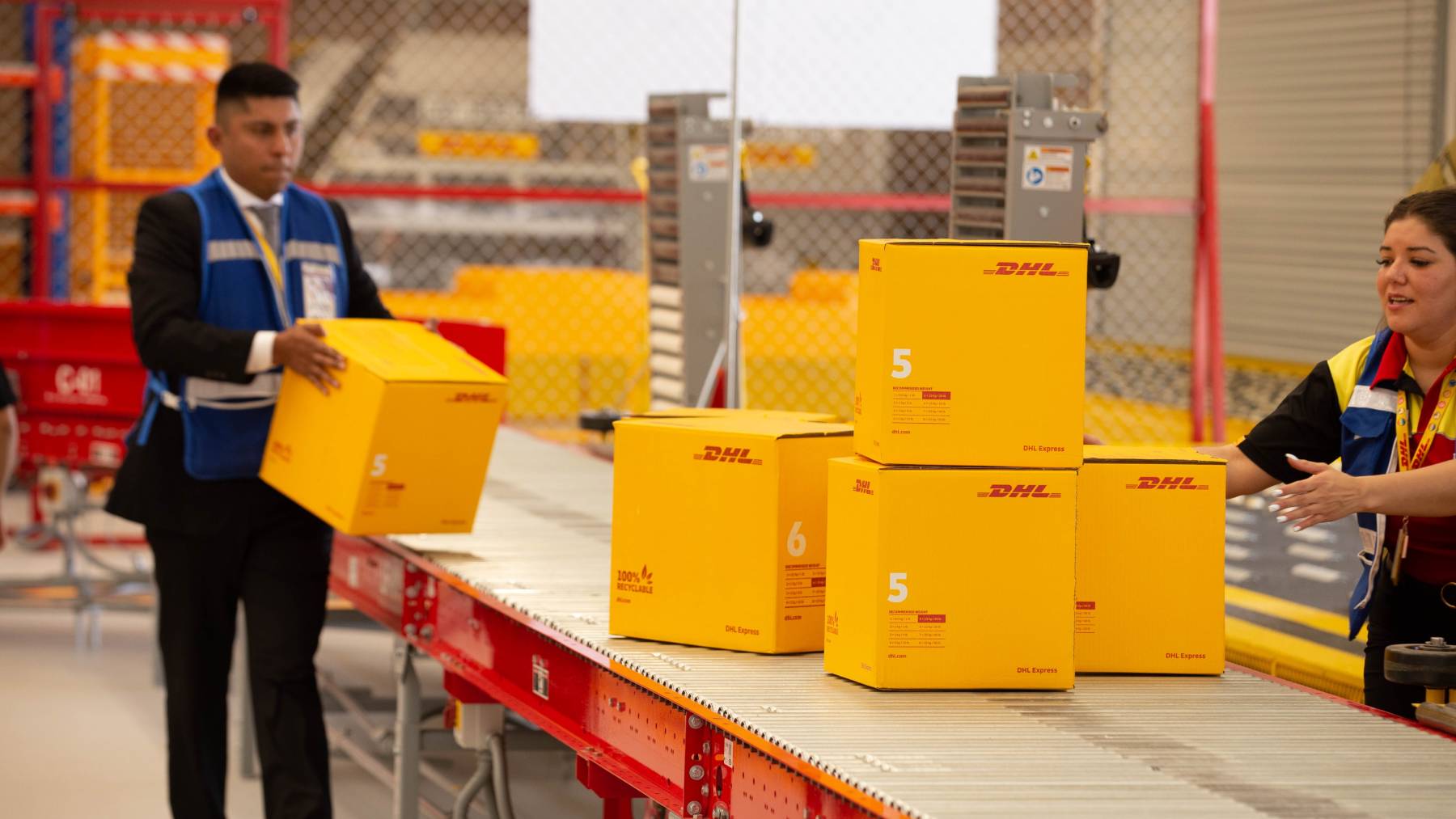
Due to a notable rise in customs red tape with the implementation of Donald Trump’s new tariff regime, DHL Express is stopping delivery to the US for amounts exceeding $800 (£603). According to the shipping behemoth, shipments from businesses worldwide to American customers will be temporarily halted starting Monday and lasting until further notice. Business-to-business shipments will continue, notwithstanding the possibility of delays, it noted.
DHL has confirmed the suspension of high-value US deliveries over tariff chaos
In 1969, Adrian Dalsey, Larry Hillblom, and Robert Lynn created DHL. Since then, it has grown to become the top logistics company in the world, with 600,000 employees spread across more than 220 nations and territories. The package delivery business is a part of the DHL Group, which also owns Deutsche Post, another well-known brand. Parcel and rapid delivery, freight transportation, full supply chain management, and specialized logistics for e-commerce are just a few of its many international services.
Considering DHL’s decision, packages up to $2,500 could previously enter the US with little documentation, but the threshold has been decreased as a result of stricter customs inspections that were implemented earlier this month in conjunction with Trump’s tariffs. It stated that shipments above $800, regardless of origin, may encounter delays of several days while it works to scale up and handle this surge. Moreover, packages under $800, which may be shipped to the US with little scrutiny, will still be delivered, the business stated. However, when the White House shuts a loophole that permits low-value shipments to enter the US duty-free on May 2, it will crack down on deliveries under $800, particularly those coming from China and Hong Kong.
Companies like Temu, the massive low-cost retailer, and Shein, a fast-fashion company, will be impacted by the repeal of the so-called de minimis rule and the DHL decision. Temu and Shein have both issued price increases due to recent changes in international trade regulations and tariffs. According to the Trump administration, many Chinese shippers use dishonest shipping methods to disguise the actual contents of cargo shipped to the US and contain illegal drugs. Furthermore, the White House said the measures were intended to target the synthetic opioid supply chain, which it said is a major contributor to the US synthetic opioid issue, under an executive order. Beijing has stated that China has the most stringent drug laws in the world and that the opioid fentanyl problem is a US issue. Hong Kong Post announced last week that it would no longer accept packages headed for the United States and that it was suspending packages sent to the US by sea as of April 27.
DHL’s decision is just collateral damage from Trump’s tariffs
According to President Donald Trump, tariffs are an essential part of his economic policy because he wants to protect employment, boost tax collections, encourage economic growth, and support American manufacturing. Trump wants to revive and restore the American manufacturing sector, which has lost a lot of jobs over the last four decades, mostly as a result of work being sent to lower-paying nations like China or Mexico. Additionally, the president feels that the U.S. is suffering a big trade deficit and that other nations are taking advantage of the opportunity to sell their products to U.S. customers. Donald Trump has imposed several tariffs on U.S. trading partners through executive orders since taking office again for his second term as president. Below, you can find the main tariffs imposed on countries worldwide:
- 25% off of all Canadian and Mexican goods that don’t adhere to the USMCA
- 10% of the energy in Canada
- 25% on steel and aluminum imports
- 25% off all cars and auto parts made in other countries
- 20% off goods originating from the 27 EU member states
- 145% of Chinese imports
- 49% of Cambodian goods
- 48% off Laotian goods
- 46% of Vietnamese goods
- 45% of Myanmar imports
- Thai imports are up 37%.
- 32% off Indonesian goods
- 26% off Indian goods
- 24% off Japanese goods
- 24% on imports from Malaysia
- 24% off goods coming from Brunei
- 18 percent on goods coming from the Philippines




