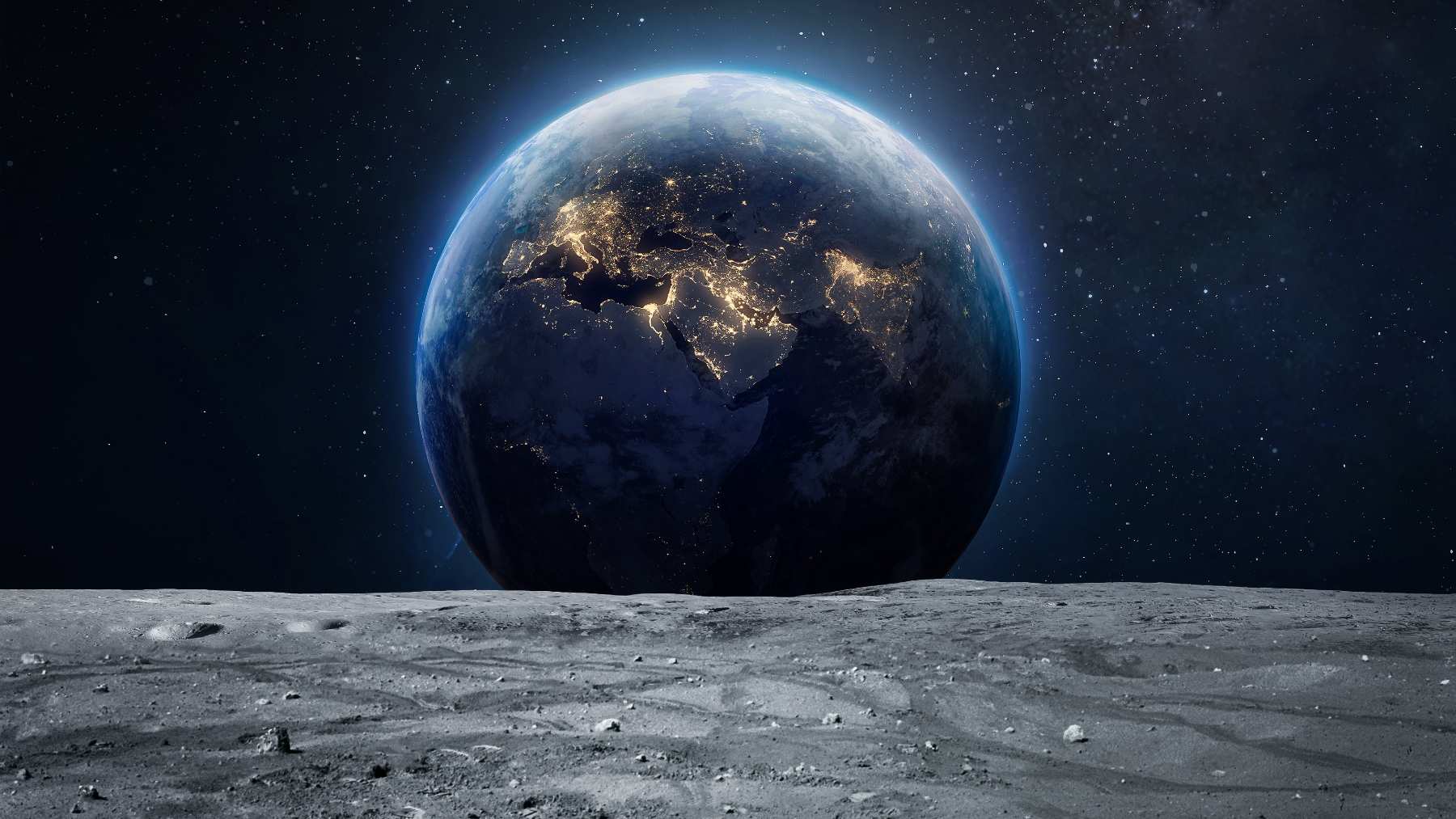
Impact craters blanket the lunar surface, ranging in size from small pits to massive basins over 1,000 kilometers large. About 4 billion years ago, during the Late Heavy Bombardment period, when the inner Solar System went through a severe period of asteroid and comet impacts, these craters were mainly formed. Due to the Moon’s absence of an atmosphere and substantial geological activity, these impact characteristics have been preserved for billions of years, in contrast to Earth, where weathering, erosion, and tectonic action constantly modify the surface.
Researchers have revealed how often Lunar impact fragments strike planet Earth
This very well-preserved cratering record documents important aspects of our solar system’s creation and development. A sizable portion of the lunar material that is expelled during crater formation reaches Earth by reaching the Moon’s escape velocity. We can learn more about the flow of material between the two bodies by examining these rocks. A group of scholars has focused on this study, and they recently released a paper about it. Under the direction of Jose Daniel Castro-Cisneros, the study employs more advanced computer models than previous research to trace how moon debris makes its way to Earth.
Using simulations, the study looks at more initial conditions over longer periods to determine whether lunar material contributes to near-Earth objects and how much of it reaches Earth. The scientists also planned to use the paths of Moon debris to piece together the date of Earth’s impact and the collision’s influence on geology and life. Objects like Kamo’oalewa, which is thought to be between 36 and 100 meters in diameter and orbits close to Earth, attract their particular attention since they may be a fragment of the Moon. Tracking particles from the Moon for 100,000 years with the REBOUND simulation software improved on previous investigations of lunar ejecta.
The researchers represented Earth and the Moon together using a more realistic ejection velocity distribution than previous attempts that employed separate phases. A more thorough picture of the material transfer from the Moon to Earth was obtained by recording data every five years and collision events, which were defined as ejecta that reached 100 km above the Earth’s surface. With half of these collisions taking place during the first 10,000 years, the team was able to determine that Earth gathers roughly 22.6% of the debris released after lunar impacts over 100,000 years. A change in one quantity causes a corresponding relative change in another, and the collision rate is distributed across time according to a power law.
What happens when lunar fragments impact
The likelihood of an Earth-Moon collision is highest on the Moon’s following side and lowest on its leading side. When they strike Earth, the lunar ejecta travel between 11.0 and 13.1 km/s and primarily strike near the equator (impacts at the poles are 24% less frequent). With a peak at 6 AM/PM, these effects are almost evenly dispersed between the morning and nighttime hours. This study shows that around 25% of lunar impact ejecta reach Earth, with half of it occurring in just 10,000 years, which greatly expands our knowledge of lunar-Earth material exchange. Unprecedented patterns in this process are shown by the findings on the concentration of equatorial impacts and the significance of the site of lunar launches.
US scientists are studying China’s lunar rocks
Though political obstacles still exist, a U.S. scientist has been chosen for the first time to examine lunar samples returned by China’s Chang’e-5 mission. NASA funding is not available to assist the research because of long-standing U.S. limits on space collaboration with China. The China National Space Administration (CNSA) recently selected Timothy Glotch, a planetary scientist at Stony Brook University, to receive a unique collection of moon rock and soil samples gathered during China’s historic 2020 sample return mission. The Chang’e-5 spacecraft successfully gathered 1,731 grams of lunar material from Mons Rümker, a volcanic location in the Oceanus Procellarum, marking the first time lunar material has returned to Earth since 1976.