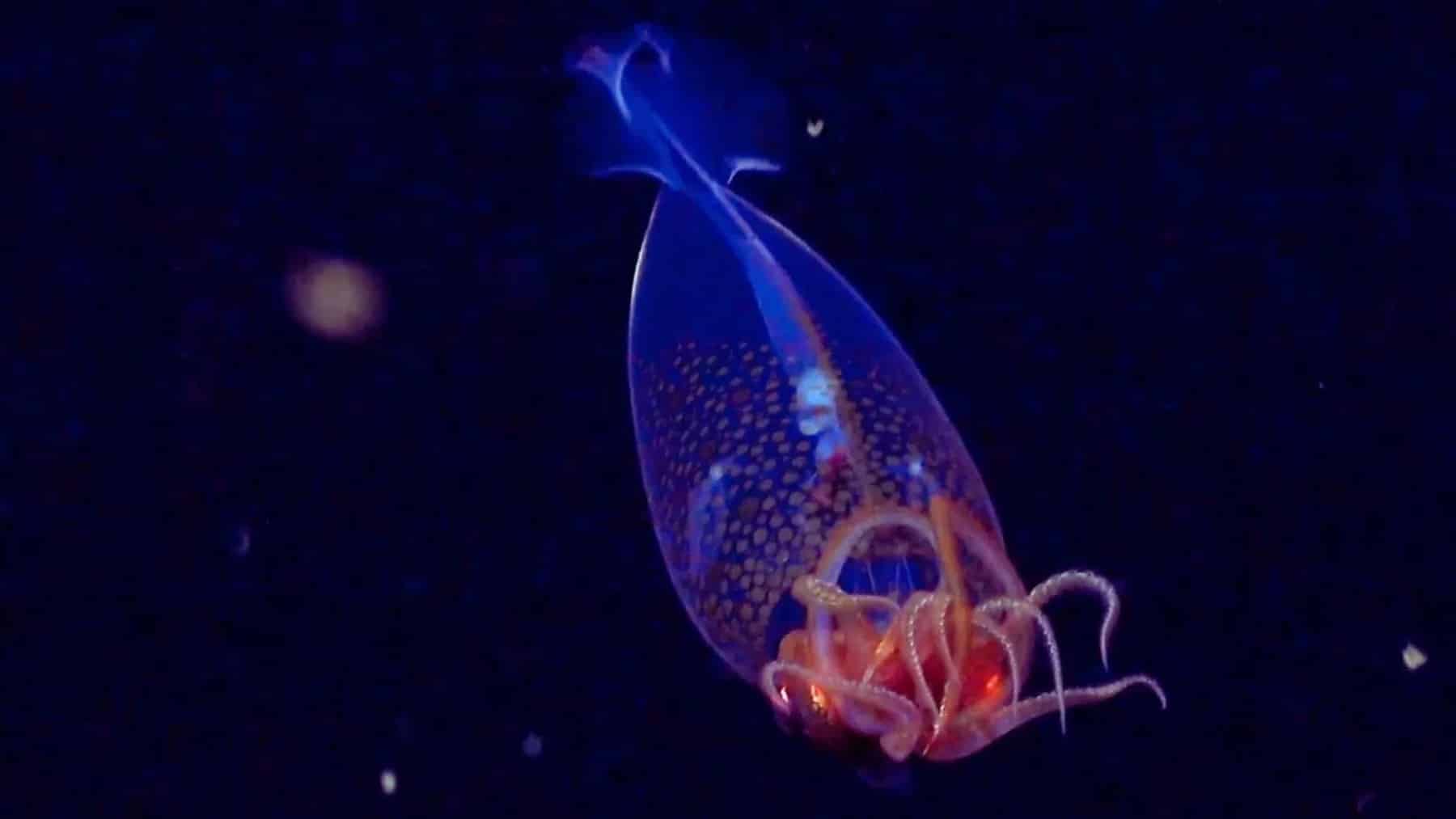
A hundred years has taken the colossal squid (Mesonychoteuthis hamiltoni), to be seen in the deep sea. The research vessel Falkor, which carried on board a crew composed of researchers from the Schmidt Institute, was able to capture images of one of the largest species of squid in its natural habitat.
The colossal squid
This is a species identified 100 years ago. It is known that, on average, these squids can measure 7 cm long and weigh around 500kg. Given its little interaction with the human being, it has not been possible to investigate its life cycle, characteristics and other curiosities, but it is known that the younger individuals present an opaque color, which is lost throughout their lives, becoming practically transparent in adulthood. We would be talking about the heaviest invertebrates on planet Earth. Can you imagine?
The expedition
On 9 March, an expedition was conducted to the Sandwich Islands in the South Atlantic Ocean. The research vessel Falkor was carrying a crew of researchers and scientists from the Schmidt Ocean Institute, who were able to capture images of this species 30 cm long at 600 m depth. To do this, they used the Ocean Institute’s SuBastian Remote Control Vehicle (ROV).
The sighting
Nothing but a centenary had to pass for the human to be able to film images of the colossal squid again.
Several sailors and fishermen have regularly seen bodies floating on the surface, which has not helped the investigation or their location.
After the sighting, it was specified that the images were inspected by an independent professional. It was the case of Dr. Kat Bolstad from the Auckland University of Technology, who was one of the selected researchers. After her analysis, she declared “It is exciting to see the first recording in situ of a colossal juvenile squid”.
She also added the times she had thought about this specie and the way in which the squids are totally alien to the human existence.
Investigation
It has not been easy to obtain detailed information about the colossal squid. After its identification, this species was difficult to locate again, given that its natural habitat is the deep sea, where human access requires specialized equipment.
Advances in science are very costly economically speaking, and not all research centres can afford such instruments. In addition, there are numerous investigations under way and it is extremely difficult to cover them all.
The meaning of this images
This year commemorates the 100th anniversary of the discovery of the colossal squid, and what better way than having been able to record images of it at a young age and in its natural habitat. These images and the fact of having located a specimen of this species is a great joy for the world of marine research. This implies that research on the colossal squid can not only be resumed, but expanded, and lead researchers to discover more and more about the seabed.
There are many other research related to the seabed, species and oceans are underway. For example, the discovery of an unknown giant sea. It is undeniable that, despite the multiple species we already know, there is a whole world to discover below the surface and we may never have enough resources to explore. We only have to wait for some of those pescies decide to go up to the surface and be seen by one of us.