
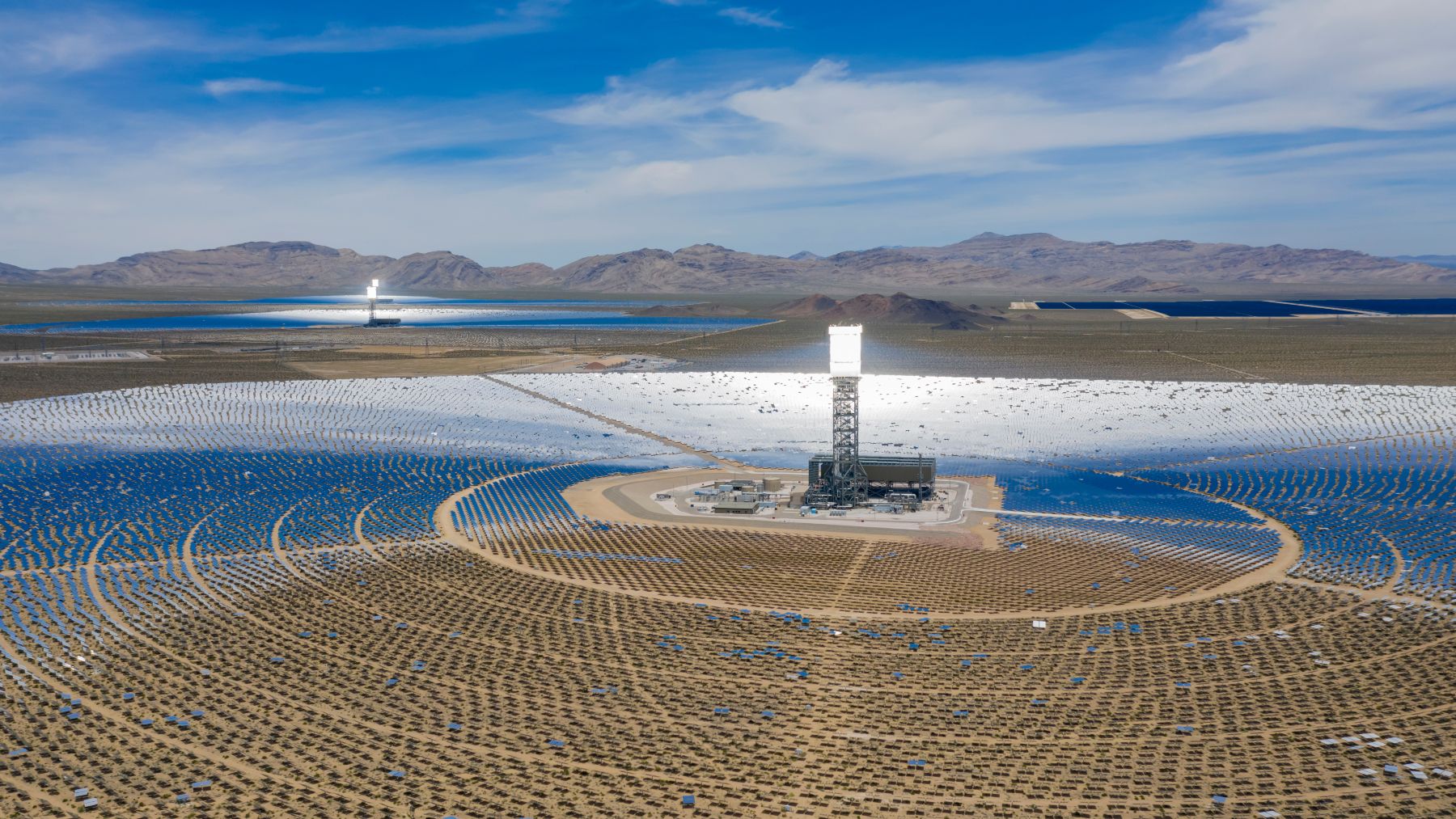
The revolutionary idea born in 2014, Ivanpah will officially close in 2026. Today, Mojave may sound like an iOS update to many, but it’s also the desert home to Ivanpah (which means clean water), a solar power plant that once became the world’s largest solar thermal plant. Now, the plant will close due to financial difficulties, technological advancements that it hasn’t been able to compete with, and environmental concerns.
They used more than 300,000 mirrors were computer-controlled and 173,500 heliostats
The plant was built on 6 square miles of government land at the foot of Mount Clark in California. The plant was built by BrightSource Energy and Bechtel, with NRG Energy and Google as the main investors.
The plant’s operation consists of hundreds of mirrors that collect solar energy and then reflect it, thus maintaining the energy supply even at night. On one hand, more than 300,000 mirrors were computer-controlled, and 173,500 heliostats directed sunlight toward elevated water-filled boilers. In this way, the heat converted the water into steam and was driven to produce electricity.
Ivanpah has faced issues due to the environmental impact
With this operation, one of the plant’s problems was precisely the complexity of its operation; coordinating so many mirrors was no easy task. Furthermore, Ivanpah has faced issues due to the environmental impact. Furthermore, an NRG spokesperson explained to CNN that, while prices were competitive in 2009 when the contracts were signed, subsequent technological advances in other forms of solar energy meant that more efficient and economical options dominated the sector.
The intense reflection of the light created an anomaly that attracted birds, causing their deaths. Some environmentalists said the solar plant was a real bird trap, and reportedly 28,000 birds were burned to death each year. Julia Dowell, a member of the Sierra Club environmental organization, told CNN that the plant was “a financial waste and an environmental disaster.”
Global warming and the search for renewable sources that don’t harm the ecosystem
Adding to these headaches was the evolution of technology. Instead of contributing to the project, Ivanpah failed to cope with other forms of natural energy that were (and are) being developed around the world. Global warming and the search for renewable sources that don’t harm the ecosystem is a topic of concern for many countries, and therefore, spending on innovation in countries like Japan is leading to the development of independent solar panels, for example.
NRG Energy was the largest investor with $300 million and Google invested $168 million
In terms of costs, the plant cost $2.18 billion to build, more than 50% of which came from US government subsidies; NRG Energy was the largest investor with $300 million, and Google invested $168 million in the project. Jenny Chase, a solar energy expert at BloombergNEF, commented that operating this type of technology proved more complex than expected: it requires perfect and constant alignment of thousands of mirrors, as well as intensive maintenance similar to that of fossil fuel plants.
As has been learned, even if the plant is dismantled, the site could be reused for another type of solar installation, more in line with current technologies.




