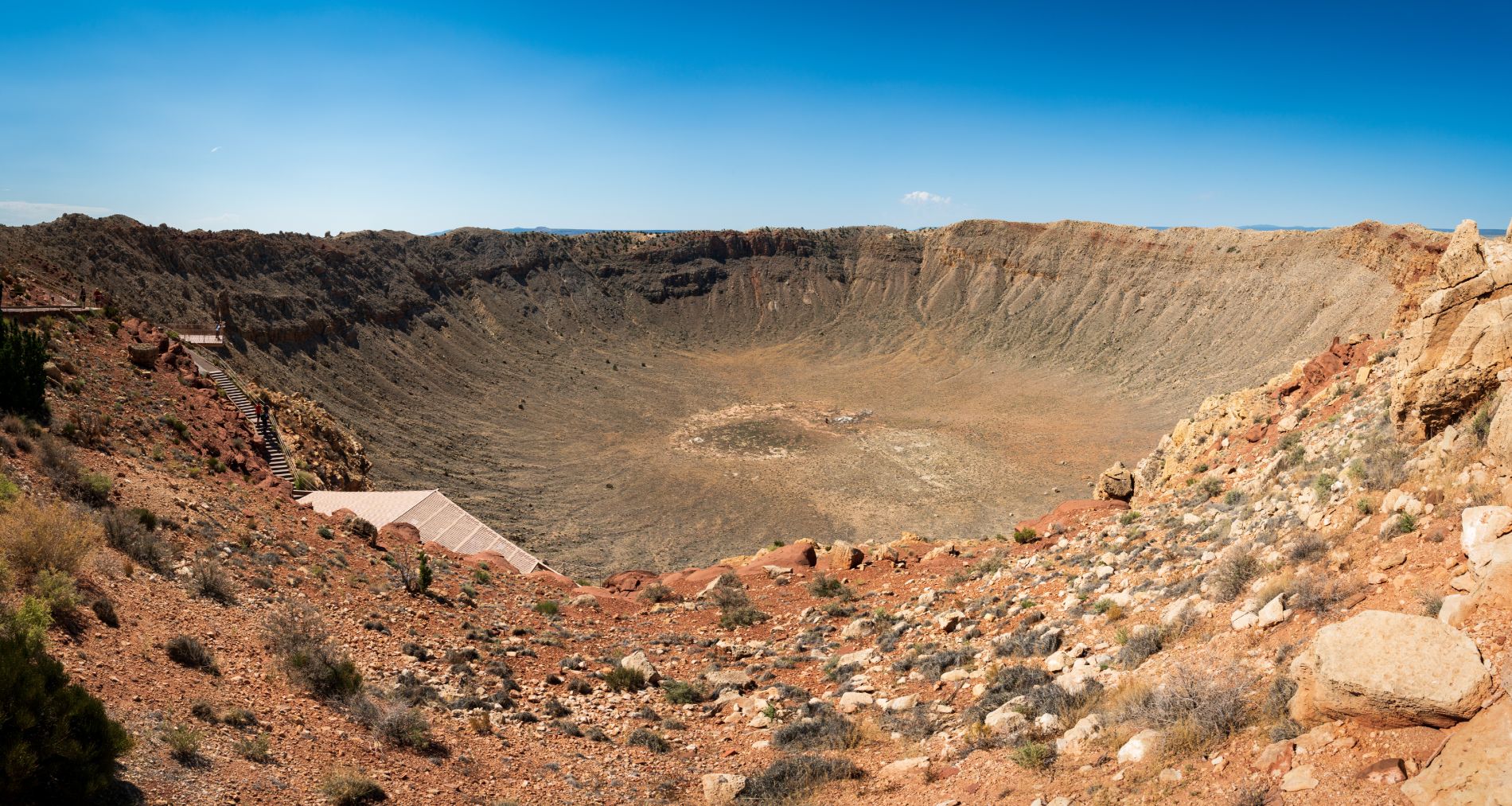
There is a crater over 1,000 meters wide and 200 meters deep in Arizona. It is Barringer Crater, which was created after a 50-meter-long meteorite hit Earth 50,000 years ago. The resulting earthquake may have caused a rockslide in the Grand Canyon, damming the Colorado River and temporarily creating a body of water 80 kilometers (50 miles) long and over 100 meters (about 370 feet) deep in what is now Nankoweap Canyon.
Associated backwater lake sediments preserved in caves up to 60 m above the present-day Colorado River
Thus, the impact excavated 175 million metric tons of limestone and sandstone, forming a crater 1.2 kilometers across and about 180 meters deep. Evidence for the Nankoweap Paleolake resulting from that impact lies in driftwood and lake sediments found in Stanton Cave, which is located nearly 45 meters above the Colorado River.
The official research release states that results supporting the hypothesis include radiocarbon dating of driftwood and luminescence dating of associated backwater lake sediments preserved in caves up to 60 m above the present-day Colorado River. This work highlights the value of radiocarbon dating near the limits of the technique, the integration of multiple dating methods, and the seismic and landslide hazards associated with meteorite impacts in regions of extreme topography like the Grand Canyon.
The land on which it is located is private property belonging to Barringer Crater Company
It’s worth remembering that the crater owes its name to the American businessman and amateur geologist Daniel Moreau Barringer, who was the first to suggest, in 1903, that a meteorite had caused the enormous hole, contradicting the scientific community of his time, which believed the cause was volcanic. In fact, the land on which it is located is private property belonging to his descendants, managed through the Barringer Crater Company.
Researchers found ancient evidence of a natural dam about 35 kilometers downstream from Stanton Cave. The Colorado River apparently overflowed the dam over a period of approximately 1,000 years. Overall, the consistent dates of the impact, landslide, driftwood, and lake sediments support the idea that Paleolake Nankoweap was formed by a seismic event generated by an asteroid traveling at a cosmic speed of more than 11 kilometers per second, producing a 10- to 15-megaton impact force.
Driftwood from Stanton Cave was initially collected in 1970 and radiocarbon dated in the 1980s
All of this is due to extensive research involving several scientists who have spent years studying the phenomenon. Driftwood from Stanton Cave was initially collected in 1970 and radiocarbon dated in the 1980s, suggesting it was around 44,000 years old—a figure at the limit of radiocarbon dating at the time. Additional driftwood samples were later collected from another elevated alcove, located 33 meters above the Colorado River and a few kilometers downstream from Stanton Cave.
The researchers explain it this way: impact-generated seismic events are revealed in different ways in the geologic record depending on scale and setting. The separate Miocene Ries and Steinheim impacts in Germany generated seismites in a sedimentary basin 80–150 km from the impact sites likely due to M8.5 and M6.4 earthquakes, respectively.
As Barringer, and the wider community, could confirm, we shouldn’t always believe what we’re told. When in doubt, research can end up providing an alternative answer that turns out to be the real answer, as in this case. This is one of the reasons why it’s important to invest in research and give scientists the space to do their work with funding and support.