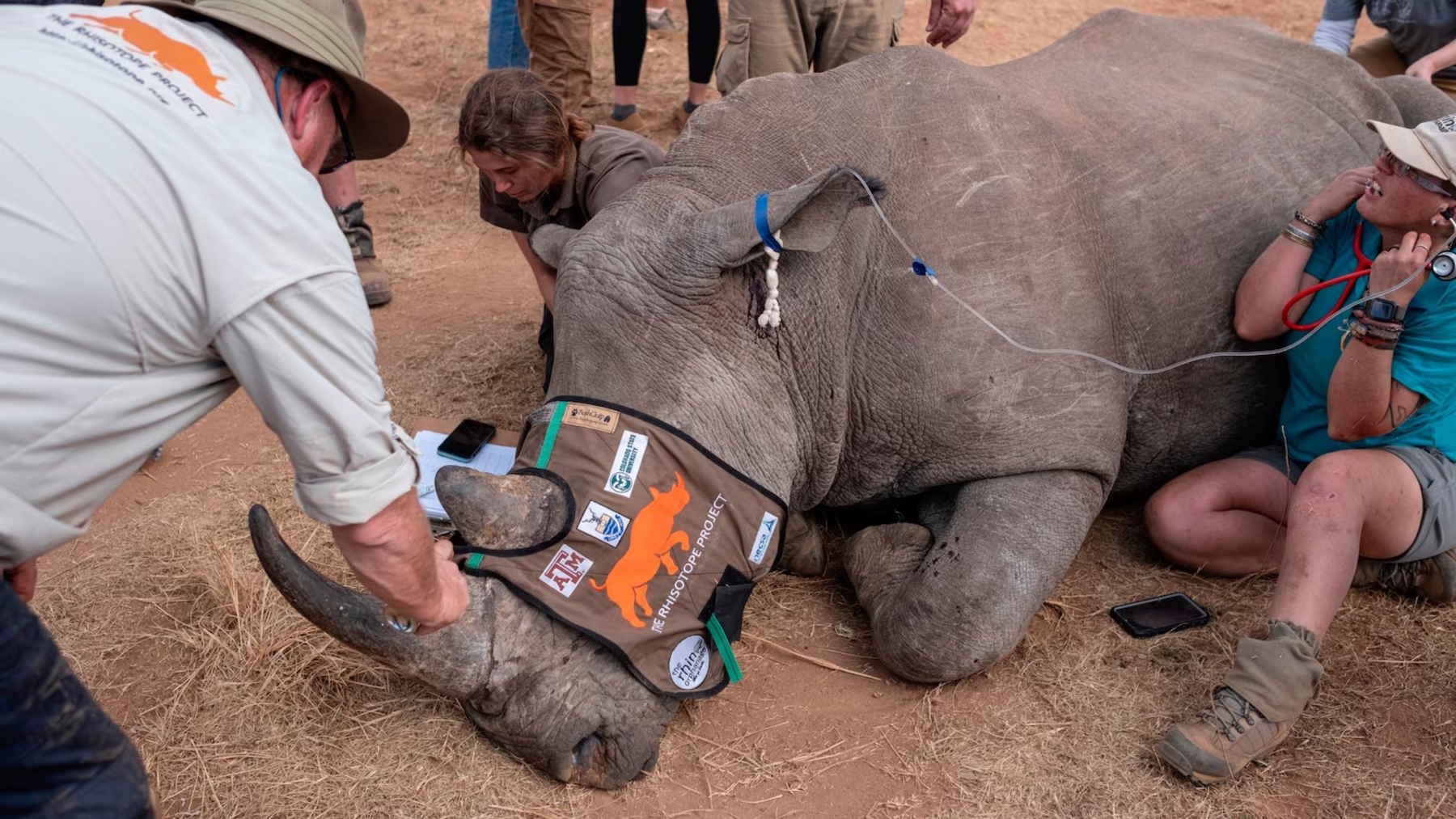
The University of Witwatersand in South Africa presents the Rhisotope Project. Jame Larkin is the main leader of the project, whose primary purpose is to end rhino poaching and illegal wildlife trafficking. To combat these two dangerous and illegal practices, the plan involves injecting radioactive isotopes into rhino horns. Mokopane was the first sanctuary where this was successfully tested. The injection of radioactive isotopes makes it difficult to smuggle rhino horns through nuclear security systems. The International Union for Conservation of Nature emphasizes that this plan represents a major and significant advance in rhino conservation. Over the last fifty years, this species has declined dramatically due to trafficking and sale on the illegal market. Read on to learn about the advances this great plan represents in safeguarding and caring for rhinos.
The new anti-poaching campain
A South African university presented an anti-poaching campaign Thursday to inject the horns of rhinos with radioactive isotopes that it says that do not harm for the animals but can be located by customs agents.
Under the collaborative project including the University of the Witwatersrand, nuclear energy officials and conservationists, five rhinos were injected in what the university hopes will be the begining of a mass injection of the declining rhino population.
They’re calling it the Rhisotope Project.
The previous year, about 20 rhinos at a sanctuary were injected with isotopes in test that paved the way for Thursday’s presentation. The radioactive isotopes even at low levels can be recognized by radiation detectors at airports and borders, leading to the arrest of poachers and traffickers.
Investigators at Witwatersrand’s Radiation and Health Physics Unit say that tests conducted in the pilot study confirmed that the radioactive material was not harmful to the rhinos.
“We have demonstrated, beyond scientific doubt, that the process is completely safe for the animal and effective in making the horn detectable through international customs nuclear security systems,” said James Larkin, chief scientific officer at the Rhisotope Project.
“Even a single horn with significantly lower levels of radioactivity than what will be used in practice successfully triggered alarms in radiation detectors,” said Larkin.
Global rhino population
The International Union for Conservation of Nature estimates that the global rhino population stood at around 500,000 at the beginning of the 20th century but has now declined to around 27,000 due to continued demand for rhino horns on the black market.
South Africa has the largest population of rhinos with an estimated 16,000 but the country experiences high levels of poaching with about 500 rhinos killed for their horns every year.
The university has urged private wildlife park owners and national conservation authorities to have their rhinos injected.
Successful Detection Trials
Larkin noted that tests showed horns could be detected even inside full 40-foot shipping containers. This finding underscores the potential effectiveness of using radioactive isotopes as a deterrent against poaching and trafficking. The Rhisotope Project represents a significant step in efforts to protect rhinos from poaching. By making their horns detectable through international customs systems, it aims to reduce illegal trade and help preserve these endangered animals.
Putting nuclear to good use
“This is just one example of how Wits University’s researchers work and think innovatively, stepping out of the clinical environments of their laboratories to bring bold, creative solutions to some of the world’s toughest challenges — often going above and beyond in their commitment to make a real difference,” says Professor Zeblon Vilakazi, Vice-Chancellor and Principal of Wits University.
The Rhisotope Project was launched to combat the high levels of illegal poaching of South Africa’s rhinos. Home to the largest population of the world’s rhinos, South Africa has been combatting the illegal poaching of rhino horns for more than a decade, as this threatens to wipe out the already small population that is classified by the International Union for Conservation of Nature (IUCN) as “Near Threatened” White Rhino (Ceratotherium simum) and “Critically Endangered” Black Rhino (Diceros bicornis).
“This project exemplifies how nuclear science can be applied in novel ways to address global challenges,” says IAEA Director General Rafael Mariano Grossi. “By leveraging existing nuclear security infrastructure, we can help protect one of the world’s most iconic and endangered species.”