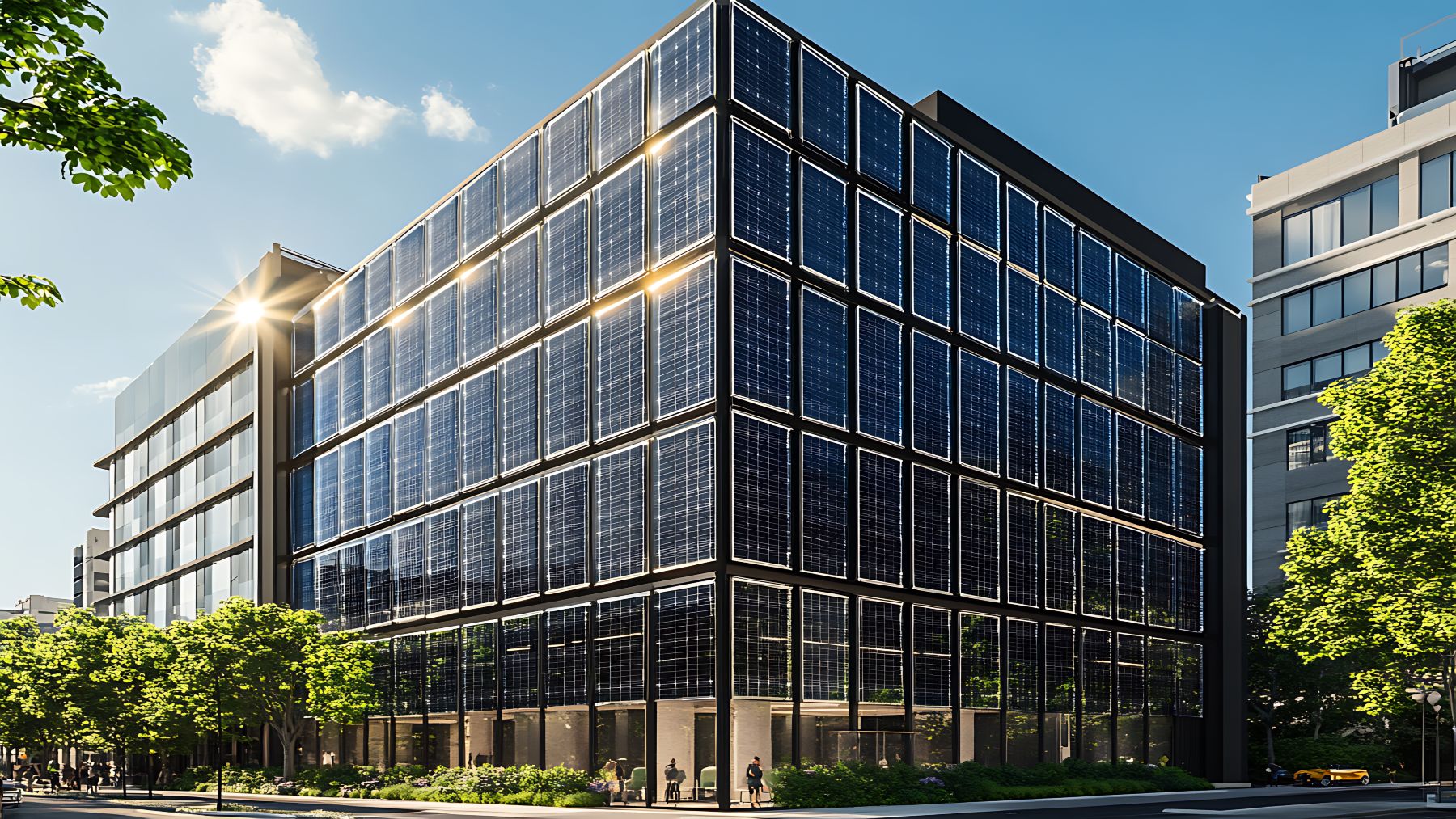
The revolutionary path toward renewable energy continues. Now, solar glass is a reality. The initial idea was to create dark panels that absorb the sun’s rays and convert them into electricity. They look like ordinary windows, letting sunlight through like any other glass. Transparent solar panels, made with a special type of solar glass, absorb ultraviolet and infrared light (invisible to the human eye) and convert it into renewable energy.
Advantages: It doesn’t require the same amount of space as traditional solar panels
Entire buildings made with this material could save significant amounts of energy and also prevent high pollution. However, this configuration comes with some disadvantages, such as the space required, the visual impact, and installation limitations. Especially in urban areas, roofs alone cannot meet the growing energy demand or evolving architecture. One of the main advantages of solar glass, also called photovoltaic glass, is that it doesn’t require the same amount of space as traditional solar panels.
Going into more detail, this is a transparent solar glass that can be installed as windows or on facades, stained glass, or skylights, among others. This solar glass converts sunlight into energy with a more design-oriented approach. It’s a technology that not only generates electricity from sunlight but also harnesses the energy of invisible light, also known as the invisible spectrum, which is the part of electromagnetic radiation not visible to the human eye, such as X-rays, infrared, or gamma rays, among others. These transparent panels do much more than just let light in.
Solar windows could supply up to 40% of the United States’ electricity needs
The possibilities for using these glasses are numerous. In addition to those mentioned above, this technology stands out for its ability to capture light from both sides of the glass and from both edges when photons reach the photovoltaic layer; this surpasses other existing solutions and allows it to produce more energy per unit, according to its creators. According to MSU researchers, solar windows and similar see-through solar technologies could supply up to 40% of the United States’ electricity needs.
In terms of space, one of the advantages of this technology is that, when used appropriately, it doesn’t take up extra space in a building. In dense urban environments, where rooftops are limited, this technology can be widely implemented, allowing buildings to produce their own energy in a discreet and space-efficient manner.
SmartWindows: Not only generate solar energy but also incorporate sensors that optimize energy consumption and comfort
This technology is already being implemented in some buildings. Not extensively, but it’s starting to provide real-world evidence of what could be expanded to more cities in the future. The Dutch company Physee is equipping European office buildings with 15,000 “SmartWindows,” which not only generate solar energy but also incorporate sensors that optimize energy consumption and comfort. According to Physee, this could reduce a building’s energy bills by up to 30%.
Building in Denmark: already uses 12,000 semi-transparent solar panels on its façade
To put it in more detail, this transparent solar development harnesses ultraviolet and infrared light in such a way that it allows the rest of the light to pass through, generating electricity in the process without darkening the room behind the glass. In Denmark, Copenhagen International School already uses 12,000 semi-transparent solar panels on its façade, enough to cover more than half of the school’s annual energy consumption.
What’s clear is that if the goal is to continue along the path of renewable energy, access to this type of technology can be very beneficial for companies. This is a niche that increasingly demands energy. The rise of transparent solar panels highlights how innovation can drive sustainable development.