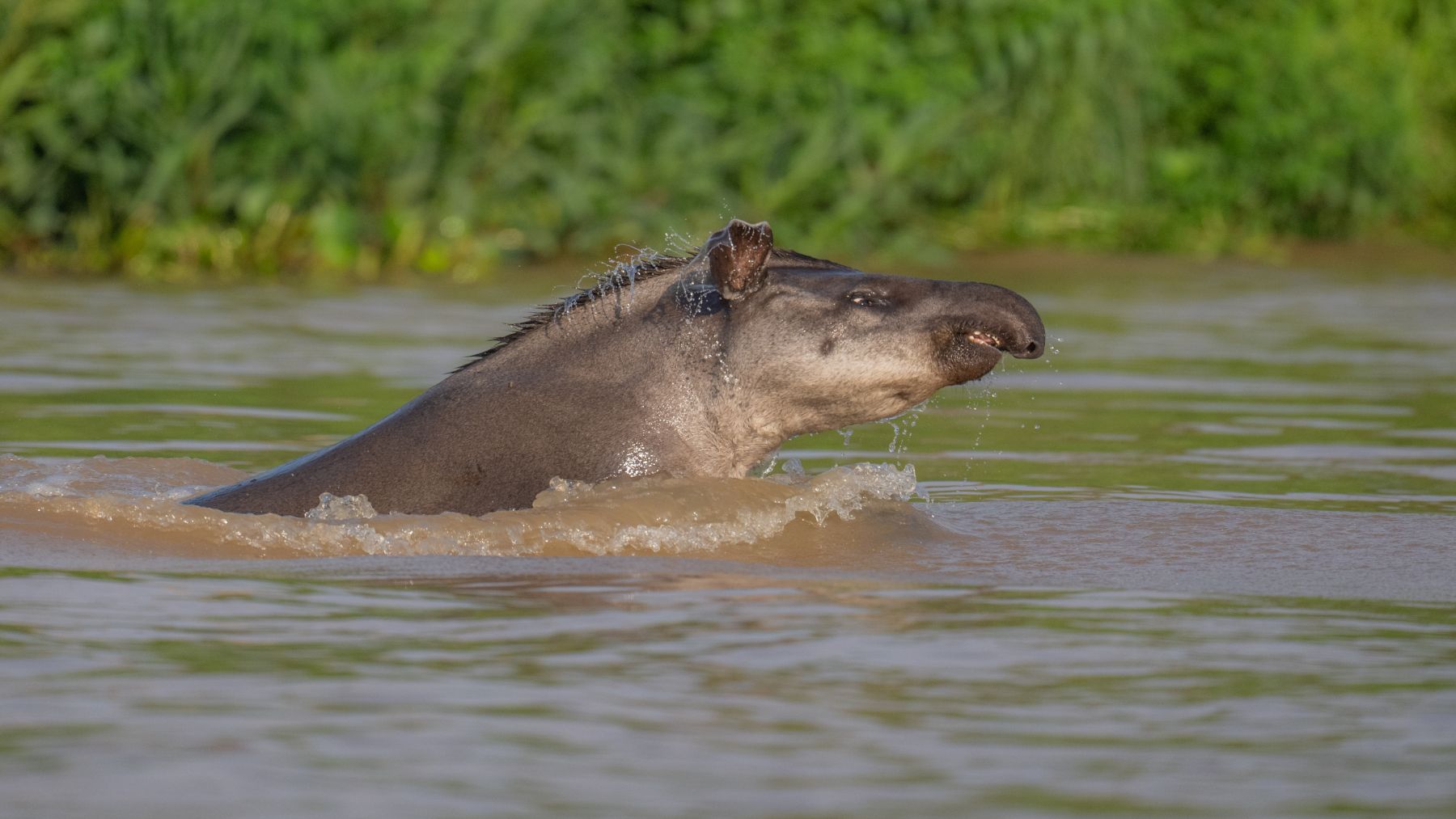
In Brazil’s Atlantic Rainforest (Cunhambebe Park), the South American tapir, also known as the “gardener of the forest,” has been spotted again after an absence of approximately 100 years. The reappearance occurred last January and is shocking the entire scientific community.
There are many reasons why an animal can become extinct, climate change, natural disasters, hunting, illegal trafficking…
The tapir, thought to be extinct in the region, was captured on camera in Cunhambebe State Park, a 38,000-hectare reserve in the Atlantic Forest. There are many reasons why an animal can become extinct, including climate change, natural disasters, pollution, hunting, illegal trafficking, habitat destruction, or the introduction of invasive species. There may also be natural causes or a result of human activity.
The appearance of these mammals is vivid proof that conservation efforts are bearing fruit and contributing to the restoration of natural balance
The South American tapir (Tapirus terrestris), the largest terrestrial mammal in South America. In Cunhambebe State Park, the presence of the South American tapir has been recorded through 108 images and videos. This discovery demonstrates the recovery of biodiversity in the Atlantic Forest, an ecosystem severely affected by human intervention. The appearance of these mammals is vivid proof that conservation efforts are bearing fruit and contributing to the restoration of natural balance.
This is fundamental for the maintenance of biodiversity in that place
Before this sighting, the last time the South American tapir had been seen in these regions was in 1914. The return, which has been defined as “a miracle of nature” by the scientific community, is fundamental for the maintenance of biodiversity in that place. The reappearance of the South American tapir in its natural habitat represents a great advance for ecological balance.
This herbivorous mammal plays an essential role in seed dispersal, which favors the regeneration and growth of tropical forests. In fact, tapirs disperse seeds and encourage forest regeneration. By feeding on fruits and vegetation, this mammal spreads seeds through its excrement, which facilitates the regeneration of local flora. That’s why they are called “gardeners of the forest.” Their presence contributes to maintaining gene flow, a fundamental aspect for the conservation of biodiversity and ecosystem stability.
The recovery of this species not only positively impacts the flora but also strengthens the health of the entire food chain
There are two most talked-about theories about the reappearance of these animals. One of the two most widely accepted theories is that the existing population of this mammal has survived in the area for a century undetected, while another suggests that these animals migrated to nearby locations. The recovery of this species not only positively impacts the flora but also strengthens the health of the entire food chain.
These spaces not only provide a safe haven for wildlife but also promote the restoration of damaged ecosystems
The sighting of the South American tapir underscores the importance of protected areas in preserving endangered species. This is especially important in our current times, when poaching, logging, and climate change are severely impacting many wild species. These spaces not only provide a safe haven for wildlife but also promote the restoration of damaged ecosystems.
Ultimately, and underscoring the above, the return of the South American tapir to the forests of Brazil is an event that not only celebrates biodiversity but also emphasizes the need to continue efforts to conserve and protect ecosystems. Let us remember that helping our planet’s flora and fauna is essential to strengthening humankind’s presence on Earth for many years to come. We need the ecosystem to continue surviving, so creating safe spaces in which species can continue to evolve is essential for balance.