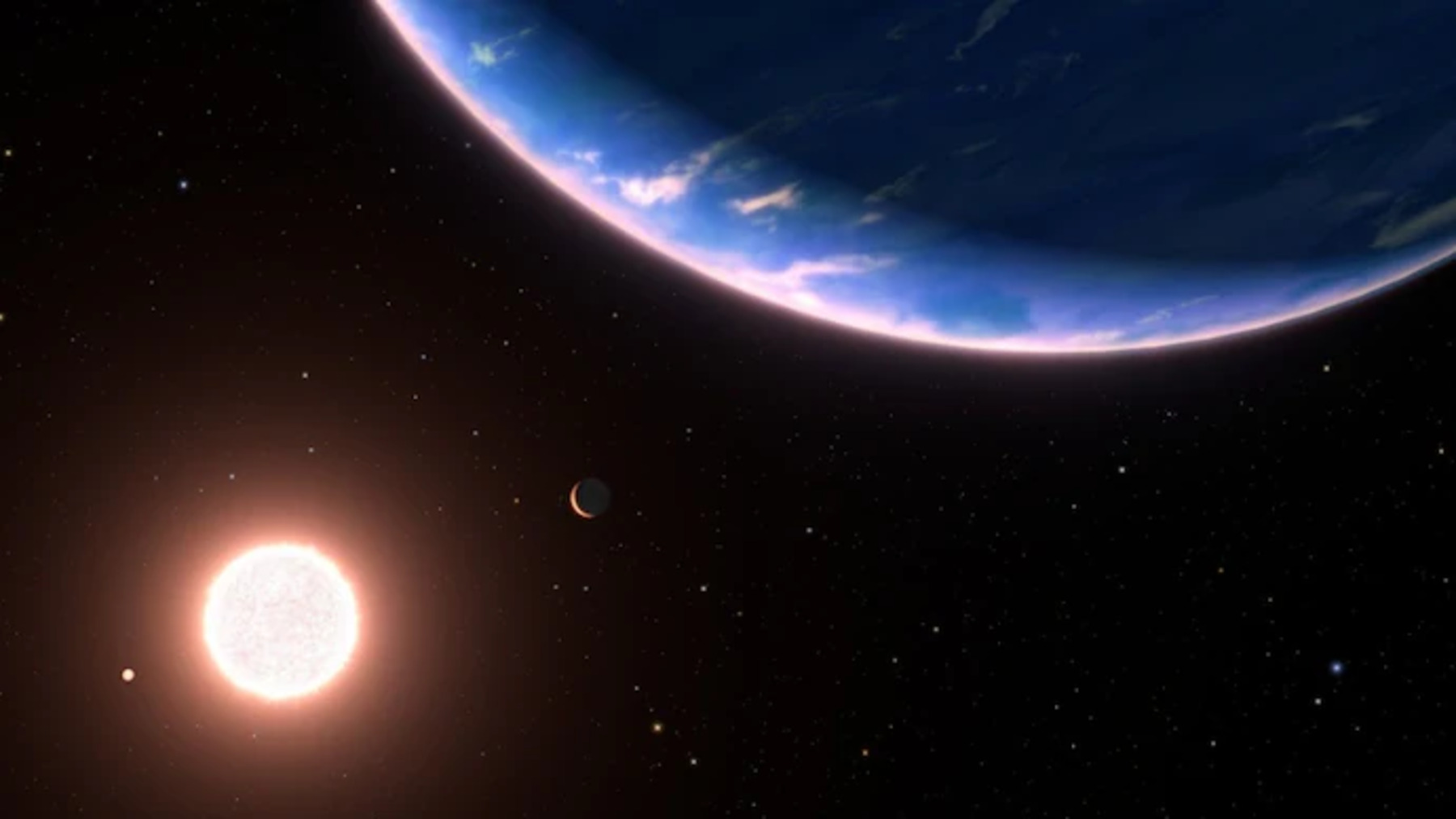
NASA, thanks to the Hubble Space Telescope and the James Space Telescope, has detected the presence of water on exoplanets. The most recent case is GJ 9827d, located in the Pisces constellation. Researchers such as Björn Benneke, Laure Kreidberg, Io Crossfield, and Thomas Greene emphasize the significance of this discovery. We must also highlight the findings of K2-18b and TRAPPIST-1. Read on to learn more.
GJ 9827d: a steamy water-world
One such interesting achievement is the planet GJ 9827d. This exoplanet, no larger than twice the size of Earth, may contain a water-rich atmosphere. Nevertheless, with temperatures rising to 800 degrees Fahrenheit, like Venus, GJ 9827d is far from welcoming. It’s a world shrouded in steam rather than a potential home for life as we have in mind.
A recent observation by NASA’s Hubble Space Telescope marks a relevant discovery in exoplanet investigations. Hubble detected water vapor in the atmosphere of GJ 9827d, the smallest exoplanet where such a discovery has been made. This finding nudges us closer to recognize planets with environments akin to Earth.
“This would be the first time that we can directly show through an atmospheric detection, that these planets with water-rich atmospheres can actually exist around other stars,” said team member Björn Benneke of the Trottier Institute for Research on Exoplanets at Université de Montréal.
The reason of finding water on exoplanets is important
Laura Kreidberg of the Max Planck Institute for Astronomy in Heidelberg, Germany, explains with enthusiasm that water on a planet this small is a landmark discovery. In addition, It pushes closer than ever to characterizing truly Earth-like worlds.
The Hubble observations, spearheaded by Ian Crossfield of Kansas University, motivated to not only discover atmospheric molecules but in specific to search for water vapor. Whether the detected water vapor is a dominant component or a minor component in a hydrogen-rich atmosphere, the finding is very important.
“Until now, we had not been able to directly detect the atmosphere of such a small planet. And we’re slowly getting in this regime now,” added Benneke.