
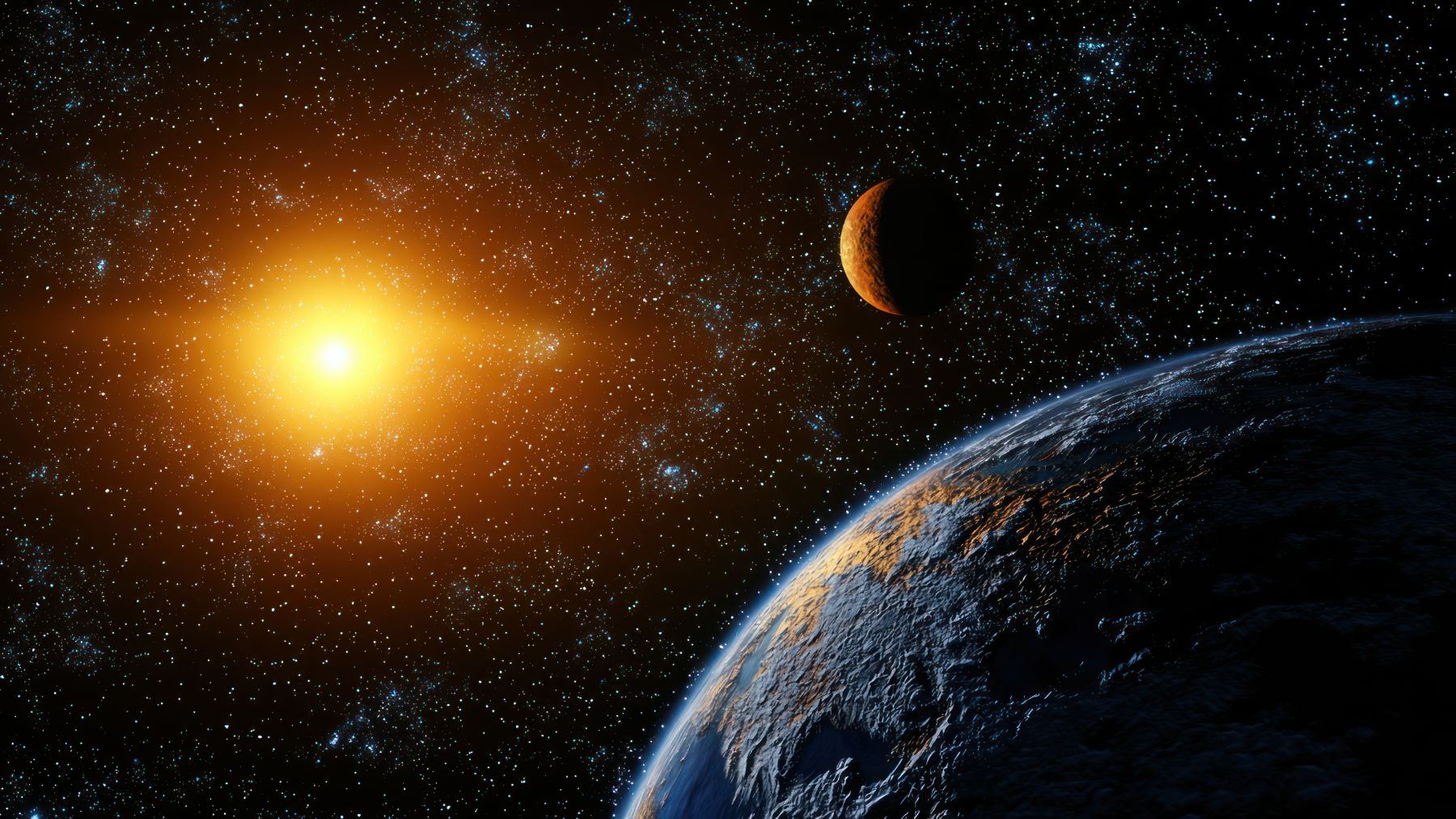
Reactions have been swift after the discovery of an Earth-sized exoplanet orbiting an ultra-cool star. The truth is that life, as we know it on planet Earth, could not exist in a place so close to the sun, with such scorching heat. In any case, astronomers are interested for a thousand reasons. Now, thanks to a specialized network of professional telescopes called SPECULOOS (Search for Planets EClipsing ULtra-cool Stars), avenues of research are being launched. Yes, the exoplanet, called SPECULOOS-3 b, is a rocky planet about 55 light-years from Earth.
The planet orbits its host star every 17 hours a year there
To detect transiting planets, it’s necessary to observe each star individually for weeks, which is why this discovery is so special. SPECULOOS-3 b orbits its host star every 17 hours (a year there, that is, its orbit around the star), but the days and nights on the planet are infinite. To understand these kinds of topics, it’s essential not to think linearly, as in outer space things work the same way they do on Earth. In any case, astronomers suspect the planet is tidally locked to its star, like the Moon to Earth. The fact is that the same side, known as the dayside, always faces the star, like the Moon to Earth, while the nightside remains dark.
To fully understand the importance of this discovery, it’s important to know that more than 70% of the stars in the Milky Way are M dwarfs, also known as red dwarfs. Compared to the Sun, these stars, in addition to being cooler and dimmer, have very long lifetimes. “We designed SPECULOOS specifically to explore nearby ultra-cool dwarf stars in search of rocky planets,” explains Michael Gillon, an astrophysicist at the University of Liège (Belgium), first author of the article and principal investigator of the SPECULOOS project.
“Life as we know it could not have arisen on the surface of the planet, with or without an atmosphere”
Therefore, in relation to this, red dwarfs, the so-called ultracool dwarfs, form a group of low-mass stars that are even dimmer and longer-lived. “Life as we know it could not have arisen on the surface of the planet, with or without an atmosphere, because it could not host large quantities of liquid water,” Gillon said. Because of the slow rate at which they consume their fuel, it is believed that these will be the last stars to burn when the Universe becomes cold and dark.
The star SPECULOOS-3 b is slightly larger than Jupiter, though much more massive. It is also thousands of degrees cooler than our Sun, with an average temperature of about 2,627 °C (4,760 F). The researchers “searched intensively” for planetary siblings of SPECULOOS-3 b in the same star system but did not find any, Gillon said. Despite the planet’s average temperature, its radiation warms the planet, which receives nearly 16 times more energy per second than Earth does from the Sun. “Although this red dwarf is more than a thousand times fainter than the Sun, its planet orbits much closer than Earth, which raises its surface temperature,” Gillon explained.
“We’re making great progress in the study of planets orbiting other stars”
It’s important to note that the Gran Telescopio Canarias (GTC or Grantecan) has played a key role in confirming this discovery, providing some of the most precise ground-based measurements of an exoplanet to date. “We’re making great progress in the study of planets orbiting other stars,” explains Roi Alonso, an IAC researcher and co-author of the article. Although SPECULOOS-3 b isn’t friendly to life, astronomers said it’s close enough to Earth to allow detailed follow-up studies of its chemical composition, which would reveal whether the planet was once geologically active.




