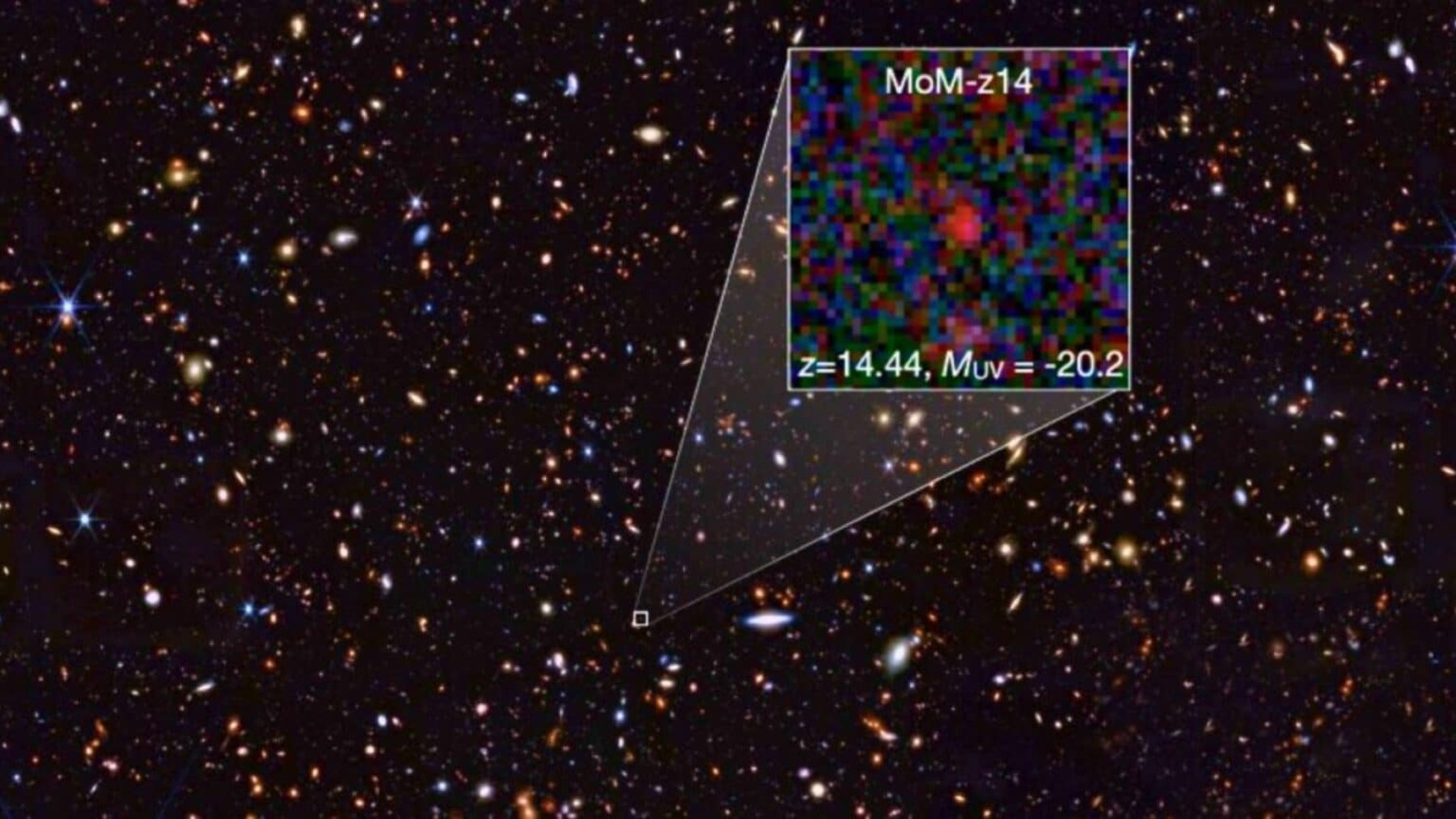
The revolution continues, and recently, thanks to NASA’s James Webb Telescope, another step has been taken toward learning more about the early universe. This discovery challenges what we know about the formation of galaxies after the Big Bang. The MoM-z14 galaxy is one of the new questions being asked by professionals such as Pieter van Dokkum of Yale University. In addition to the new insights gained about stellar matter, research into globular clusters is also continuing. Read on to learn more.
Scientists’ greatest hope: to understand how the universe was organized
If you get the chance to ask an astronomer what his principal goal is, or rather, what his hope is, he will most probably to tell you that it is to get to know how the universe was organized in its first million years. This is due to the fact that we already know that, after the Big Bang, the universe went through a time of accelerated expansion and cooling until the first atoms started to group together, creating stars and galaxies. However, what happened next? And what is under this?
In fact, for a long time, investigatos thought that this development took hundreds of millions of years. Many theoretical models forseen that the first galaxies could only have come out after 500 or 600 million years. Until the James Webb telescope came along and changed many of the things we believed until then. This most recent discovery found something that, until a few years ago, would have been considered not real.
The unimaginable achievement of James Webb
Remember by the time we said that galaxies were believed to have only formed 500 or 600 million years after the Big Bang? Well, in May 2025, the James Webb Telescope found a galaxy that formed just 280 million years after the Big Bang. This discovery is so unreal that Pieter van Dokkum, professor of Astronomy and Physics at Yale University, comments:
“This galaxy existed when the universe was about 280 million years old—we’re getting quite close to the Big Bang. Just to put that in context, sharks have been around on Earth for a longer timespan!”
This galaxy has already been designanted as MoM-z14, an acronym for “Mother of all early galaxies”. The reason? Well, it was observed with a redshift of z = 14.44, the highest ever recorded, and even though it is a fairly compact galaxy, it is very luminous, suggesting an intense stage of star formation.
As if the surprises weren’t over yet, MoM-z14 has high levels of nitrogen in comparison to carbon, which is likely to what we observe in the globular clusters of the Milky Way. In other words, maybe this star formation was already complicated and advanced much earlier than previously conceived.
How this discovery has an impact on us?
Moreover to the discovery of MoM-z14 being a record, it straight dares theories about galaxy formation. This is due to the fact we had never concieve that such bright galaxies might exist at such an primary stage in the universe. It even surprised the James Webb Telescope mission, because the investigators implicated in it were expecting to find only faint traces or simple clusters at this time.
“The bigger picture here is that JWST wasn’t supposed to discover any galaxies this early in the universe’s history at least, or at least at this point in the mission.” – Van Dokkum
That’s why now, going under anything earlier thought, more than 100 galaxies liley to MoM-z14 have been recognized in the first 400 million years after the Big Bang – and this number grows with each recent analysis of James Webb’s data, see? An example of this was when the JWST visited the Question Mark Galaxy and found something historic.