
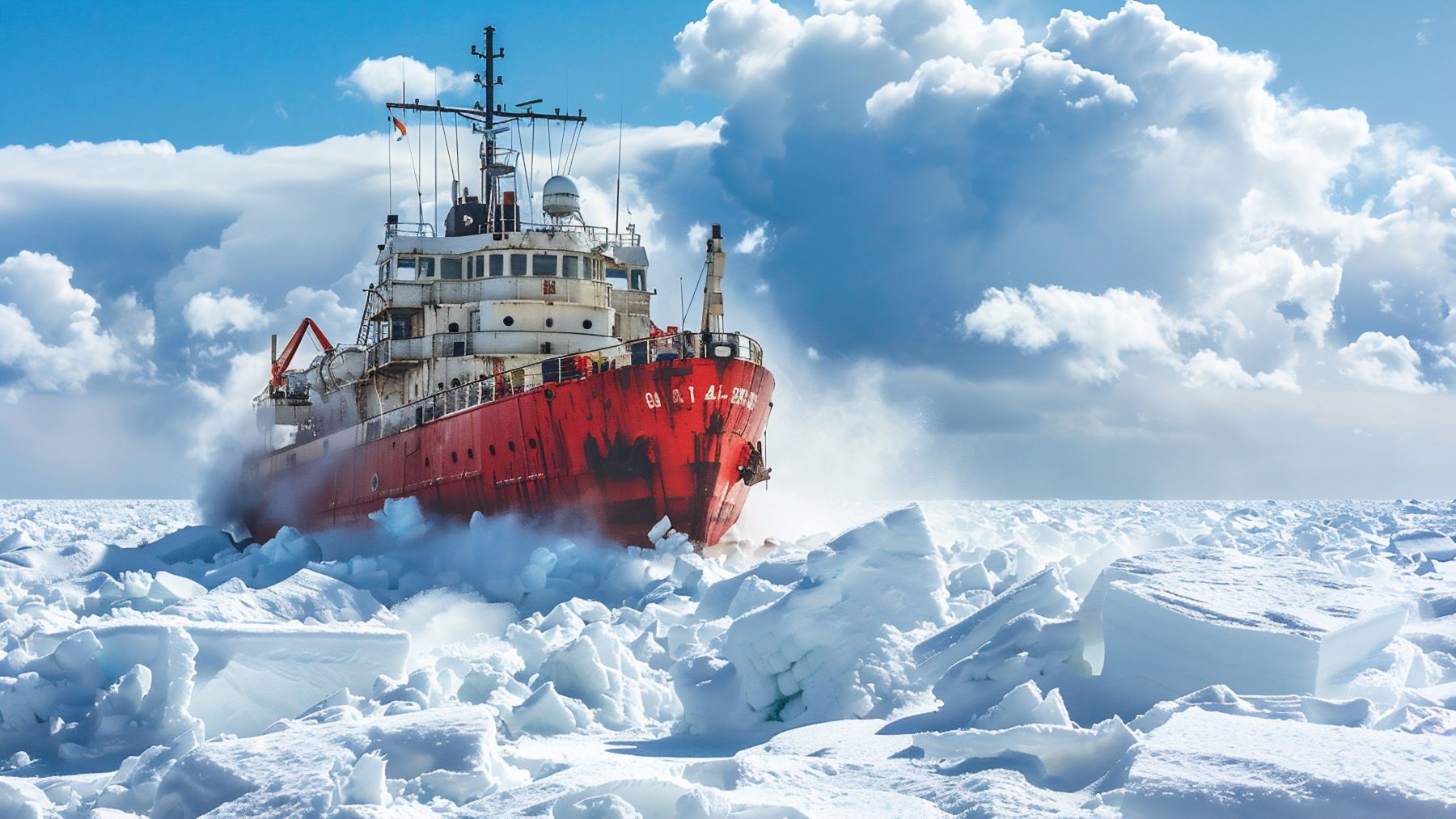
The U.S. Nathaniel B. Palmer will cease service in the United States. The National Science Foundation (NSF) confirmed it will terminate the lease of the Palmer, its only Antarctic research icebreaker, and will also suspend aircraft for a new vessel. This is due to a series of cuts made by the Donald Trump administration. Decommissioning this vessel (which has been in operation since 1992) would leave the United States without an icebreaker to study southern mares and would cede scientific leadership to rival countries like China.
The glacier, also known as the “Doomsday Glacier,” is 128 kilometers long and could raise sea levels by up to 3.3 meters
This news is very important because, although satellites can track ice loss from the surface, many of the most important measurements are obtained underwater, in places only accessible by a reinforced icebreaker. No other US ship can fully replace it.
Regarding the cuts, the government claims they will free up resources for the country’s three aging Antarctic research stations. The truth is, the budget also halts the development of a new ship that was supposed to succeed the Palmer in the 2030s. Let’s remember that global warming is a reality, and melting ice is a problem that needs to be solved. Signs of deterioration have been observed on the Thwaites Glacier in Antarctica, which are extremely worrying. This glacier, also known as the “Doomsday Glacier,” is 128 kilometers long and could raise sea levels by up to 3.3 meters if it collapses completely. This would completely transform the landscape of coastal cities around the world.
Researchers warned that these cuts and the Palmer’s withdrawal from the US agenda would jeopardize decades of US leadership
This event would be tremendously devastating for the planet. In this regard, it is important to note that the Palmer has transported scientists near the Thwaites Glacier to study its possible collapse. In fact, regarding scientific leadership, researchers warned that these cuts and the Palmer’s withdrawal from the US agenda would jeopardize decades of US leadership in the study of the Southern Ocean and the Antarctic coast. This is an area of the planet where melting is precisely a consequence of emissions from the burning of fossil fuels, which is melting the ice from below.
This decision, according to experts, comes at the worst possible time in terms of geopolitics. China and Russia are intensifying their polar investment, adding new icebreakers and expanding their presence on the continent. And with the recent “crisis” in Greenland, this move on the chessboard seems at odds with Trump’s move in the north. For American scientists, the retirement of the Palmer not only represents a setback for research, but also a geopolitical setback.
Each season the Palmer only makes a few voyages
In other words, the decommissioning of the Palmer would cede access to the most unexplored region on the planet to other nations. Although a replacement had been planned, with an allocation of $61 million for the initial design and an estimated cost of $1.2 billion, the NSF has “paused” the project. Remember, the Nathaniel B. Palmer has capacity for 39 scientists and support personnel. Getting on board is not easy. Each season, which typically lasts from late October through March, the Palmer only makes a few voyages, each lasting one to two months.
In addition to the above, the Palmer has six laboratories, an aquarium, and a hangar for two helicopters, as well as a sauna, gym, and movie theater. It can penetrate almost a meter of ice while traveling at three knots (5.6 km/h). Therefore, even once scientists secure funding for an expedition, it can take years before they set sail.




