
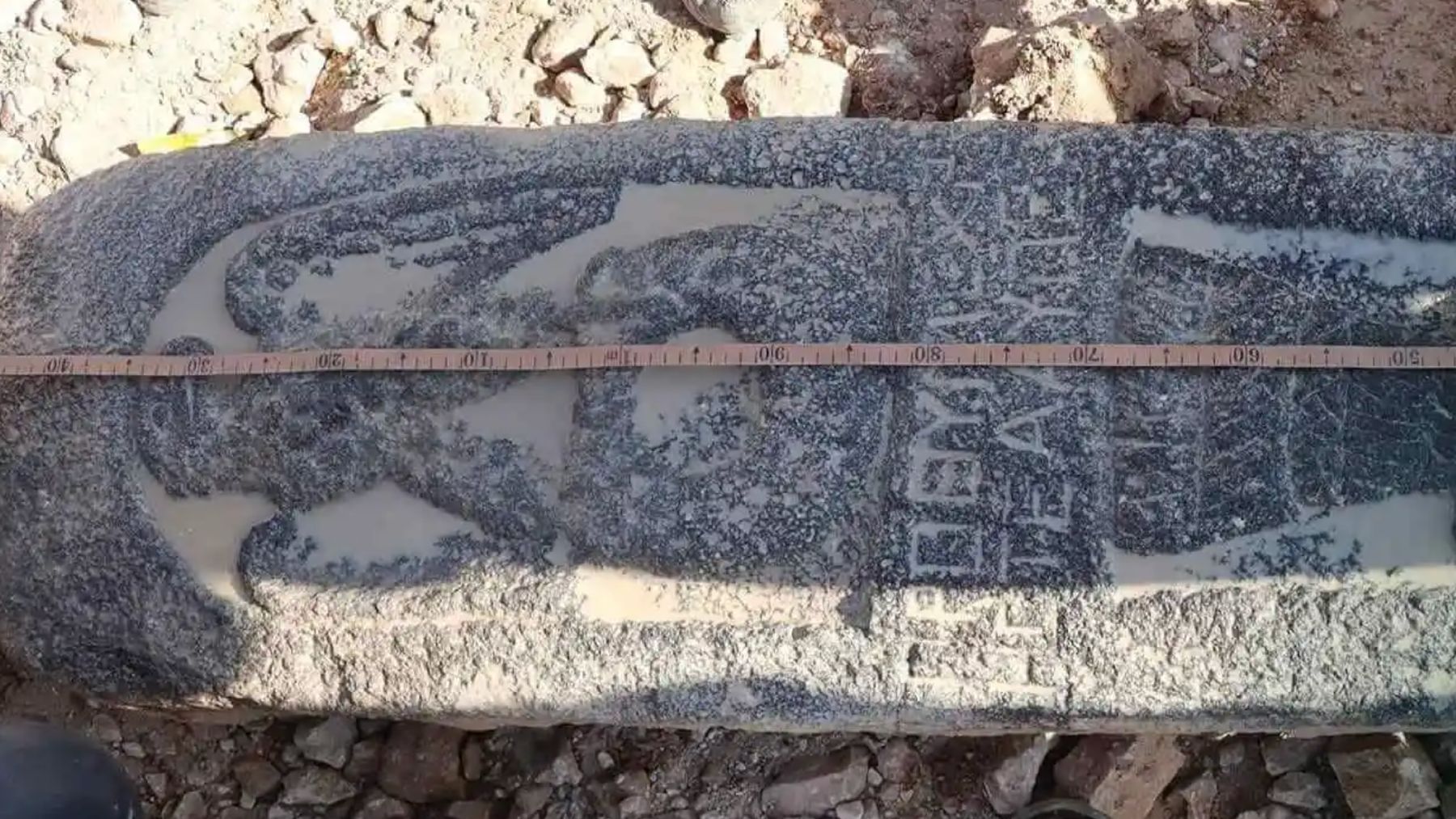
A highly significant discovery has recently been made in Manbij, Syria, revealing the cultural fusion of the Roman Empire in the Near East. It is a Roman funerary stele featuring an imperial eagle, a symbol of power that reappears in a land marked by war. The discovery also contains a hidden message in Greek; the find was buried behind a market in the sacked city of Manbij.
It is a Roman-era funerary monument, more than 2,000 years old, which has been recovered by heritage authorities
Thus, the report describes how archaeologists discovered this Roman-era funerary stele, carved in black basalt stone. It is a Roman-era funerary monument, more than 2,000 years old, which has been recovered by heritage authorities. This funerary monument was identified thanks to a tip from a Manbij resident, who stumbled upon the stone behind the cardamom wholesale market and notified the authorities.
Following its discovery, the Syrian Directorate of Museums and Antiquities sent a team of archaeologists who recovered the stele and transported it to an ancient Turkish bath in the city, where it remains under safekeeping until its subsequent transfer to the Aleppo museum. This discovery not only recalls the imposing Roman iconography, but also reveals how art, religion, and imperial power were intertwined in a land of cultural convergence. Important information that reveals what experts already knew.
This bird represented strength, victory, and divine protection
To understand the details of the discovery, we must understand that the eagle was not just any symbol. It was a symbol of supremacy, associated with Jupiter, the supreme god, and the emblem of the Roman legions. This bird represented strength, victory, and divine protection. The relief depicts an impressive eagle with its wings spread, holding a laurel wreath in its talons, demonstrating the undisputed superiority of the Roman Empire.
On the other hand, the laurel wreath he holds suggests glory and renown, and could also indicate the deceased’s elevated military or civic status, or even his loyalty to the Empire. The fact that the inscriptions on the Roman stele appear in Greek reflects the persistence of Hellenistic culture in the region, even under Roman rule. This type of symbolism was common in funerary monuments of high-ranking officials, veterans, or honorable citizens. Furthermore, it confirms the profound cultural fusion between Rome and the Hellenistic regions of the east.
The use of Greek instead of Latin was commonly employed in administration, trade, and in the epitaphs of the deceased
There are many small details that draw the attention of experts. On the one hand, the fact that these types of stelae were common in Roman territories, but their discovery in Syria, and especially in a city like Manbij, takes on a special dimension. It confirms the convergence of civilizations. On the other hand, this choice is also not uncommon, since in the eastern provinces of the Roman Empire, the use of Greek instead of Latin was commonly employed in administration, trade, and in the epitaphs of the deceased. This discovery highlights and recalls the tremendous importance of the Roman Empire and its vast territorial reach.
This discovery also reminds us that the passage of time, despite destruction, still holds treasures to be found. This part of the world has been so destroyed and looted in recent years due to wars that the mere fact of its discovery is a milestone. It is estimated that more than a million archaeological objects were looted from Syria between 2011 and 2019, and at least 700 sites have been damaged or destroyed. This, therefore, is yet another piece in the complex puzzle that is the history of Syria, a country that has been the cradle and crossroads of civilizations for millennia. And as we say, the treasures that remain to be discovered will still surprise us in the years to come.




