
Good news for Massachusetts. The Animal and Plant Health Inspection Service (APHIS) is eliminating, effective immediately, 12.3 square miles of the Asian longhorned beetle (Anoplophora glabripennis) quarantine area in Worcester County, Massachusetts. The city is moving toward a conservation victory against the Asian longhorned beetle.
Zones: The northern portion of the Town of Auburn and the towns of Boylston/West Boylston, Shrewsbury, and Worcester
According to APHIS, this area was determined to be eligible for removal from quarantine after the Asian longhorned beetle program completed final host tree surveys. The northern portion of the Town of Auburn and the towns of Boylston/West Boylston, Shrewsbury, and Worcester remain under quarantine. State forestry workers are removing the invasive species. Their collective efforts and targeted action protect vital ecosystems and local economies.
The Asian longhorned beetle is a destructive, wood-boring pest that threatens 12 genera of hardwood trees
This is an important issue of concern for citizens, as the damage this type of beetle can cause can be terribly destructive. The Asian longhorned beetle is a destructive, wood-boring pest that threatens 12 genera of hardwood trees, including maple, in North America. Since 2008, the Department of Conservation and Recreation has hunted this beetle using an unconventional method: climbing and inspecting millions of trees.
The U.S. Department of Agriculture, the Illinois Department of Agriculture, and the City of Chicago announced the eradication of the Asian longhorned beetle
APHIS first discovered the Asian longhorned beetle in the United States in New York in August 1996. It was subsequently detected in areas of Illinois (1998), New Jersey (2002, 2004), Massachusetts (2008, 2010), Ohio (2011), and South Carolina (2020). Illinois has also been a high-profile case, where the beetle was also a major problem. The U.S. Department of Agriculture, the Illinois Department of Agriculture, and the City of Chicago announced the official eradication of the Asian longhorned beetle (Anoplophora glabripennis) from Illinois by 2022.
Chicago: A quarantine of up to 35 square miles was established for this pest in and around the city
At that time, the quarantine also affected several localities. Specifically, in Illinois, the areas under quarantine for the EACL were several Chicago neighborhoods, including Oz Park, Ravenswood, Kilbourn Park, Loyola, Park Ridge, O’Hare, Addison, and Summit. A quarantine of up to 35 square miles was established for this pest in and around Chicago.
Program activities continue in Worcester County, Massachusetts
Significant cases also occurred in Brooklyn and Queens, New York (2019) and part of Tate Township, Ohio (2025). Program activities continue in Worcester County, Massachusetts; Nassau and Suffolk counties in New York; Clermont County, Ohio; and Charleston and Dorchester counties in South Carolina.
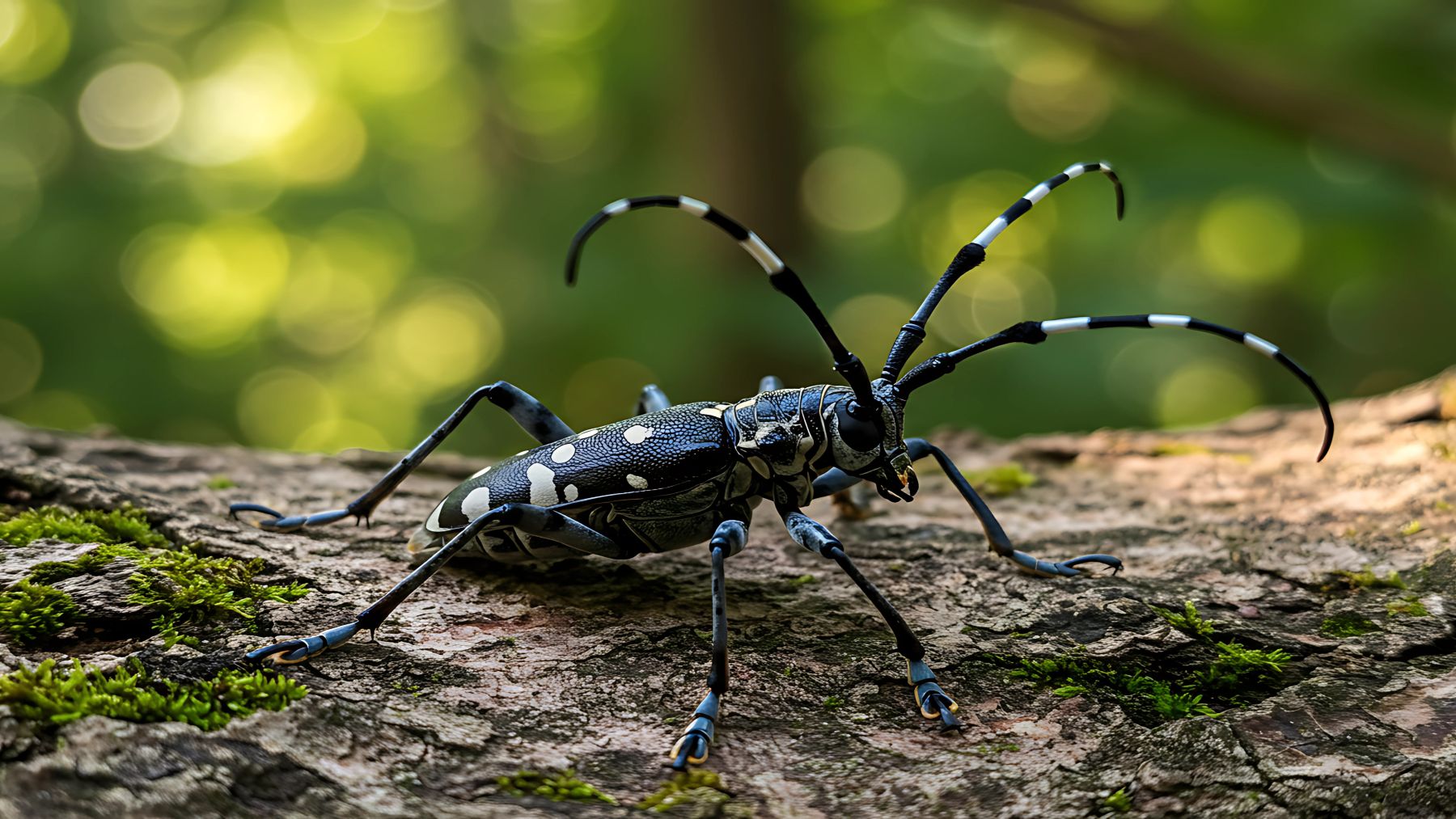
The beetle: It is glossy black with upright antennae twice the length of its body
How to recognize this beetle? The EACL is about 1.5 inches long. It is glossy black with upright antennae twice the length of its body. These antennae are banded with black and white. Favorite host tree species for this pest include maple, birch, elm, and poplar, among others. Currently, under IPPC standards, Anoplophora glabripennis is considered a present pest: it is not widely distributed and is subject to official control in the United States.
Research: Climbers explore trees for subtle signs, such as dimples in the bark
As we’ve mentioned before, although it may seem archaic, the best way to track and eliminate this pest is by climbing trees. Matt Shreiner, a DCR tree climber, said, “It’s kind of like an Easter egg hunt.” Climbers explore trees for subtle signs, such as dimples in the bark. As experts explain, the beetles lay eggs or dime-sized exit holes left by emerging adults. They then burrow out after eating into the tree trunk and destroying any life within it.




