
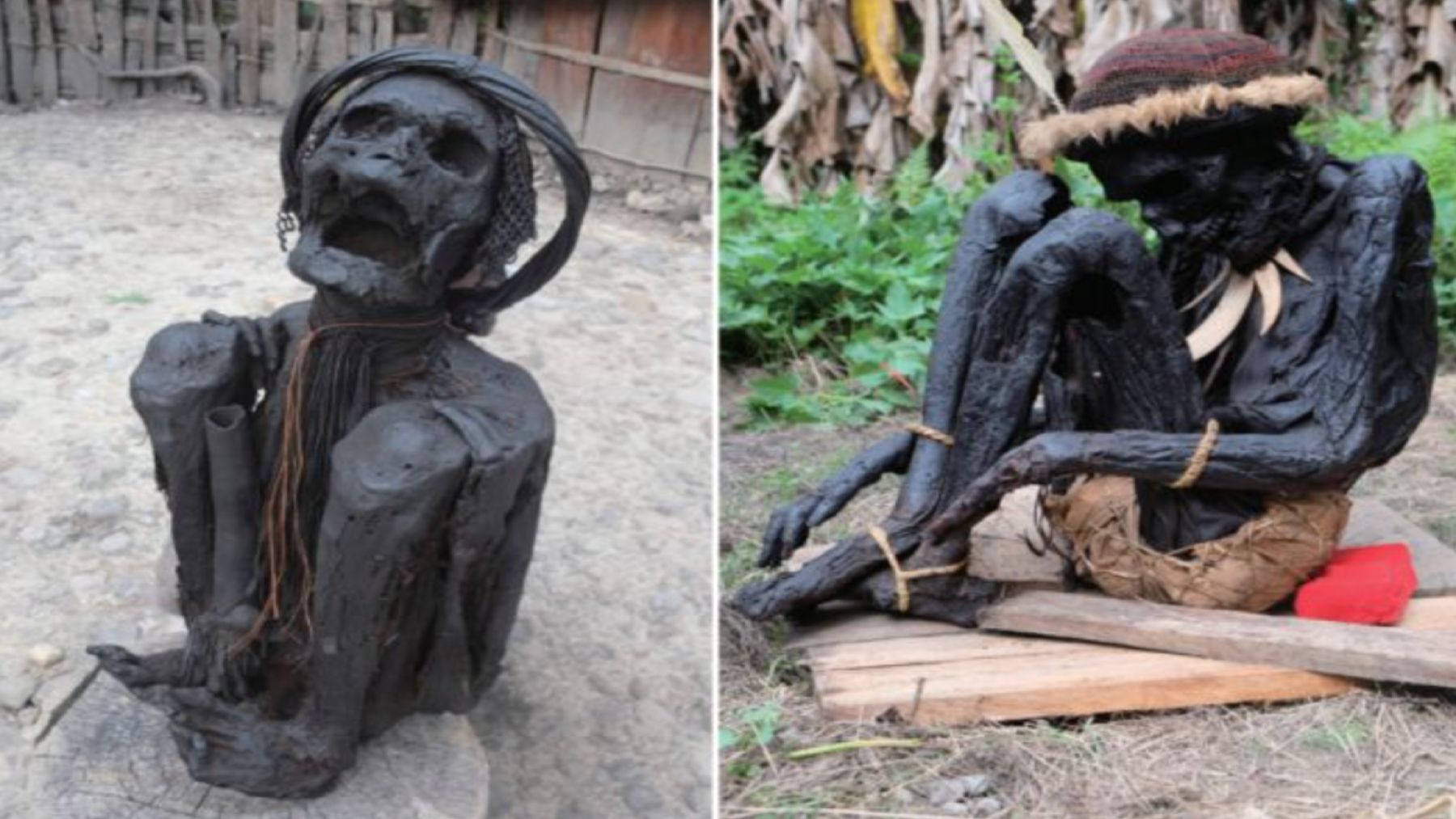
Discoveries continue to surprise the scientific community. A recent discovery in Southeast Asia has revealed that corpses dating back more than 12,000 years were carefully preserved, and therefore, mummification began 5,000 years earlier than in Egypt and Chile.
The oldest mummified human remains in the world are not in Africa or South America, but in Asia
We have to go back in time to understand the scope of the new research. For decades, the official story held that the earliest known human mummies belonged to the cultures of Ancient Egypt, 4,500 years ago, or to the Chinchorro civilization on the coast of Chile, about 7,000 years ago. But this new study has radically overturned this statement: the oldest mummified human remains in the world are not in Africa or South America, but in Asia.
Communities in Southeast Asia were already practicing the art of preserving their dead
It seems like we may have been underestimating exactly how widespread the practice has been. Thousands of years before the ancient Egyptians perfected their mummification techniques, communities in Southeast Asia were already practicing the art of preserving their dead. Bones that show signs of deliberate mummification have been found across Southeast Asia and southern China, with ages dating back to the pre-Neolithic period up to 12,000 years ago. The human remains were found at 11 archaeological sites in regions including Guangxi (China), Vietnam, Borneo, Java, Thailand, Laos, Indonesia, and the Philippines.
The identification of a form of smoke-dehydration mummification dating back more than 12,000 years at sites in Southeast Asia
The technique used by earlier Asian cultures is quite different from the more well-known mummification practices. A team of researchers led by archaeologist Hsiao-chun Hung (of the Australian National University) has identified a form of smoke-dehydration mummification dating back more than 12,000 years at sites in Southeast Asia, making these the oldest mummies in the world.
Many carefully mummified : they were deliberately placed with their arms and legs flexed far beyond their natural limits
The details of the discovery provide highly relevant information for understanding the processes of mummification and burial. Many carefully mummified corpses were buried in hyperflexed positions that cannot be explained by natural decomposition; that is, they were deliberately placed with their arms and legs flexed far beyond their natural limits. “Our burial samples from Southeastern Asia highlight a remarkably enduring set of cultural beliefs and mortuary practices that persisted for over 10,000 years among hunter-gatherer communities who were related through their craniofacial attributes and genomic affinities to Indigenous New Guinea Highland and Australian populations,” the researchers write in their paper.
Many of these burials show some burning of the bones
When comparing the positions of the skeletons found with photos of modern Papuan mummies, the similarity between the two spoke for itself. In many, the individual is curled in a crouching or fetal position, tightly bound in place. Moreover, many of these burials show some burning of the bones. “The tradition of smoked mummification constitutes compelling evidence of the long-term cultural continuity between ancient Southeast Asian mortuary practices and the ethnographic practices of Papua and Australia,” the researchers state.
When asked why it took so long to discover this form of mummification, experts say it’s because the result was obtained from an analysis of the bones of 54 individuals using X-ray diffraction (XRD) and Fourier transform infrared spectroscopy (FTIR), two methods that can detect microscopic changes caused by heat. Based on their findings, the researchers believe that the process was similar to the modern-day rites of the Dani people in New Guinea. The experts also conclude that deliberate mummification is far more widespread around the world, more complex and varied, and older than we thought.




