China and the United States are developing directed energy weapons. Following Beijing’s presentation of Hurricane, the Pentagon has responded with the Epirus Leonicas system. At Camp Atterbury in Indiana, Tyler Miller, in collaboration with MIT Tech Review, has developed drones under the direction of Andy Lowery. Meanwhile, the US Navy is finishing the ExDECS prototype, tested at the Dahlgren Naval Surface Warfare Center. Based on the use of drones in Ukraine, Iran, and by the Houthis, this represents a major advance in Stryker armored vehicles. Read on to learn more.
The immediate US response
China is already showcasing its own high-powered microwave system, known as Hurricane, placing the technological race in a highly competitive arena. This move prompted a response from the US, which accelerated ongoing projects and poured resources into prototypes capable of neutralizing swarms of drones.
The urgency of this push has resulted in million-dollar contracts and tests in different scenarios, with the Pentagon determined not to allow Beijing to gain the upper hand. The latest example of this determination was seen in Indiana, where a military contractor presented the Leonidas system to US commanders and representatives of allied countries.
The system’s engineering allows waves to be directed in milliseconds and drones to be shot down in mid-flight
The demonstration at Camp Atterbury lasted two hours, with the final part capturing the attention of the military audience. Epirus activated its microwave weapon and managed to simultaneously shoot down 49 drones, demonstrating the equipment’s ability to neutralize mass attacks.
According to Axios, the company’s CEO, Andy Lowery, explained that his proposal is not limited to use in armed conflicts and that it could also be applied in ports, airports, and stadiums.
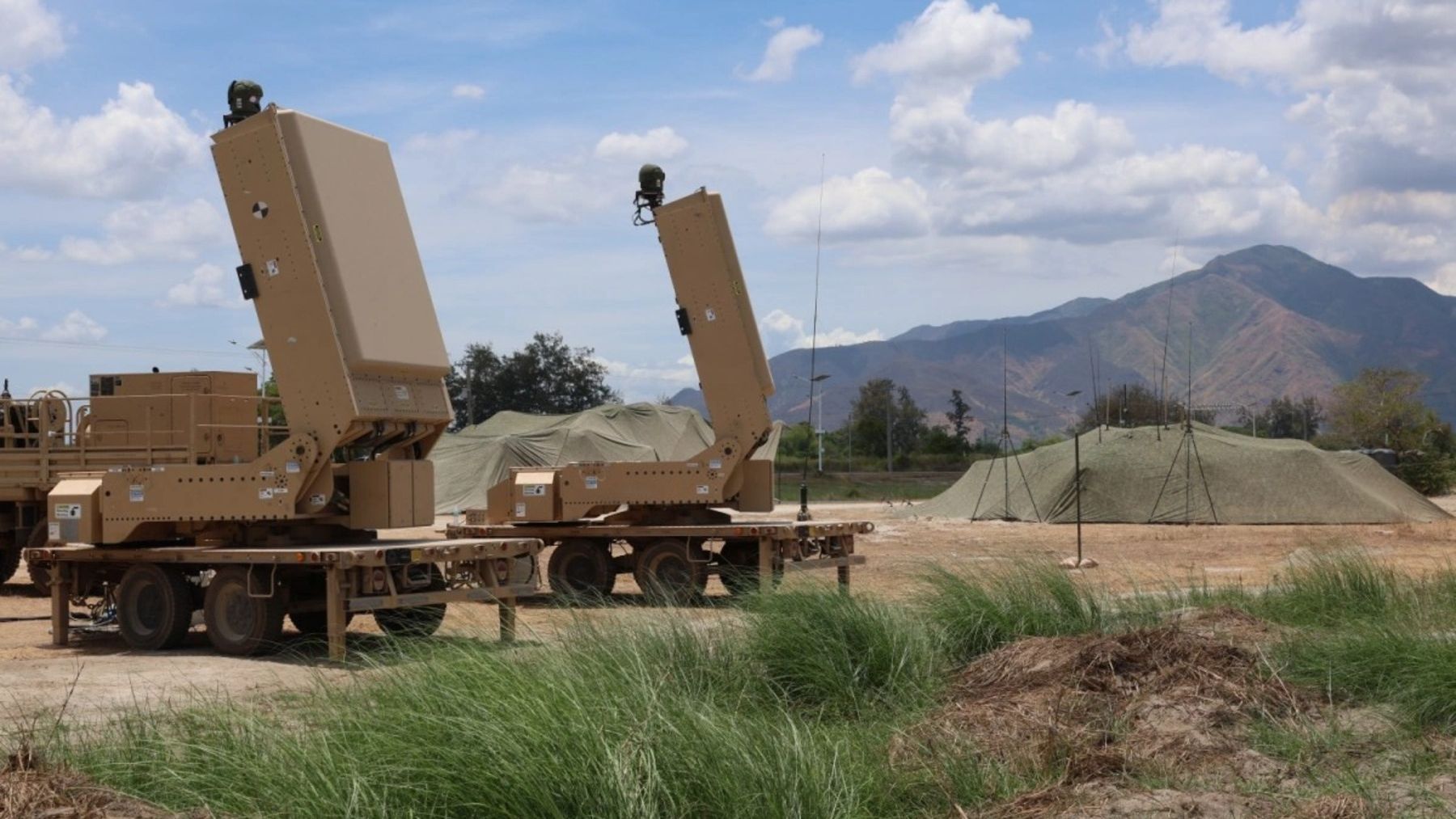
The Leonidas design is based on a metal structure the size of a garage door installed on a trailer, with dozens of amplifiers made of gallium nitride that can withstand extreme temperatures and high voltages.
The software manages the energy’s orientation and allows it to be directed toward a target in a matter of milliseconds or spread out in a wide arc of about 60 degrees. Tests conducted at the Torrance facility in California showed how the waves enter the drones’ circuits, causing the devices to crash. As engineer Tyler Miller pointed out in statements to MIT Tech Review, “sometimes, if we turn the drone 90 degrees, it’s another motor that shuts down first.”
In 2023, the U.S. Army signed a $66 million contract with Epirus, which was extended months later with an additional $17 million. The goal is to evaluate the system’s viability in real-world maneuvers, as was already done in the Philippines in a live-fire exercise. Senior commanders recognize the weapon’s potential, although they insist that it still needs to be integrated into more complex defense chains that include sensors and kinetic systems.
The Navy also joined this effort by developing the ExDECS system, designed for expeditionary operations. That prototype was delivered to the Dahlgren Naval Surface Warfare Center in Virginia to test its response to aerial drones and unmanned boats loaded with explosives. Initial port tests showed that microwaves were able to disable outboard motors on unmanned boats similar to those launched by the Houthis in the Red Sea.
The proliferation of drones in recent wars is forcing the search for faster and more sustainable defenses
The global context explains the rush. In Ukraine, drones have become a tool of attack and defense, with small aircraft capable of dropping explosives on trenches or guiding operations behind enemy lines. In the Middle East, both the Houthis and Iran have used drones to attack merchant ships and US bases.
This proliferation multiplies the risk that coordinated swarms will overwhelm the response capacity of costly and limited defenses such as missiles or lasers in a matter of hours.
Epirus executives argue that Leonidas’ advantage lies in the fact that it does not run out like a rocket battery, as it can continue to launch waves as long as it has a power supply. That “one against many” capability, in Lowery’s words, has been one of the central ideas with which the company has tried to seduce the military and potential industrial partners.
Epirus is preparing smaller versions of Leonidas for armored vehicles, drones, and entire cities
The immediate future points to miniaturization of the system. Epirus is working on more compact versions that can be mounted on Stryker armored vehicles or even larger drones. The possibility of fixed installations capable of protecting entire urban areas with energy barriers is also being studied.
Lowery himself used a mythological reference to express the ambition of the project, stating that drones “are like Icarus, with their wax wings,” and finishing with a phrase that sought to highlight the nature of his weapon: “We built a spectacular wax wing melter.”
The United States is thus facing a strategic showdown in which microwave technology is emerging as an essential tool for maintaining supremacy over rivals that are already deploying similar advances. And in this arena, the mantra of not falling behind seems to be guiding every step taken by the Pentagon and its contractors.