
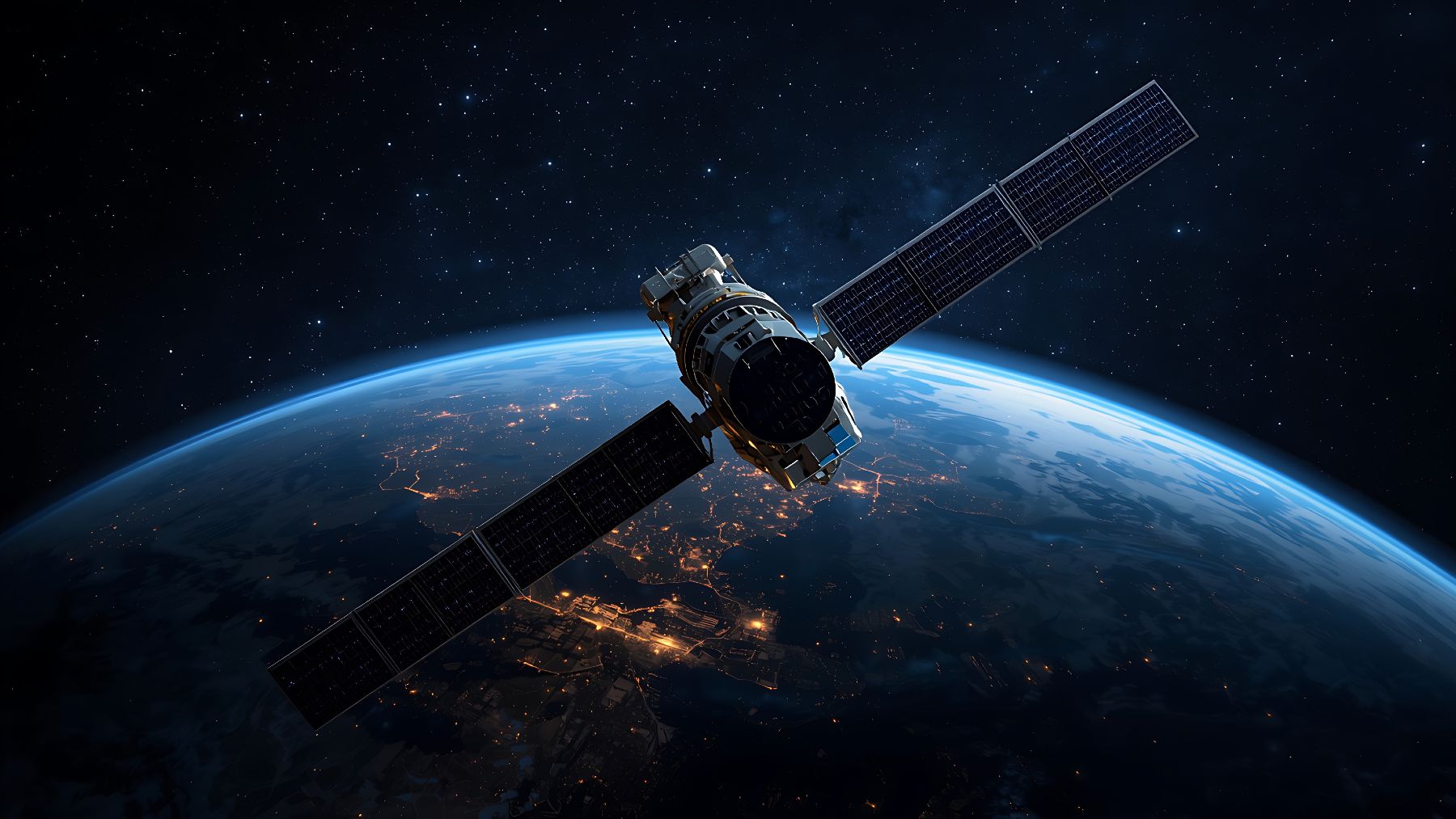
Recently, China and the United States, the world’s superpowers, have been equally committed to promoting the next generation of renewable energy technology in space. One sector where this battle is shaping up is photovoltaics, a branch of renewable energy and a “new” term that will begin to be used more frequently: Space-Based Solar Power (SBSP). Both world powers want to capture the “market” for solar panels in space, a battle that adds to the existing race to be the power with the largest possible presence in space.
How it works: capturing solar energy and transmitting it to the planet via microwaves, solving a large part of humanity’s energy problems
Regarding both countries, on the one hand, the United States operates in a democracy where regulatory and security issues must be thoroughly addressed before the operational version of its space-based solar power system (SBSP). On the other hand, China continues to pursue its flagship project, known as the “Chasing the Sun” program.
The idea, in simpler terms, is for a space station to orbit the Earth, capturing solar energy and transmitting it to the planet via microwaves, solving a large part of humanity’s energy problems. This is the idea in the minds of the major powers, something that would put an end to many current problems, but also a very difficult idea to develop. Space photovoltaics still seems a distant prospect, but in the last decade, ESA, NASA, and the Japanese (JAXA) and British (UKSA) space agencies have conducted feasibility studies of different technologies and have initial plans to test them. Proof of this are the United States and China.
Space-based solar panels would reduce Europe’s need for terrestrial wind and solar power by 80%
According to a study conducted by researchers from King’s College London and Xi’an Jiaotong University (Suzhou, China), the potential impact of this technology has been quantified. The study indicates that space-based solar panels would reduce Europe’s need for terrestrial wind and solar power by 80% and could reduce the costs of the European electricity system by up to 15%. According to experts, there are two ways to put this into practice. On the one hand, heliostats are devices with a mirror that reflects sunlight toward a fixed target (the point of electricity production). NASA proposes placing them in a beehive shape and always oriented toward the sun. On the other hand, there is the option of placing flat solar panels in a large rectangular configuration that moves to always face the sun.
A large amount of funding is required, which can be a significant issue
In any case, experts face a list of complexities, some of which we can list. For example, atmospheric interference. Due to the location of the Space-Based Solar Power (SBSP) system and the need for its signals to reach Earth, atmospheric problems are likely to arise during setup. In addition to cost issues, we already know that space missions aren’t exactly cheap. A large amount of funding is required, which can be a significant issue, especially if the mission is nearing its final phase. And the dangers of solar radiation and micrometeoroids are a reality. These are just some of the obstacles astronomers will face when carrying out this work.
“Achieving net-zero emissions by 2050 will require a significant transition to renewable energy”
This is certainly a project of astronomical dimensions, and one that requires preparation for both success and failure. “Achieving net-zero emissions by 2050 will require a significant transition to renewable energy, in which this emerging technology could play a key role,” said Wei He, lead author of the study and a professor in the Department of Engineering at King’s College London.




