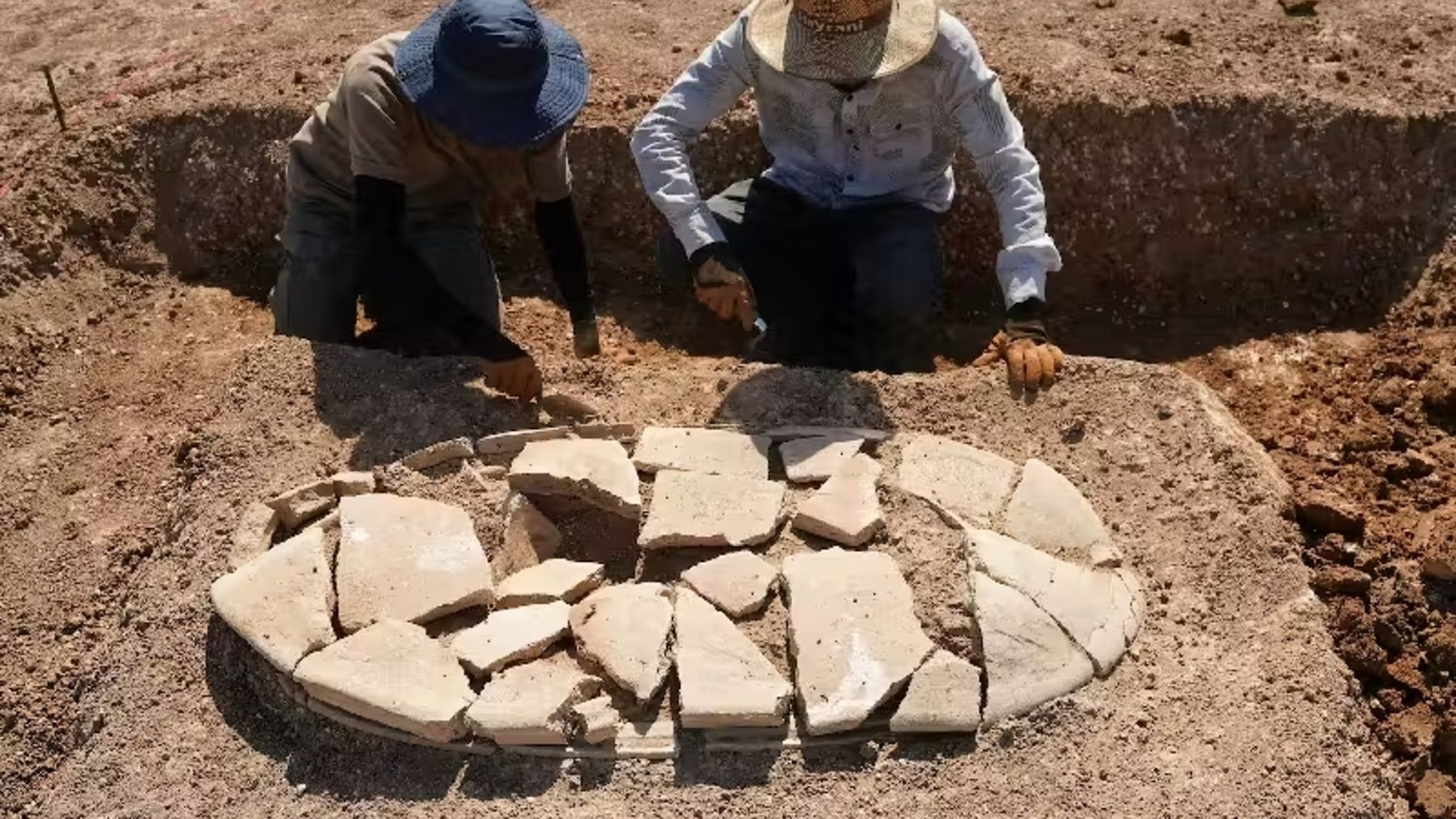
In addition to material objects, buried bodies could offer essential clues about disease, nutrition, causes of death, and even family relationships through genetic analysis. Each grave is a time capsule. And as the sun warms the newly exposed stone slabs, archaeologists race against time to document them before water covers them again or, worse, time destroys them.
A discovery made possible by an environmental catastrophe
The origin of this discovery has a much more disturbing background than the simple passage of time. Iraq is experiencing one of its worst droughts in almost a century. Rainfall has decreased dramatically, while temperatures are soaring year after year. Added to this are the effects of dams built upstream in neighboring countries such as Turkey and Iran, which have reduced the flow of the region’s great historic rivers: the Tigris and the Euphrates.
Today, the country has less than 10% of its water reserves available, and the situation in some regions, such as Basra, is already critical. Crop failures, forced migration, and an increase in diseases transmitted by contaminated water are leaving a painful mark on millions of Iraqis. And, paradoxically, this climate tragedy is bringing long-forgotten archaeological treasures to light.
This is not the first time this has happened. In 2022, the same waters of the Mosul Reservoir revealed a city more than 3,000 years old, probably from the Mitanni period. Elsewhere in the country, Assyrian structures, submerged palaces, and irrigation canals have briefly emerged during periods of extreme drought. History is literally “floating” again.
A unique but fragile opportunity
The discovery of the Hellenistic necropolis could offer a new narrative on the ancient history of Iraq, which has traditionally focused on the splendor of the Sumerian, Babylonian, and Assyrian civilizations. This finding suggests that Greek influence was more lasting and profound than previously thought, and that even in areas far from major centers such as Seleucia or Babylon, Hellenistic ideas took root.
The site where the tombs were found appears to correspond to an acropolis or elevated settlement, possibly a secondary city that existed for centuries. Surveys have detected signs of occupation from the Nineveh V period to the Islamic era. This continuity shows that the area was a strategic hub for millennia, a kind of microcosm of Mesopotamian history.
However, the future of the site is uncertain. When the water level in the reservoir rises, the tombs will once again be hidden and, in the worst case scenario, could suffer irreparable damage. The conservation of these archaeological sites, exposed to the ebb and flow of water, erosion, and a lack of institutional resources, is one of the great challenges facing researchers in Iraq.
In a context where the country’s priorities are marked by the daily survival of its population, protecting heritage may seem like a luxury. But what is at stake here is not just a collection of old stones: it is the memory of a civilization, the opportunity to reconstruct a more complex, richer, and more human history.
The legacy left behind by receding waters
The paradox is clear: while thousands of people in Iraq suffer the consequences of water scarcity, the receding waters reveal unknown chapters of their past. A past that, as it is unveiled, reminds us of the fragility of memory and the urgency of preserving it.
The story of the discovery of Hellenistic tombs in the Mosul reservoir is the story of a country torn between beauty and disaster, between the grandeur of the past and the uncertainty of the future. But it is also a story of resistance: that of the archaeologists who, amid the mud and heat, continue to unearth the roots of an ancient people.