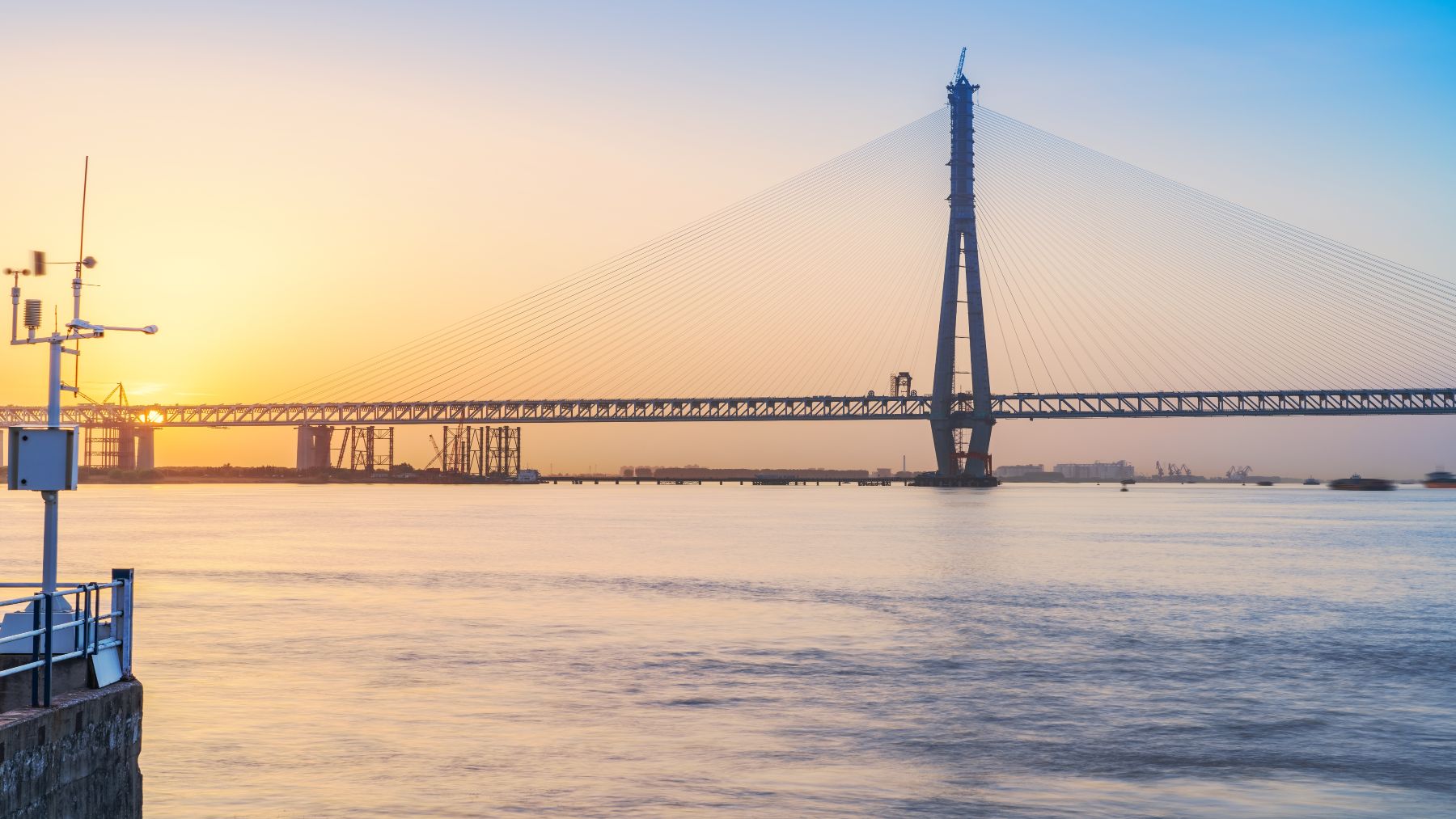
The world’s longest suspension bridge is now operational. The Changtai Yangtze River Bridge, a 10.3-kilometer bridge connecting the cities of Changzhou and Taizhou, has just opened to traffic. This project connects strategic regions in the east of the country and, given its size, is already the longest bridge in the world, according to its category.
The Changtai Bridge is built over the Yangtze River in Jiangsu Province, on China’s east coast
As for being a world landmark, the South China Morning Post reports that the Changtai Yangtze River Bridge is already classified as the longest cable-stayed bridge in the world. The technology used, according to engineers, is world-first. The Changtai Bridge is built over the Yangtze River in Jiangsu Province, on China’s east coast. Construction of the Changtai Bridge has marked several technological milestones, taking six years to complete and for the first time in history, it connects three types of roadway into a single structure. Its main span reaches 1,208 meters, while its towers rise 350 meters high, 30 meters shorter than the Empire State Building in New York. It opened in September of this year and is already generating a lot of buzz.
Foreign engineers continue to explore all the new features of this “great” new bridge. Experts from Roads & Bridges explained that this infrastructure combines highways, local roads, and an intercity rail system, making it an unprecedented multifunctional project. State-owned China Communications Construction explained: “The project team achieved the fastest sinking speed for large caissons in silty clay layers, developed the world’s first intelligent tower crane with a lifting capacity exceeding 10,000 ton-meters, and advanced the industrialized construction of steel-concrete composite pylons.”
The cables are also less sensitive to temperature changes
Continuing with the more technical aspects, the structure uses carbon fiber tendons for the first time in the history of bridge engineering to create high-strength composite cables. These cables are also less sensitive to temperature changes. Due to its technology and the innovation it entails, Interesting Engineering assures that these characteristics place it among the most advanced projects in the world in its category.
Li Zhen, about the Changtai towers: “are like human legs, whose stability and strength depend on the underwater caisson”
This is certainly an unprecedented construction. The structure incorporates a 200 km/h high-speed rail line, an intercity railway, and a local highway. “This is the first time a large bridge has incorporated a side-by-side traffic design,” the engineers explain. The bridge’s foundations were extraordinarily reinforced to withstand the Yangtze’s strong currents. Li Zhen, construction manager for the Jiangsu Provincial Transportation Engineering Bureau, told the South China Morning Post that the Changtai towers are like “human legs, whose stability and strength depend on the underwater caisson.”
“These robots could navigate complex underwater terrain and clean sand from the corners of the caisson”
One of the major innovations is the use of robots to clean the bridge’s foundations. During underwater operations, the team employed intelligent robots for the first time. “These robots could navigate complex underwater terrain and clean sand from the corners of the caisson.” Furthermore, in terms of time, which is ultimately what bridge users are interested in, the infrastructure will significantly reduce travel times, from an hour and a half to just 20 minutes, and will improve logistical efficiency in local and international trade, according to experts.
For now, the bridge has already passed the weight test. The bridge withstood a final load test involving 110 trucks with a total weight of 4,400 tons. The structure, its creators claim, can support a load capacity of 530,000 metric tons. In short, it seems that innovation, science, and technology have made possible an advancement that will surely be replicated in other parts of the world.