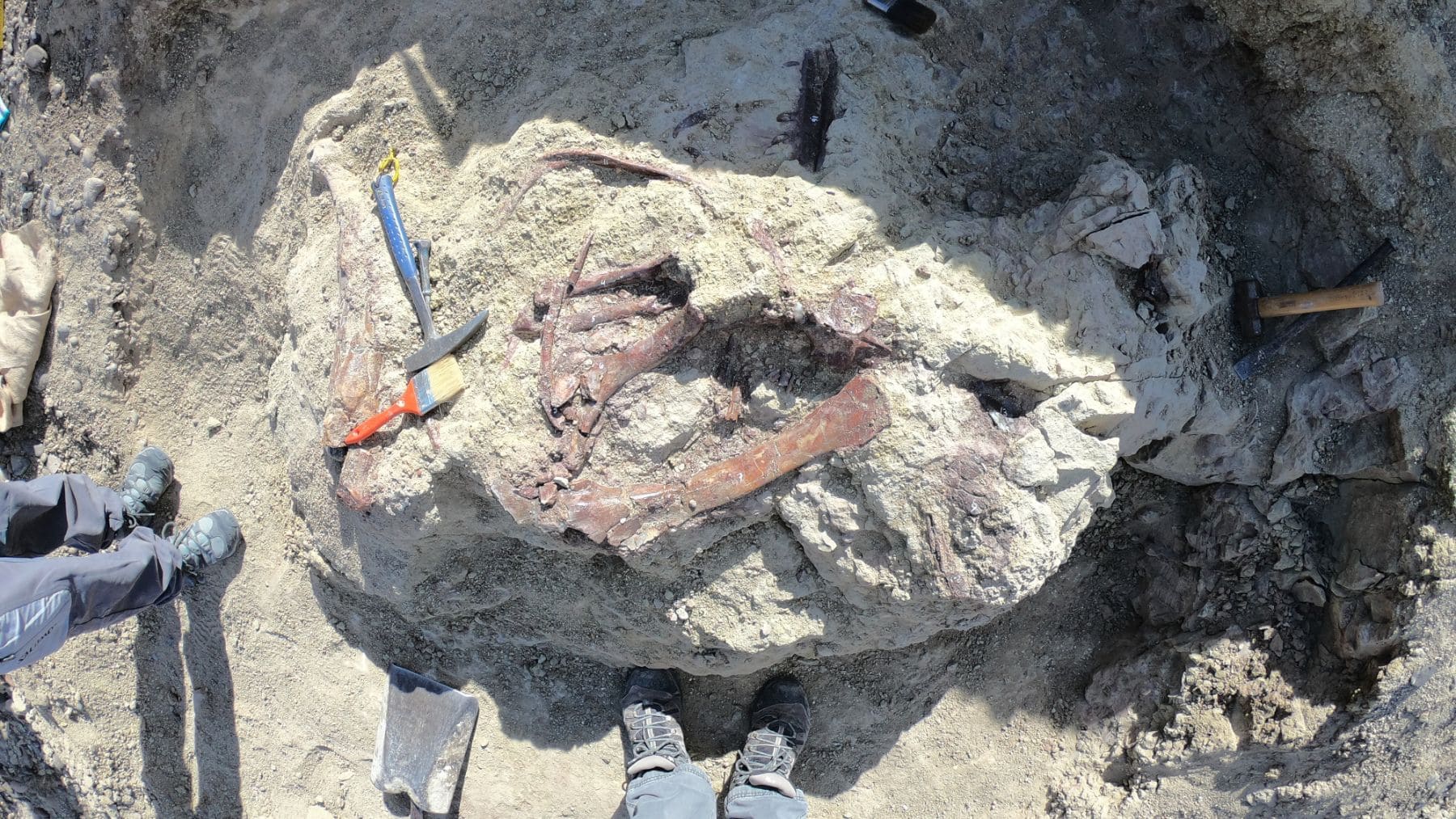
Science continues to unearth discoveries that return across the globe. This time, it’s the discovery of the fossil remains of a previously unknown carnivorous dinosaur, with a crocodile bone still trapped between its jaws. Among the landscapes of southern Argentine Patagonia, a group of scientists discovered the fossil of a previously unknown carnivorous dinosaur, which they named Joaquinraptor casali. The discovery, recently published in the journal Nature Communications, not only reveals a new species of megaraptor but also one of the few documented examples of a fossilized dinosaur in the act of feeding. In other words, it’s a unique find.
The data indicate that this dinosaur lived approximately 67 million years ago, in the late Cretaceous
This historic discovery was made by researchers from Conicet (National Institute of Technology) and public universities in Argentina, as well as the Carnegie Museum of Natural History in the United States. It was published in the journal Nature Communications. The data indicate that this dinosaur lived approximately 67 million years ago, in the late Cretaceous, just before the impact that wiped out the non-avian dinosaurs. The description of the species was based on the partial skeleton they found and sheds new light on the predators that inhabited this South American region during the late Cretaceous. The specimen, excavated in the Lago Colhué Huapi Formation in Chubut Province, in the heart of Patagonia, represents one of the most recent and best-preserved species of this group of predators.
Findings: A large part of the skull, jaws, arms, ribs, vertebrae, and limbs
As noted above, the remains found reveal very interesting information. A large part of the skull, jaws, arms, ribs, vertebrae, and limbs were found, offering a much more complete picture of what this carnivore looked like. The name Joaquinraptor was chosen in tribute to the son of the first author, Lucio Manuel Ibiricu, a researcher at the Patagonian Institute of Geology and Paleontology, a branch of CONICET-CENPAT (National Commission for the Study of the Patagonian Geology and Paleontology) in Puerto Madryn. The site where the skeleton was found, which the researchers had informally named Joaquin Valley, was also considered.
The shape of the skull was elongated and light, and its teeth, although small for its size, were adapted for making precise cuts
Unlike the iconic T. rex, its arms were long, muscular, and ended in sharp, curved claws. The remains found belonged to an adult specimen about 19 years old at the time of its death, as determined by analyzing growth marks on the tibia. Bruno Álvarez, one of the co-authors of the work, “was the first to see some fragments on the surface. Then, we returned with the rest of the team and opened the excavation, where we immediately realized the potential of this new discovery.” The shape of the skull was elongated and light, and its teeth, although small for its size, were adapted for making precise cuts rather than crushing bones.
Joaquin Raptor’s bone structure shows adaptations for speed and agility, meaning it was very different from the large T-Rex
Aside from all the information this discovery provides, the most interesting thing is what scientists found between its teeth. It’s the arm bone of a prehistoric crocodile. The bone, a humerus from a primitive crocodile, was wedged between the dentary bones of Joaquin Raptor, meaning the dinosaur died suddenly while feeding. Everything about this discovery is impressive. Joaquin Raptor’s bone structure shows adaptations for speed and agility, meaning it was very different from the large T-Rex we all remember, despite being a top predator. This is an unique moment for the science. It’s almost like if someone had taken a picture 67 million years ago. Just impressive.