
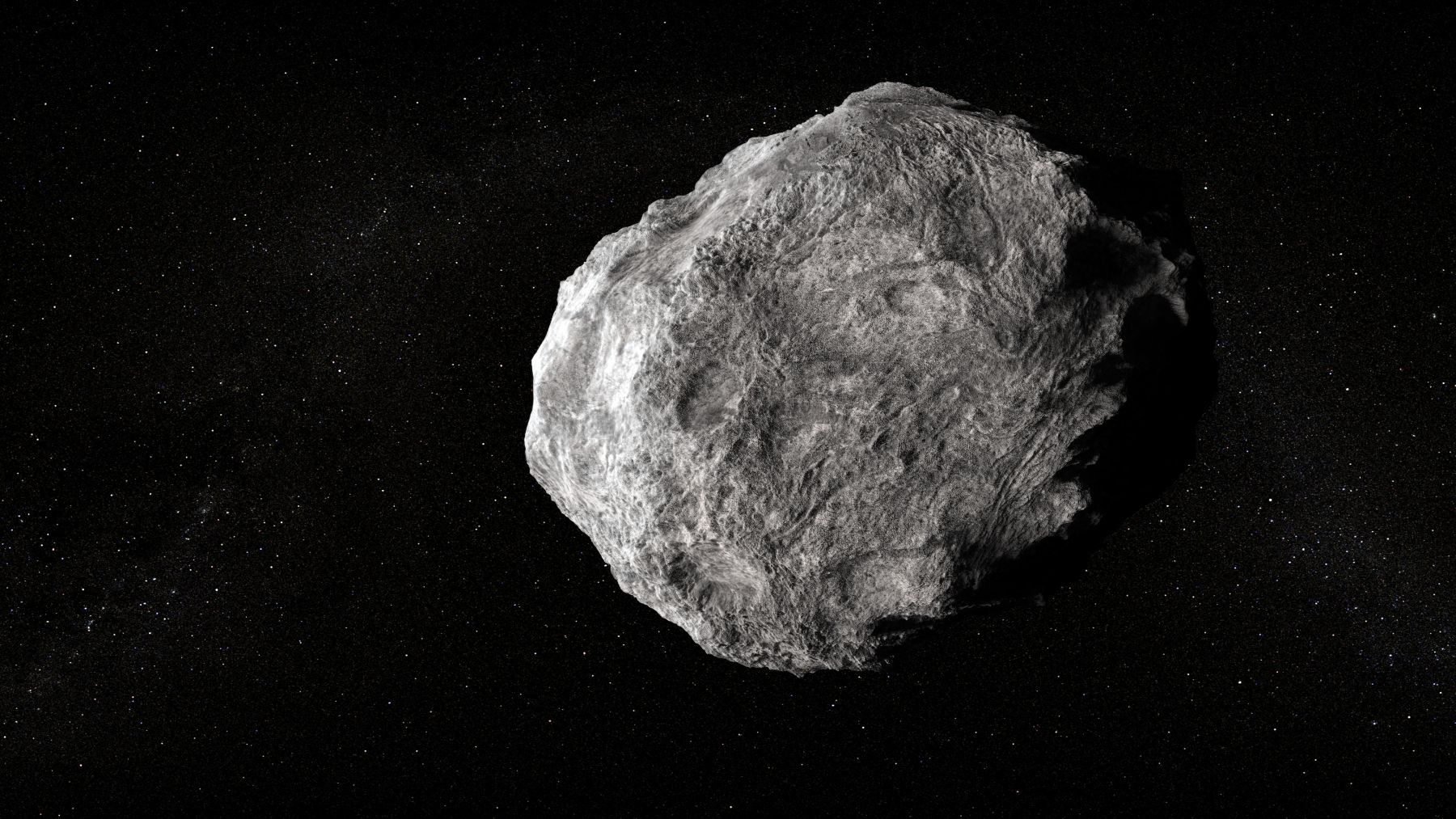
Scientists have recognized that there is a new quasi-satellite of Earth and it is called asteroid 2025 PN7, it is a quasi-moon, detected by Pan-STARRS (Haleakalā) in August 2025. Various cosmological models built by astronomers suggest that it has been circling the planet for more than 60 years and counting. It is a tiny wandering rock that orbits the Sun on a trajectory so similar to that of our planet that, from our perspective, it appears to be escorting us through space.
According to observations, this entity is as if constantly trying to behave like our planet’s second moon
There is already talk that asteroid 2025 PN7 is Earth’s second moon, which has remained hidden from the naked eye all this time due to its small size and dim magnitude. According to observations and the opinions of scientists, this entity is as if constantly trying to behave like our planet’s second moon. Its orbit is not gravitationally tied to Earth, as is our natural satellite’s, but its motion is so delicately tuned to ours that it seems to follow us wherever we go. It has been reported that it orbits the Sun with an orbital period practically identical to Earth’s, which suggests that it orbits our planet.
The discovery of 2025 PN7 is not only important but also highly significant for astronomy, as it has the potential to help astronomers refine and modernize current models
Experts have confirmed today that it will remain a quasi-satellite for at least the next six decades, accompanying Earth in a constant, millimetric choreography. 2025 PN7 belongs to the elusive Arjuna group of asteroids, a subcategory within the Apollo asteroids, whose orbits not only mimic Earth’s but also establish a 1:1 orbital resonance. The discovery of 2025 PN7 is not only important but also highly significant for astronomy, as it has the potential to help astronomers refine and modernize current models of co-orbital dynamics. It is a type of asteroid that completes its orbit around the Sun in the same time as Earth, as we previously mentioned.
If we talk about specific data, the size of 2025 PN7 ranges between 19 and 30 meters in diameter
This discovery is very interesting because while there is a general understanding of the approximate number of celestial life forms on our planet, seeing that an asteroid mimics the characteristics of a natural satellite provides more context to this celestial census. If we talk about specific data, the size of 2025 PN7 ranges between 19 and 30 meters in diameter, dimensions that, combined with its faint brightness, explain why it was so difficult to detect.
The 2025 PN7 could become an ideal target for probes or robotic missions, both to test navigation technologies and to study its composition
It was the Pan-STARRS1 observation system in Hawaii that finally managed to identify it on August 2, 2025, although curiously, a review of previous astronomical archives revealed its presence in images dating back to 2014. Given its relative proximity and stable orbit, 2025 PN7 could become an ideal target for probes or robotic missions, both to test navigation technologies and to study its composition. Therefore, the discovery of this asteroid opens the door to space missions dedicated to observing the movements of 2025 PN7.
Their discovery and presence allow for the refinement of orbital resonance models, and their existence raises interesting questions
Many asteroids contain significant concentrations of platinum, iridium, palladium, nickel, and other rare earth metals—elements that are scarce on Earth and whose extraction involves environmentally harmful extraction processes. Therefore, their discovery and presence allow for the refinement of orbital resonance models, and their existence raises interesting questions about the past and future of these ephemeral companions of Earth.




