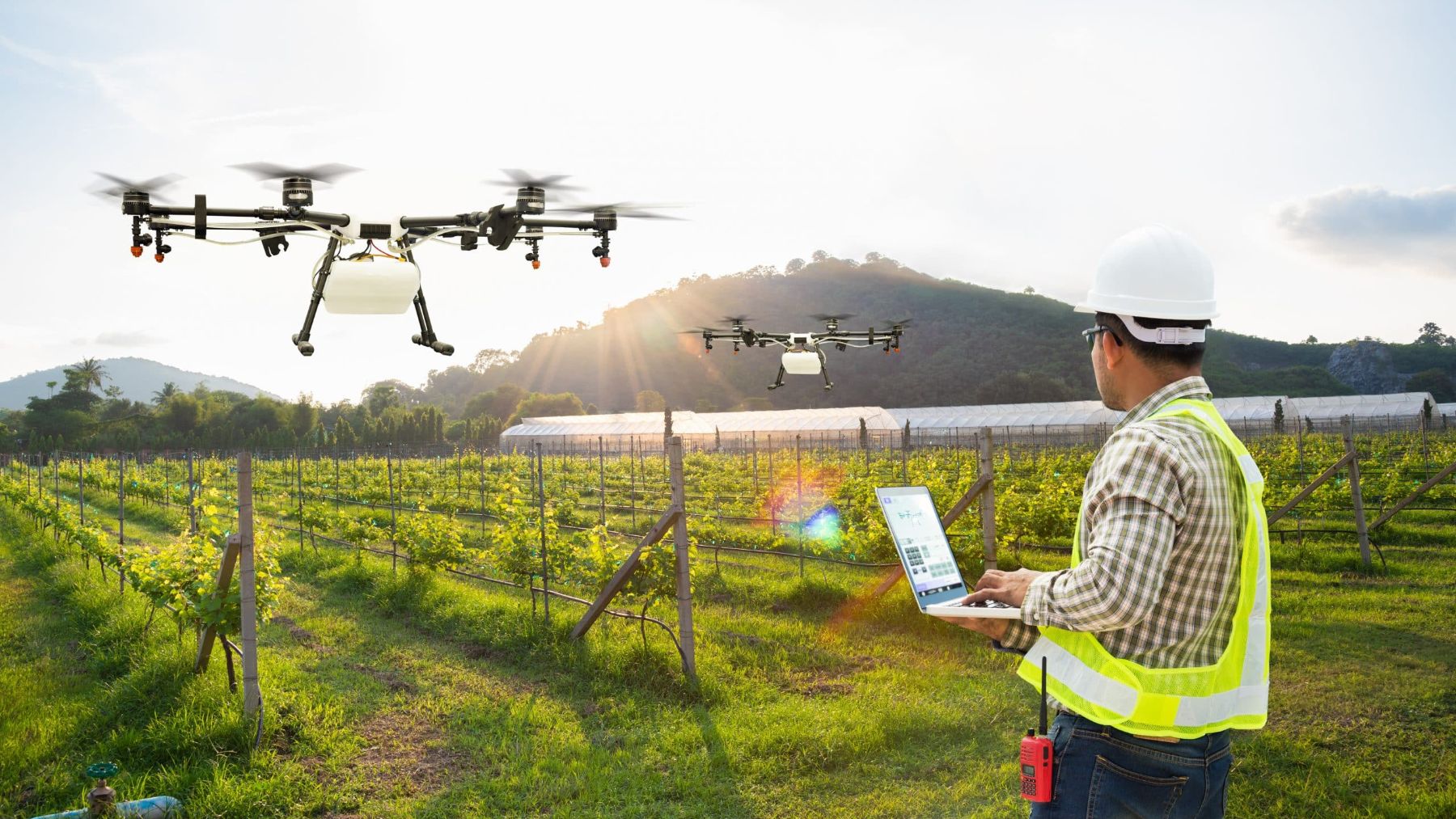
Precision agriculture is currently undergoing a major change as a result of artificial intelligence, as it is taking into account deep learning and machine learning to combat climate change and ensure food security for the world’s population. Through the use of sensors, drones, and hyperspectral cameras, pests such as the Amaranthus palmeri virus can be studied and combated. Likewise, models based on Convolutional Neural Networks, together with agricultural robotics and LiDAR systems, make tasks in the field easier. Finally, it should be noted that all data is stored in a cloud. Keep reading to learn more.
Data that germinates: the digital transformation of agriculture
Efficient information management has become a fundamental pillar of the new agricultural paradigm driven by digital transformation. The characteristic process of digital agriculture begins with data capture using sensors installed in the crop environment. These sensors monitor multiple agronomic variables in real time, such as soil moisture, temperature, phenological status, and the presence of pests, generating a constant flow of information.
This information is collected by a digital platform that acts as the central core of the system. Specialized software, in combination with AI algorithms, then processes and analyzes the collected data. The result of this analysis is a series of recommendations or intervention alternatives aimed at optimizing production, improving resource efficiency, and reducing environmental impact. Based on these suggestions, the farmer evaluates the available options and makes informed decisions about the actions to be implemented, either using their own machinery or resorting to automated systems.
In this context, agricultural robotics can play a versatile role: on the one hand, there are comprehensive platforms capable of covering all stages of the process (from data collection to the execution of actions in the field) and, on the other hand, there are also more specific solutions that focus exclusively on one stage of the cycle, such as automated harvesting or robotic weed control.
The smart “eye” that looks after your food: early pest detection
Identifying and controlling pests and diseases is essential to safeguarding crop health and yield. Early detection is crucial, as it enables rapid intervention to limit their negative effects. Often, the first signs of a problem appear on the leaves, where color changes, spots, or other alterations serve as warning signs of a possible spread of disease to the rest of the plant. Artificial intelligence can play a key role in the detection and management of pests and diseases in crops, as it allows for the early and automatic identification of subtle patterns on leaves that often go unnoticed by the human eye.
Thanks to the use of thermal, multispectral, and hyperspectral cameras on drones or agricultural machinery, it is possible to monitor large areas. In addition, AI facilitates a more accurate diagnosis by differentiating between nutritional deficiencies, water stress, or fungal, bacterial, or viral infections, which helps to apply the appropriate treatment in each situation. Integrated into precision agriculture platforms, this technology also contributes to optimized decision-making, suggesting specific actions such as localized applications of plant protection products or adjustments to irrigation. Overall, it makes pest and disease detection a faster, more efficient, and more sustainable process, with a positive impact on agricultural productivity.
Higher yields, fewer herbicides: how AI protects crops
Effective weed control is essential to improving crop yields and ensuring that global food production increases by more than 70% in order to feed an ever-growing population. Traditionally, weed management has relied on the application of herbicides and tillage (mechanical control). However, the use of herbicides carries significant risks, such as the presence of residues in food, environmental contamination, and the emergence of resistant biotypes. Despite this, herbicides continue to be widely used due to their high efficacy, targeted action, cost-effectiveness, and speed of action.
In this context, recent advances in image processing, computer vision, and artificial intelligence have opened up new possibilities for precision agriculture. Deep learning, and in particular convolutional neural networks, have shown great potential for discriminating between crops and weeds with greater accuracy than traditional image analysis methods. Integrated into smart spraying systems, these technologies allow herbicides to be applied in a localized rather than uniform manner, reducing costs, optimizing resources, and minimizing negative impacts on the environment.
Artificial intelligence gives robots autonomy, allowing them to make decisions based on their environment.
Artificial intelligence gives robots the ability to act autonomously, making decisions based on the conditions of their environment. This makes it possible to develop more accessible and efficient automation systems capable of transforming agricultural management. These robots stand out for their versatility: they can traverse fields, collect geospatial data, and analyze crop conditions using advanced sensors such as LiDAR and RGB cameras. Their mobility allows them to approach individual plants and capture high-resolution images, which are then analyzed by artificial intelligence algorithms. This facilitates the early detection of pests, identifying incipient outbreaks before they spread throughout the plot.
Another key application is the creation of 3D maps, which allow the height of plants and planting density to be measured and the volume of biomass to be estimated. This information is essential for predicting crop yields and optimizing agricultural management decisions. Furthermore, by incorporating simultaneous localization and mapping (SLAM) algorithms, temporal interpolation techniques, and object detection methods such as PointPillars, the collected information can be processed and applied to digital crop monitoring. This approach highlights the enormous potential of robotics and artificial intelligence to revolutionize the efficiency and sustainability of agriculture in the future.
From sky to soil: sensors, AI, and clouds for sustainable agriculture
In short, AI is transforming precision agriculture by converting large volumes of data into useful information for decision-making. It acts as the brain of the system, processing data captured by sensors and applying advanced techniques such as computer vision. This makes it possible, for example, to identify fruits, assess their degree of ripeness, and detect potential pests and diseases early on, allowing for production estimates and localized, efficient treatments. On the other hand, cloud platforms play a fundamental role, collecting, storing, and processing all this information in real time. These platforms facilitate the integration of data from different sources, allow remote access, and ensure that AI algorithms work with up-to-date information, improving the accuracy of recommendations and decision-making.
In addition, AI algorithms generate detailed maps of crop conditions, optimizing the use of essential resources such as water and fertilizers. This technology also drives automation and agricultural robotics, managing vehicles and robots that perform tasks such as pruning or applying products, adapting in real time to changing field conditions. Ultimately, the combination of AI and cloud platforms not only improves productivity but also contributes to more sustainable, connected, and intelligent agriculture. In this way, AI could significantly improve environmental sustainability and global food security in the long term. AI has the potential to optimize the ecological impacts of agricultural practices by reducing the use of resources, especially water and chemical inputs. Improving crop production and minimizing waste will become indispensable processes for feeding the growing world population, particularly in developing nations with limited food resources.