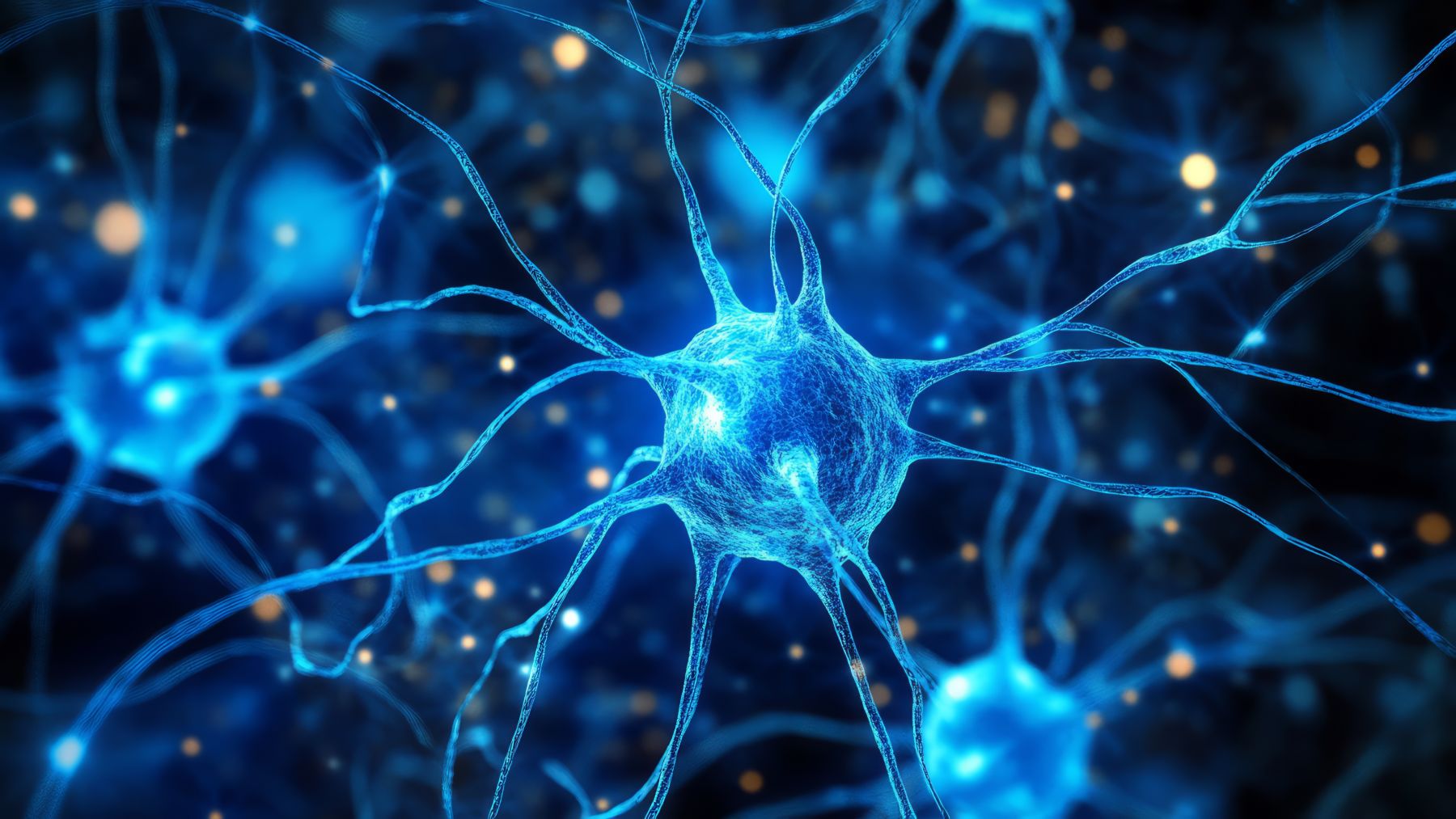
Good news for the scientific world. New neurons created in the laboratory can learn and communicate using chemical and electrical signals just like natural ones, opening the door to new treatments that were previously unfeasible. Engineers at the University of Massachusetts at Amherst have developed an artificial neuron like no other. This artificial neuron is the first in history capable of firing, learning, and responding to chemical signals exactly as a biological neuron would.
A possible communication directly with our brains to repair neural circuits damaged by diseases like Alzheimer’s
From what we know so far, this breakthrough opens the door to much more efficient computers or medical devices that could communicate directly with our brains to repair neural circuits damaged by diseases like Alzheimer’s. The flow of electrical information from cell to cell involves approximately the same voltage and energy consumption as natural neuronal communication. Hence the importance of this discovery. “Our brain processes an enormous amount of data. But its energy usage is very, very low, especially compared to the amount of electricity needed to run a Large Language Model like ChatGPT,” says Shuai Fu, a graduate student in electrical and computer engineering at UMass Amherst and one of the authors of the study recently published in Nature Communications.
The secret ingredient of this artificial neuron is a protein nanowire synthesized from the bacterium Geobacter sulfurreducens
Researchers claim that the human body is 100 times more electrically efficient than a conventional computer circuit. Now, with this new creation, it is closer than ever to imitating reality. The secret ingredient of this artificial neuron is a protein nanowire synthesized from the bacterium Geobacter sulfurreducens, a microorganism with the superpower of generating electricity. Scientists have been developing synthetic neurons and connecting them to complex machines for years, but their simple functions pale in comparison to those of our brains, which clearly should not be underestimated.
The researchers built their neuron around a memristor made from these protein nanowires
“Previous versions of artificial neurons used 10 times more voltage and 100 times more power than the one we created,” says engineer Jun Yao. The researchers built their neuron around a memristor (a resistor with memory) made from these protein nanowires. This design drastically reduces the voltage required for its operation. What Yao and his colleagues have created is an artificial neuron that can essentially “whisper” to us, as they explain in their findings.
The artificial cell achieved charge integration, rapid depolarization and repolarization
The researchers integrated the memristor into a simple resistor-capacitor circuit to replicate the different phases of a neuron’s electrical activity. “We currently have all kinds of portable electronic sensing systems, but they are comparatively clumsy and inefficient,” Yao explains. The artificial cell achieved charge integration (the slow buildup before a neuron fires), rapid depolarization (the sudden spike when a neuron fires), and repolarization (the return to a resting state).
This is an almost unprecedented advance even though the new synthetic neuron is currently only a prototype
What the team did was connect the artificial neuron to living human heart cells. This allowed the electronic neuron to read their activity and captured live how the cells modified their rhythm upon receiving norepinephrine, a common heart medication. This is an almost unprecedented advance; in any case, the new synthetic neuron is currently only a prototype, although it is still a historic event, as for the first time there is a technology that could unite the electronic and biological in a natural way. We will have to wait for further advances to see its application in real-life cases.