
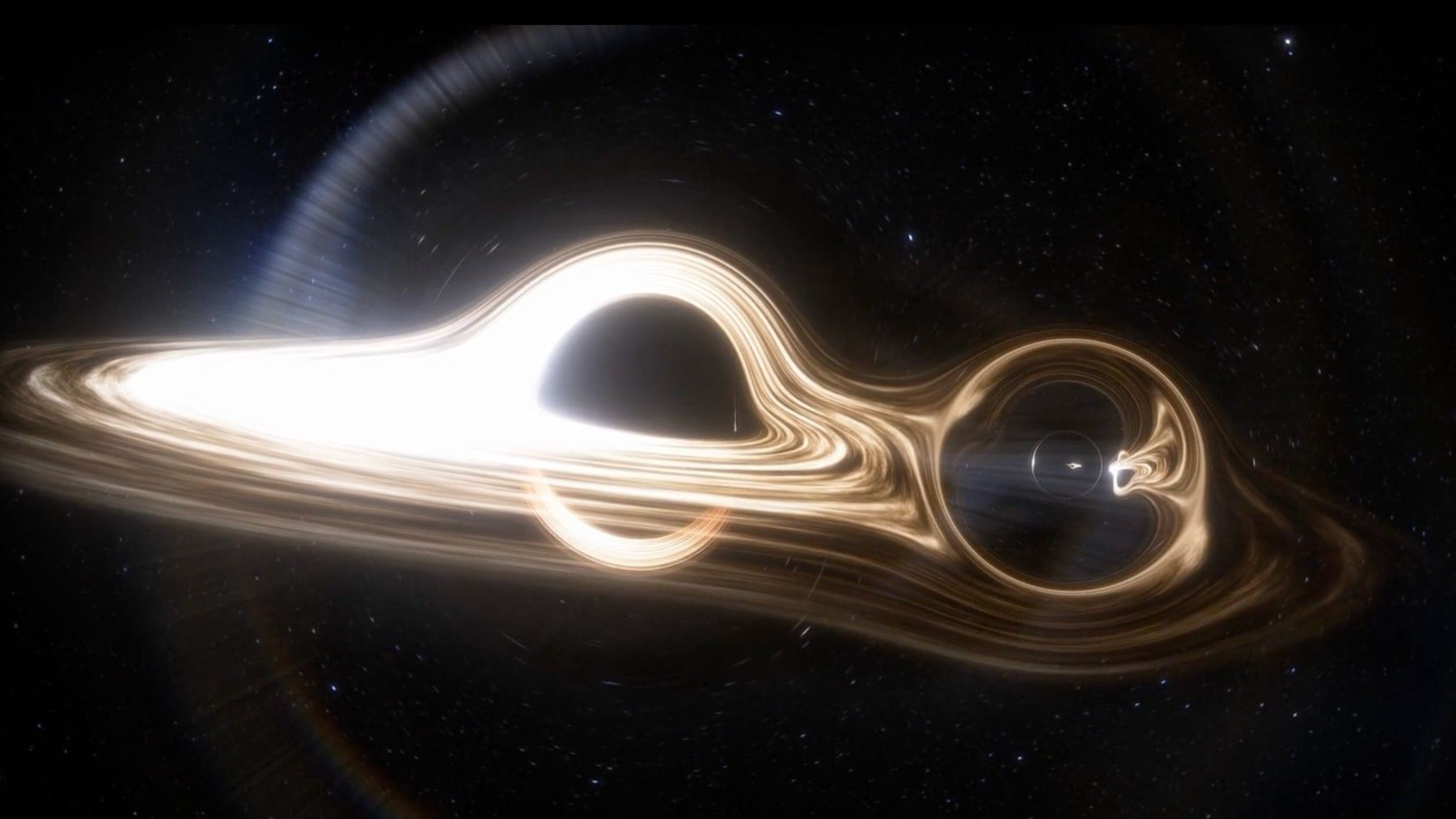
Recently, in the world of astronomy and astrophysics, alongside the work of NASA, a new discovery has been made that could help us understand the universe around us. Based on the study of two black holes, it has been observed that there may be the possibility of black hole fusion and the appearance of cosmic energy located in space-time. This fact implies greater depth in gravitational waves and the discovery of essential information for the creation of galaxies and dark matter. Based on the analysis of particle jets, questions about the universe have answers.
What is behing a black hole
Black holes have always been concieve as mysteries in the world of investigation, with their composition, orbit and purpose widely not common to most of the world’s scientific community. Nevertheless, these mysterious forces have the capacity to warp space-time, gobbling up everything in their way.
Currently, a revolutionary achievement has just been made in which two black holes orbit each other, which implies that the scientific community can come to comprehend these happenings on a much deeper level. In fact, black holes are not easy to recognize, but to get this discovery intense jets of particles have been used that are essential to the investigations of black holes due to the fact that they suggest a tangible response about these items, which would otherwise be not be recognizable.
Transient outbursts
Because black holes are invisible, scientists can only find them by detecting the light produced when they shred stars or gas clouds and create a bright, hot, rotating disk of material that gradually falls inward. TDEs are powerful probes of black hole accretion physics, Chornock said, revealing how close material can get to the black hole before being captured and the conditions necessary for black holes to launch powerful jets and winds.
The most productive search for TDEs has used data from the Zwicky Transient Facility, originally built to detect supernova explosions, but also sensitive to other flashes in the sky.
The ZTF has discovered nearly 100 TDEs since 2018, all within the cores of galaxies. X-ray satellites have also detected a few TDEs, including two in the outskirts of a galaxy that also has a central black hole. In those galaxies, however, the black holes are too far apart to ever merge. The newly discovered black hole is close enough to the core’s massive black hole to potentially fall toward it and merge, though not for billions of years.
New avenues for next research
Thanks to these opportunities for detecting black holes, recent avenues are opening up for future investigation, promising a deeper comprehension of the cosmic forces at work. In fact, scientists can currently investigate how black holes merge and interact. The subject that two black holes have been noticed orbiting each other, more over to being a uncommon phenomenon, can show a great deal of information related to gravitational waves, ripples in space-time caused by huge objects that are moving.
This interaction founded among the two holes is a essential and decisive way in which so-called supermassive black holes form and evolve, as when they merge, they can liberate enormous quantities of energy, which might have relevant implications for the surrounding space. Analyzing these mergers could shed light on the genesis of galaxies and the mysterious dark matter that makes up much of the universe.
The achivement of two black holes orbiting each other has got the public’s imagination. Black holes have been a basic of science fiction for long time, but they have also piqued the interest of the scientific community. As we go in to the understanding of these objects, so does their relevance in popular culture.




