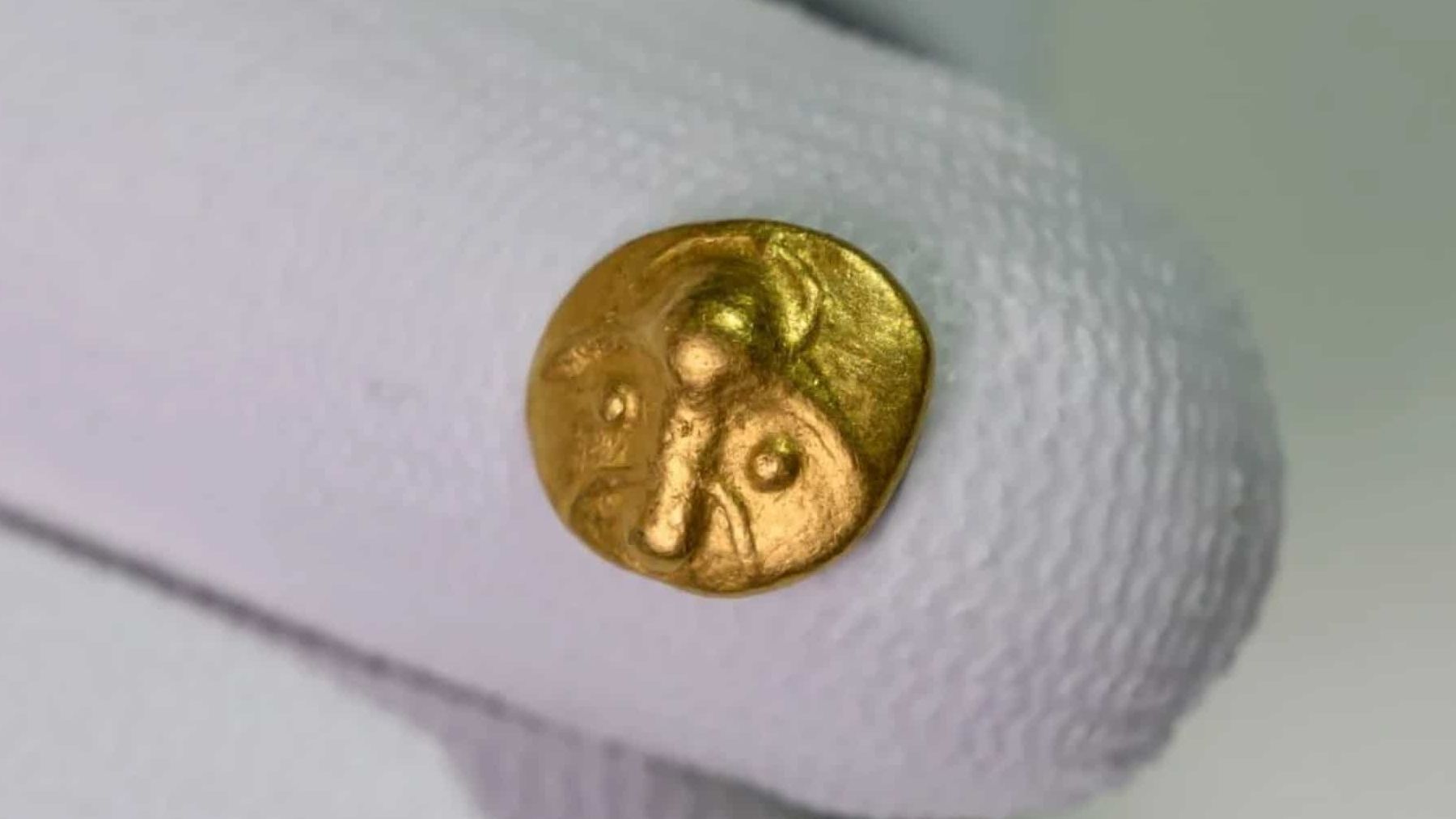
An archaeological discovery has sparked new debate: in Saxony, near Leipzig, there is speculation about how the Celts communicated with Central Europe during pre-Roman Germania. The Landesamt für Archäologie Sachsen (Saxony State Office for Archaeology) recently unveiled a small gold stater coin that was found in Gundorf. The coin features torques and a deer figure that are directly linked to the Kingdom of Bohemia and other archaeological sites in Brandenburg and Bavaria. Read on to find out more.
What lies behind this great story
History sometimes appears in the most unexpected places. In a seemingly ordinary field on the outskirts of Leipzig, an amateur archaeologist equipped with a metal detector recently found a tiny gold coin which, despite its size, is rewriting part of Central Europe’s past. It is the oldest coin ever found in the German state of Saxony: a Celtic “quarter stater,” minted in almost pure gold more than 2,200 years ago.
The news was officially announced by the Landesamt für Archäologie Sachsen (Saxony State Office for Archaeology) during a ceremony led by the state’s Minister of Culture and Tourism, who highlighted the significance of the find as a new key piece in understanding the commercial and cultural exchanges between the Celtic peoples and the populations that inhabited what is now eastern Germany.
Although it may seem surprising, Saxony was historically outside the Celtic settlement area. However, this coin, known as Regenbogenschüsselchen in German (something like “rainbow saucer”), shows that relations between the two worlds were more intense than previously thought. This type of coin owes its name both to its concave shape and to an ancient superstition: it was believed that they appeared where a rainbow touched the ground, as they were often discovered after heavy rains, when the water unearthed them from the fields.
A treasure hidden beneath the surface
The discoverer was a certified volunteer officially affiliated with the Landesamt für Archäologie. Instead of keeping the piece, as unfortunately happens in too many cases, he acted with exemplary responsibility by immediately notifying the archaeological authorities. This behavior has been praised not only for its legality, but also for what it represents: an example of how civic engagement can actively contribute to the preservation of historical heritage.
The coin was found in the Gundorf area, northwest of Leipzig, and has therefore been named the Gundorf coin. It is exceptionally well preserved, in almost perfect condition, as if it had never been in circulation. Experts believe that this coin was not part of a common monetary system, but rather a symbolic object, probably owned by a member of the local elite who had commercial or social ties with the Celtic world.