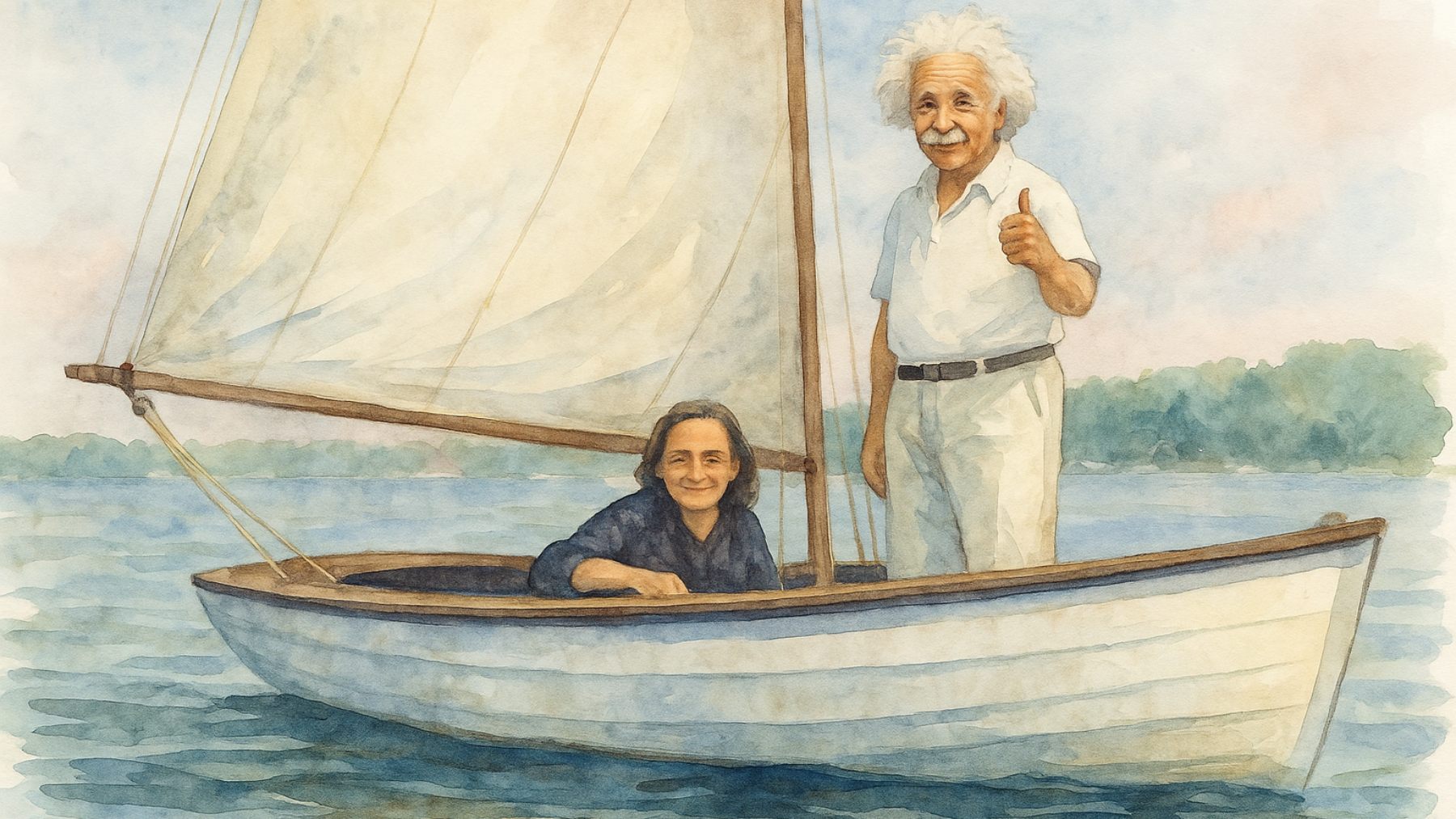
Albert Einstein is not a person you would think that has to be rescued, local sailors around Cutchogue, Long Island, used to tell otherwise. By one merchant’s count, “more than 30” people claimed to have rescued the greatest physicist of the 20th century after he ran aground or flipped his dinghy… proof that even a mind built for cosmic order could delight in nautical chaos.
A birthday boat, a peaceful life—and a looming storm
Einstein’s love affair with boats began far from New York. In 1929, for his 50th birthday, friends in Germany gifted him a sleek vessel named Tümmler—“Porpoise”.
At Caputh, outside Berlin, he had his own jetty, and his wife wrote to his sister with glee about how intensely he enjoyed sailing. Here was the perfect counterweight to a life of equations: set sail, lean back, and —as he famously put it— “let the boat drift.” That drift would eventually get him rescued, again and again.
History, of course, intruded. In 1933, as the Nazis rose, Einstein fled Germany and tried to prevent his beloved Tümmler from falling into hostile hands. He even asked a friend to smuggle it to the Netherlands. The plan fizzled.
The Prussian police seized the boat, blasted the news in the papers, and painted Einstein as a traitor. Valued at 25,000 Reichsmarks, the craft sat idle until 1934, when it was auctioned for just 1,300 RM—an insult in numbers. After the war, Einstein looked for it but never found it. The man who bent spacetime couldn’t retrieve a single wooden hull.
Nautical physics prince rescued in US waters
In America, he started over with the *Tinef*, a Yiddish self‑own meaning “junk” or “not as good as the original”.
The name was affectionate and accurate. The Tinef was small, homely, and eternally in minor trouble. Locals in eastern Long Island grew used to the sight: the tousle‑haired Nobel laureate, smiling sheepishly as yet another good Samaritan rescued him from a sandbar or towed him back to the dock. For a community that saw him as a demigod of mathematics, the serial rescues were disarming, even endearing.
Why keep doing it? Because theory was work; drifting was therapy. In the lab and on the page, Einstein demanded unforgiving precision. On the water, he embraced a laissez‑faire style bordering on slapstick. His laissez‑faire wasn’t thoughtless—it was intentional.
Sailing became a place where he didn’t have to solve anything, where being rescued was just part of the ride. The physicist who taught us that time is relative made time feel irrelevant whenever he pushed off from the pier.
A mind surrendered to the sea
There’s a darker symmetry to the tale. In Germany, his boat was taken by force; in America, he surrendered control willingly, letting the breeze write the plan and neighbors write the punchline—by rescueing him, again. It’s as if he reclaimed a small piece of freedom by abandoning mastery altogether.
Does the story matter beyond trivia? It does, because it punctures the pedestal. We like our geniuses efficient, tidy, and “on brand.” Einstein at sea was none of those. He was messy, joyful, and profoundly human. He solved the universe’s riddles, then shrugged at simple seamanship and got rescued for his troubles.
That gap between his brainpower and his boat handling is what makes the anecdotes stick. It’s the reminder that brilliance has blind spots—and that friends with a tow line are a kind of grace.
Einstein once said, “A calm and modest life brings more happiness than the pursuit of success combined with constant restlessness.” On the deck of a rickety boat named Tinef, constantly rescued, constantly drifting, he found a modest happiness the equations couldn’t give him. And in that, maybe, lies the real theory of relativity: greatness on one axis, gentle absurdity on another, all of it balanced —*barely*— on a hull that someone would soon have to tow back to shore.