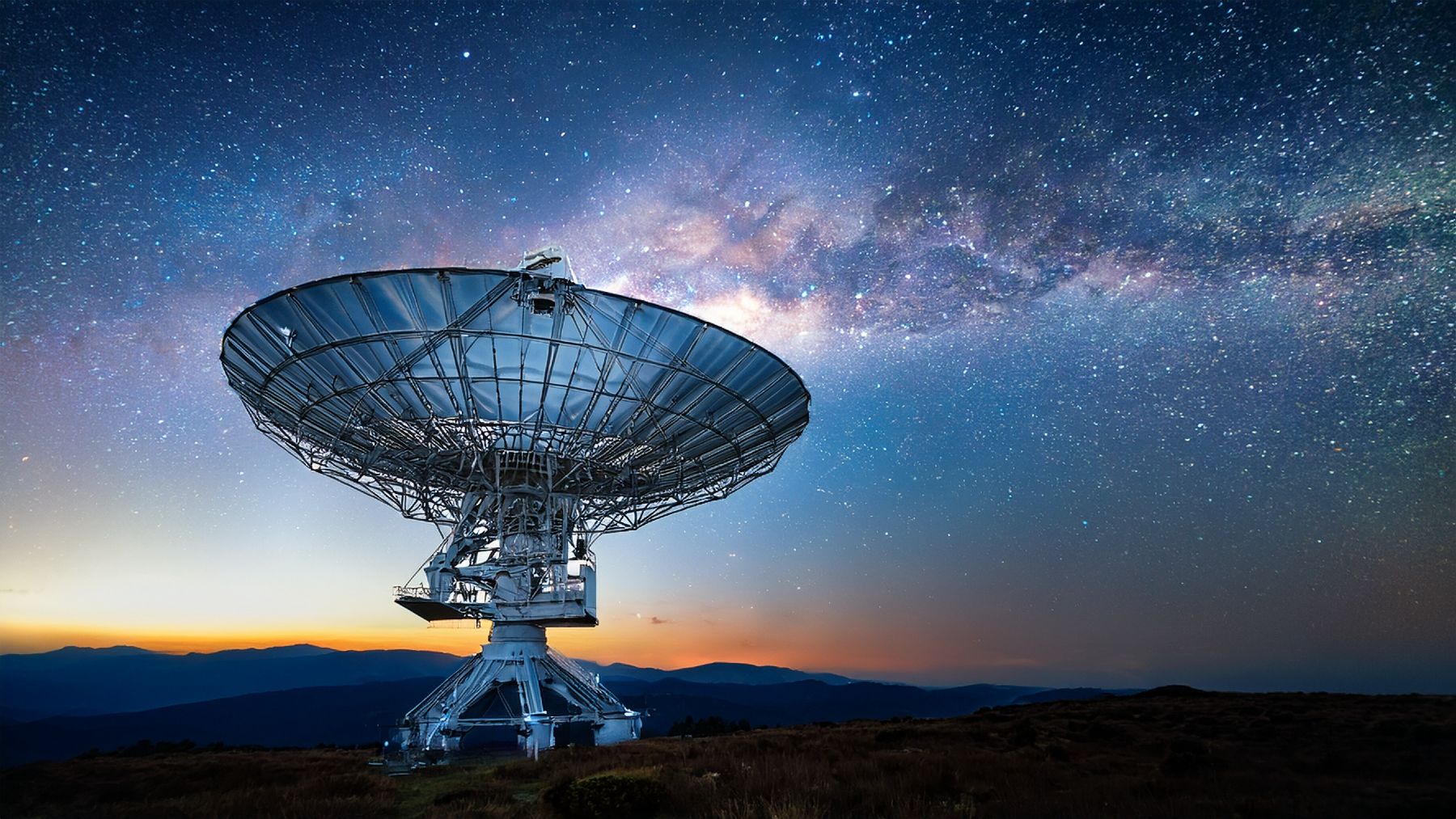
The Australian Square Kilometre Array Pathfinder telescope (ASKAP) has detected an unregistered satellite near Earth. At first, the Australian astronomers who discovered the signal were unable to identify it. It wasn’t until scientists from the Commonwealth Scientific and Industrial Research Organization (CSIRO) discovered the signal was closer than they expected. Clancy James, associate professor at the Curtin Institute of Radio Astronomy at Curtin University in Western Australia, told CNN how excited they were to think they had discovered an unknown object near Earth.
Relay 2 had already become space junk
NASA launched Relay 2, an experimental communications satellite, into orbit in 1964. It was an updated version of Relay 1, which had launched two years earlier and was used to relay signals between the United States and Europe, as well as to broadcast the 1964 Summer Olympics in Tokyo. Just three years later, with its mission over and its two main instruments out of service, Relay 2 had already become space junk. Since then, it has been orbiting our planet aimlessly.
These types of zombie satellites can be dangerous in that they can confuse researchers and astronomers. In the search for extraterrestrial signals, human-made space debris can send out deterrent signals, as it is clearly doing.
“These are incredibly powerful bursts of radio waves”
Normally, the team would look in the data for a type of signal called a “fast radio burst”—a flash of energy emanating from distant galaxies. “These are incredibly powerful bursts of radio waves lasting about a millisecond,” James said. “We don’t know what causes them, and we’re trying to figure that out, because they really defy known physics- they’re so bright. We’re also trying to use them to study the distribution of matter in the universe.”
The entire signal lasts about 30 nanoseconds, or 30 billionths of a second, but the main part lasts only about three nanoseconds, and that’s actually the limit of what our instrument can detect,” James said. “The signal was about 2,000 to 3,000 times brighter than all the other radio data our instrument detects; it was by far the brightest object in the sky, by a factor of thousands. The Australian astronomers sent a letter outlining what they had found so they could find the answer, which they eventually found.”
New source of false events for observations of astrophysical transients
The letter stated: “We report the detection of a burst of emission over a 695.5 MHz-1031.5 MHz bandwidth by the Australian Square Kilometer Array Pathfinder, ASKAP. The burst was localized through analysis of near-field time delays to the long-decommissioned Relay 2 satellite, and exhibited a dispersion measure of 2.26⋅10−5 pc cm−3 — 69.7 TECU, consistent with expectations for a single pass through the ionosphere”, and concludes: Our observation opens new possibilities for the remote sensing of ESD, which poses a serious threat to spacecraft, and reveals a new source of false events for observations of astrophysical transients.
The discovery has sparked speculation about the number of unregistered satellites currently orbiting Earth. In theory, all active satellites should be registered for safety and accountability reasons. However, this detection suggests otherwise.
“We may be mistaking more terrestrial signals for extraterrestrial ones than we realize,” Dr. O’Sullivan said. And as we’ve seen, this isn’t the first time astronomers have confused out-of-orbit signals with what we already know as ‘space junk.’