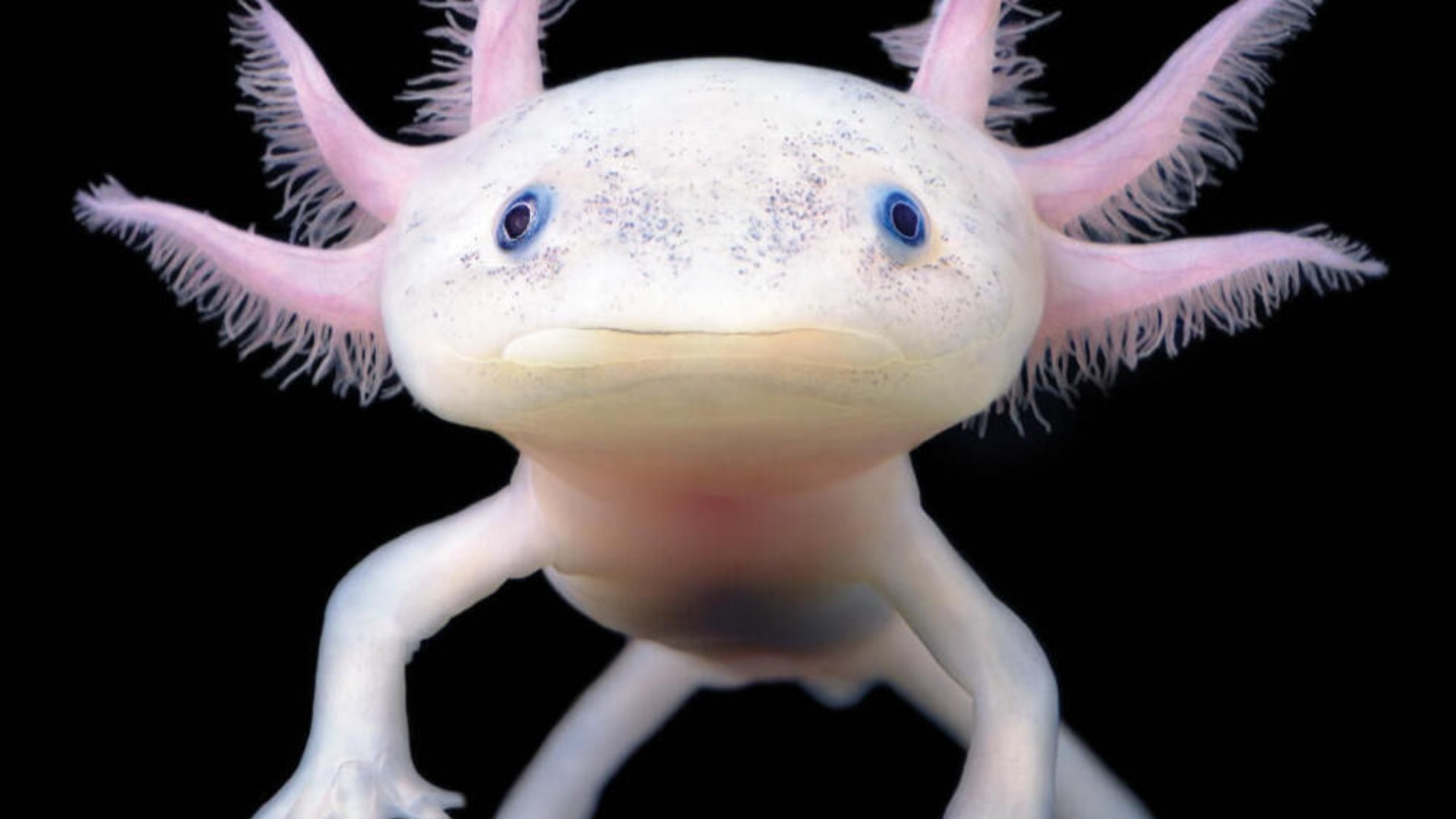
The Karolinska Institute at Uppsala University in Sweden has been working for years on regenerative medicine. An example is the study of the axolotls, or the studies they have carried out with the CD109 molecules. However, a huge step has been taken in regenerative biology through the study of Mexico’s endemic species, the axolotl. It is a marine species that has the ability of cellular regeneration. It has been studied from a biological point of view what is the process, and is that these beings are able to regenerate only the limb they have lost, thanks to the ability to replicate with embryonic cells. The next step is to study its similarity with human cells and try to replicate it in humans.
Axolotls
This is a species of amphibian native to Mexico, related to the tiger salamander. In recent years videos and photos of this species have gone viral. Characteristic for its colors, its smile and its fins that imitate the feathers. With a life expectancy of between 10 and 15 years, the Mayans called them the “monsters of the sea”. According to them, they avoided death. They feed mainly on small crustaceans, larvae, snails and some fish. They are oviparous and their eggs are usually 8 to 20 eggs.
Striking features of the axolotls
Despite their deceptive appearance, axolotls possess another feature that is much more striking to researchers. They have the ability to regenerate limbs identical to those he has lost, and regain it weeks later.The Northeastern University of Boston has published a study in Nature Communications. There are many unknowns posed by this feature, and virtually all have been resolved.
Locate the missing limb
One of the main questions is, how do axolotl´s cells know which limb they have lost? Thanks to retinoic acid. Widely used in creams for the skin, it is a molecule derived from vitamin A. It is responsible for identifying which part has to be regenerated, acting as a cellular GPS. But what exactly happens when an axolotl loses a limb? The wound is covered with a cellular mass called blasphemy. These cells have the ability to regenerate any part of the body, similar to embryonic ones. Depending on the area of the body, the presence of retinoic acid varies. This favors that if they lose a finger, the amount is smaller, and if they lose a limb from the shoulder, be able to regenerate the entire arm.
What about the bones?
As if this regenerative capacity was not enough, the researchers discovered the SHOX gene. It is related to the growth of long bones and is also present in the human body. To determine its exact function, the researchers eliminated with genetic editing. It could be observed that the axolots continued to regenerate their limbs, but with much shorter sizes (as happens with humans who have abnormalities in this gene).
Can humans regenerate our limbs?
This was one of the premises that biologist James Monaghan, the study leader, wanted to answer. If we share genetic structure with the axolotls, why are we not able to regenerate? The difference between the two species is how the cells deal with a wound. The axolotls have “memory”, and their cells simply replicate what they knew how to do when they were embryos. However, in humans, the cells form scars and there ends their function.
With all this, the answer to the question is no. At least for now. The researchers’ next step is to study our body’s cellular processes, so they can find a way to activate that regenerative function that our cells seem to have forgotten or put to sleep.
Learn about other underwater species here!