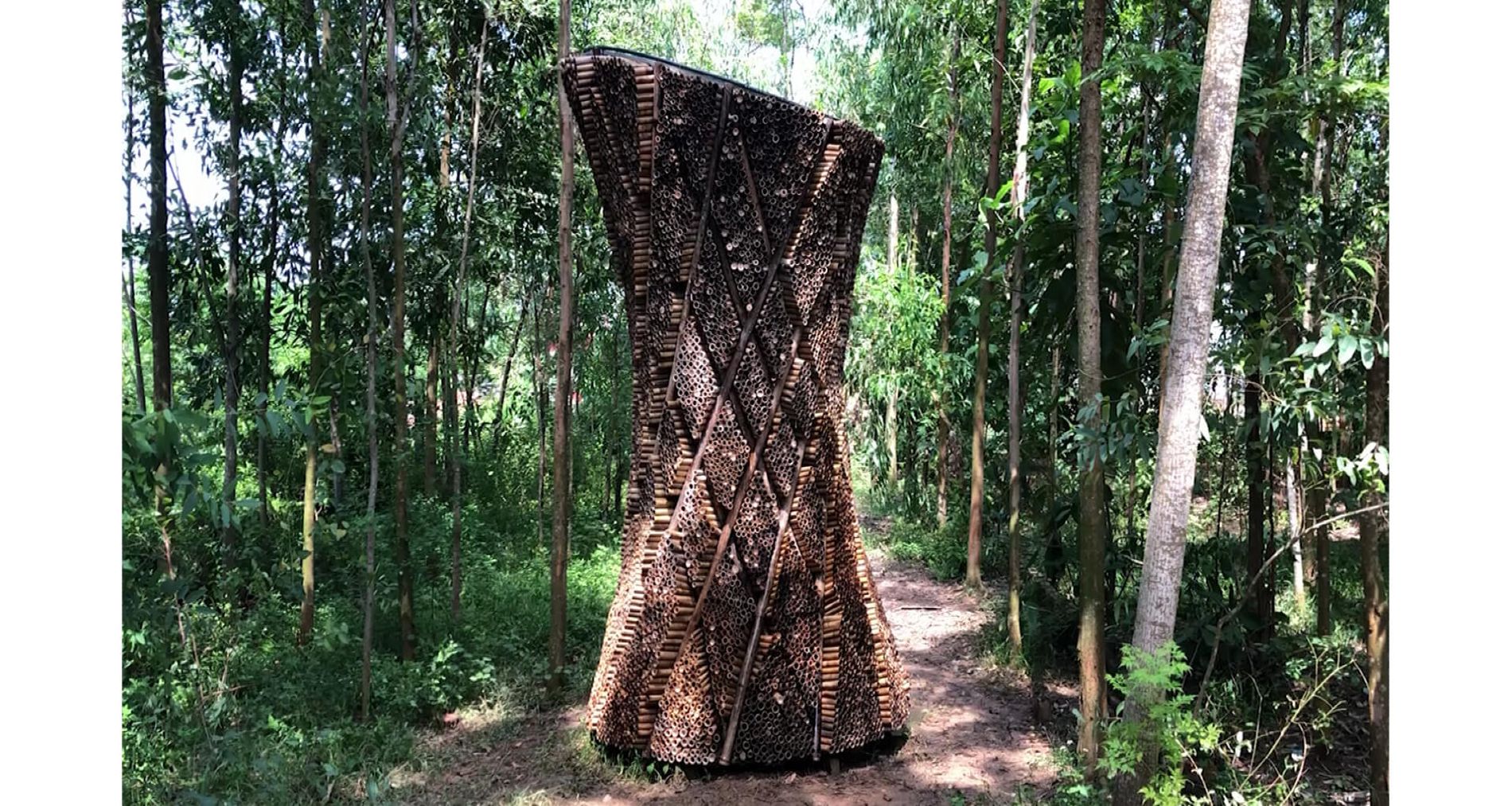
As we’ve discussed in previous articles, global warming is one of the main problems and concerns facing humanity today. For this reason, alternatives are emerging to address high temperatures. In this case, it’s bamboo. This tree can be used to create a tower so that when water evaporates, it absorbs heat from the circulating air and reduces the ambient temperature. This is how the AREP Tower (Architecture, Research, Engagement, Post-Carbon) is designed.
Water flows by gravity through a system of channels and comes into contact with the hot outside air
The adiabatic cooling tower combines an ancient technique with a modern design, like the tower designed by the French AREP Group. This tower is built with bamboo, a material we associate with Asian forests, but which is also natural, abundant in the region, fast-growing, lightweight, and durable.
In the case of the bamboo tower, water flows by gravity through a system of channels and comes into contact with the hot outside air, which, when transformed into steam, naturally reduces its temperature. According to AREP tests, this tower can reduce the ambient temperature by up to 6°C. This means that the closer a person gets to this adiabatic cooling tower, the cooler the air feels. An ingenious structure made of bamboo that has a hyperboloid shape for greater structural stability.
It’s a process that doesn’t require gas or electricity
This adiabatic process we’re referring to involves a system in which no heat is exchanged; that is, there is no heat transfer either into or out of the system. Hence the novelty of the process, which is combined with bamboo branches.
The advantages of this process go directly into the consumer’s pocket. It’s a process that doesn’t require gas or electricity. Therefore, the idea of having a rudimentary “air conditioner” that doesn’t use energy and still works is very appealing. Furthermore, since it doesn’t depend directly on energy, it makes us think about the carbon footprint. In this case, it would be zero.
A process which automatically generates a natural cooling by 6 degrees when one is nearby
Adiabatic cooling only requires hot air and water. It relies on a simple premise: when water evaporates, it uses energy. This energy is “absorbed” by the heat of the ambient air, a process which automatically generates a natural cooling by 6 degrees when one is nearby. All that was left to do was to imagine a functional and inexpensive system using a minimum of resources for a maximum of freshness. To achieve this, AREP combined cutting-edge digital tools with local craftsmanship in an innovative way, says the official statement of AREP.
Furthermore, this tower’s maintenance is simple and inexpensive. Because it’s built with local materials and without complex technology, it can be repaired and maintained by the community using traditional methods. This idea is currently being tested in Vietnam and was specifically designed to respond to the increasingly frequent heat waves in urban areas.
The element: inexpensive, lightweight, robust, fast-growing, and minimally processed
In this case, the choice of bamboo as a material is explained by the fact that it is a natural element found in Vietnam, inexpensive, lightweight, robust, fast-growing, and minimally processed. In summer, these areas could be cooled using this system, which, by using only water and hot air, in addition to the aforementioned advantages, is a completely silent system.
We await the evolution of this ingenious idea. On the one hand, it can be seen as a long-term solution that can make life easier, especially in rural areas with limited access to air conditioning. On the other hand, the environmental impact of using bamboo branches must be calculated, especially if the idea is to implement this in other countries. Bamboo in Vietnam is considered a natural and zero-mile product, but if an attempt is made to implement it in Europe or the United States, these requirements are no longer met.