
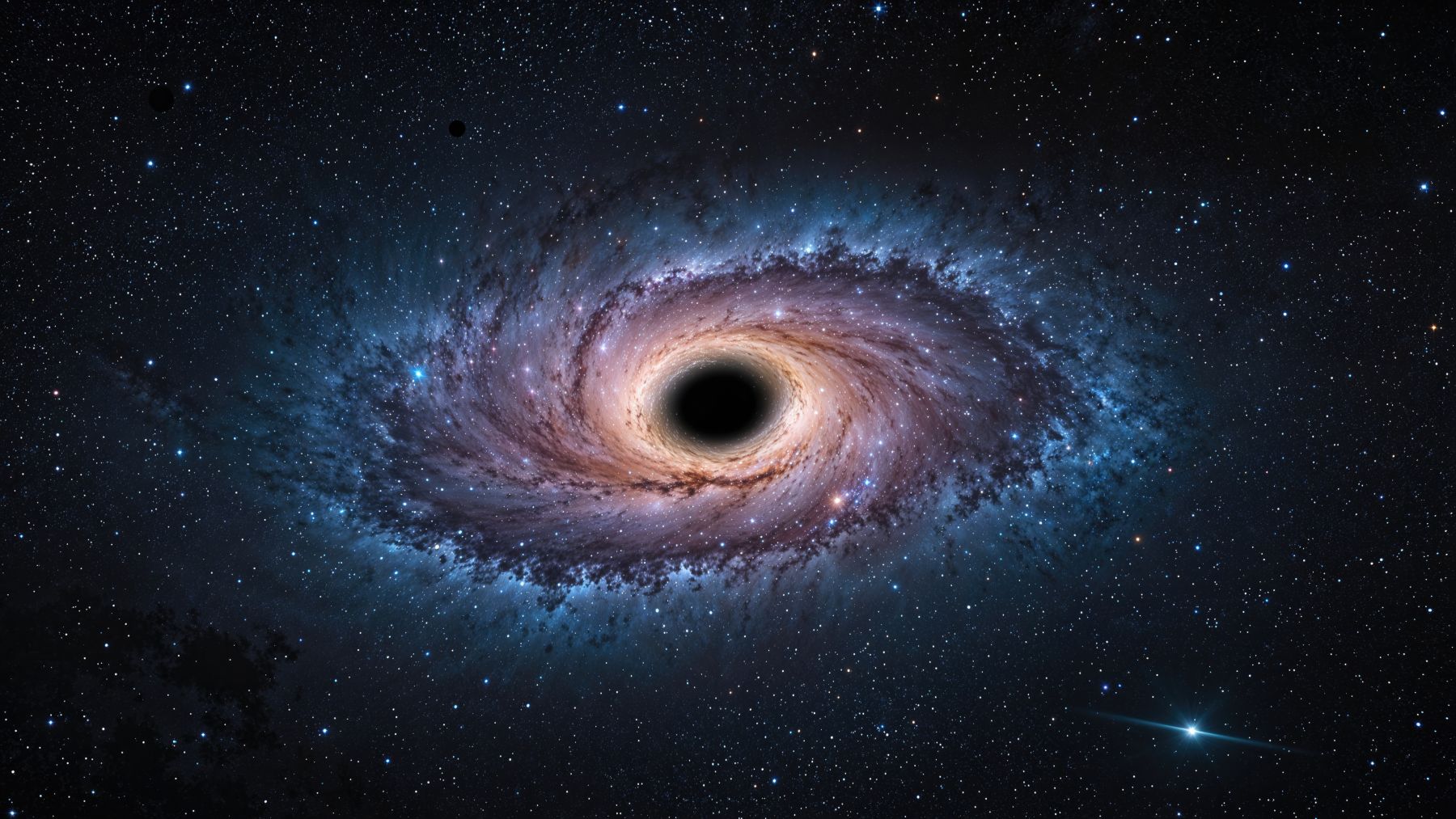
Scientific discoveries continue to amaze not only experts but also amateur astronomers. A study published in the journal Nature Astronomy has detected the most energetic and brightest flash ever observed from a supermassive black hole, caused when this cosmic colossus tore apart and devoured a giant star that ventured too close. According to the study, the black hole responsible has a mass of about 300 million suns and is located in a galaxy approximately 10 billion light-years from Earth.
Matthew Graham: “This is truly a once-in-a-million event”
According to current data, the flare from the black hole, as the phenomenon is known, is believed to be the largest and most distant ever recorded. “This is truly a once-in-a-million event,” said Matthew Graham, a research professor of astronomy at the California Institute of Technology and lead author of the study. The phenomenon, first detected in 2018 by a camera at the Palomar Observatory in California, shone with an intensity 10 trillion times greater than that of the Sun, and its brightness has been slowly diminishing ever since.
The enormous black hole and its surrounding disk have an estimated mass of 500 million times that of the Sun
The fact is that part of the intensity stemmed from the colossal size of both cosmic objects involved. According to researchers, the destroyed star had between 30 and 200 times the mass of the Sun, a cosmic rarity both for its size and its short lifespan. The enormous black hole and its surrounding disk have an estimated mass of 500 million times that of the Sun. “It’s reasonable to think that (the star) collided with another, more massive body in its original orbit, which essentially pushed it toward the black hole… too far, as was later shown,” stated Matthew Graham.
The flare was first detected in 2018 during an extensive sky survey using three ground-based telescopes. At the time, it was recorded as a particularly bright object, but after a few months, scientists were unable to glean much useful information. Since their discovery more than 60 years ago, accreting supermassive black holes in active galactic nuclei (AGN) have been recognized as highly variable sources, requiring an extremely compact and dynamic environment. Their variability is linked to various phenomena, such as changes in accretion rates, temperature variations, foreground absorbers, and structural changes in the accretion disk. Driven by a new generation of time-domain studies, the extremes of black hole variability are currently being explored, as explained in the publication, which details what a black hole is and how it can behave.
This phenomenon, this flash from the black hole, was practically forgotten until 2023
The phenomenon was observed thanks to scientists using telescopes in California, Arizona, and Hawaii, which allowed them to rule out other explanations such as supernovae, jets of material, or gravitational lensing effects. “At first, we really didn’t believe the numbers about the energy,” admitted Matthew Graham. The discovery also allows researchers to “examine the interaction of supermassive black holes with their environment in the early universe,” as explained by Joseph Michail of the Harvard-Smithsonian Center for Astrophysics. The fact is that this phenomenon, this flash from the black hole, was practically forgotten until 2023. That’s when astronomers roughly calculated the distance to the particularly bright object they had observed, and the result left them perplexed.
The fact is that thanks to these observations, “we now know that (the black hole) is a much more dynamic environment and that we are only just beginning to scratch the surface,” says Graham, highlighting the importance of continuing to investigate because clearly, what we thought we knew in one way may not be so at all and may instead become a tremendously changing phenomenon, as is the case.




