
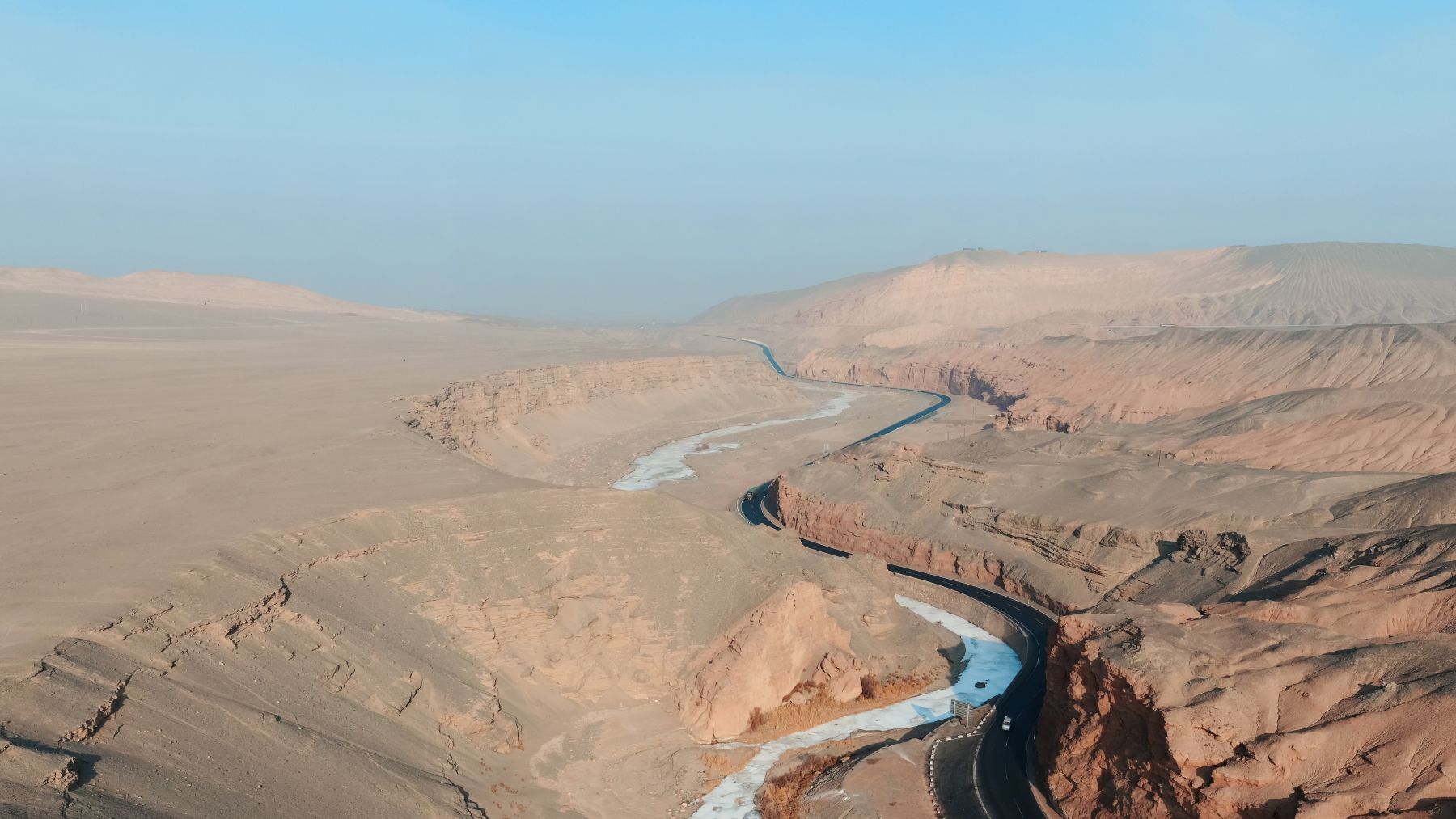
Clean energy is a reality for countries around the world. Some can afford to invest more in solar panels than others, but China is one of those countries that can. The Taklamakan Desert, in the Xinjiang Uyghur Autonomous Region, is the second largest shifting sand dune desert in the world. It is there that the Chinese government plans to install a solar energy field with the goal of developing renewable energy and revitalizing the country’s regions.
“At the time, 99% of the people I consulted were skeptical: ‘There’s no water in the desert, so how can you raise shellfish there?”
The Chinese government’s program aims to combat desertification with solar panels. As ambitious as this plan may seem, significant concerns have been raised about the resources and priorities of the parties involved in this integration. “At the time, 99% of the people I consulted were skeptical: ‘There’s no water in the desert, so how can you raise shellfish there?’ I did a test and found the salinity was 8 per 1,000. I was thrilled: we had found a treasure,” said Gong Yonghong, president of Qiemo County Shishi Fresh Aquatic Products Company.
Desertification is a major concern for China: It is estimated that desert covers 20% of its land surface
Speaking of data, the technique relies on local brackish groundwater and microbial formulations that make it possible to breed marine species. Using naturally salty groundwater to mimic the sea, local farms raise marine life in the middle of the desert. The problem of desertification remains a major concern for the Chinese government. It is estimated that desert covers 20% of its land surface. Today, from pearls and seafood to mega solar projects, this “sea of death” has become the engine of a new economy.
The desert-like environment has caused serious consequences for the country’s citizens
“We take saline groundwater and, using our microbial formulations, transform it into modern seawater. That’s it,” Gong Yonghong added. The desert-like environment has caused serious consequences for the country’s citizens, including severe sandstorms, strong winds, poor infrastructure, and the main cause of poverty in the country.
The farm expects to increase jobs, income, and even exports, proving that the desert can be more than just sand
All of the problems we’ve mentioned have led Chinese government officials to consider viable initiatives to address them. One of these is the Photovoltaic Desertification Control Plan. With expansion plans, the farm expects to increase jobs, income, and even exports, proving that the desert can be more than just sand. Now, it’s a five-year plan that runs from 2025 to 2030. “Our pearl oysters start out smaller than grains of sand, literally from fertilized eggs. If we raise them for cultured pearls, we implant the nucleus and, eight or nine months later, we open the shells to harvest,” Gong Yonghong emphasized.
“The project covers 7,600 hectares and has an installed capacity of 4 gigawatts”
In Ruoqiang County, the sands are becoming a renewable energy powerhouse. “The project covers 7,600 hectares and has an installed capacity of 4 gigawatts. It is currently the largest single-site solar plant in the world,” said Shen Jinxing, Ruoqiang Regional Operations and Maintenance Center of CGDG Xinjiang Zhonglv Electric Technology. The new plan therefore aims to install a massive 253 GW of solar power capacity and revitalize more than 670,000 hectares of land destroyed by deserts in the Northern Hemisphere.
Xinjiang is consolidating its position as a clean energy hub
So, this could mark the beginning of a major change. However, all parties must ensure a positive solution to the current problems. Xinjiang is consolidating its position as a clean energy hub, with solar and wind projects already reducing coal use and powering millions of homes.




