
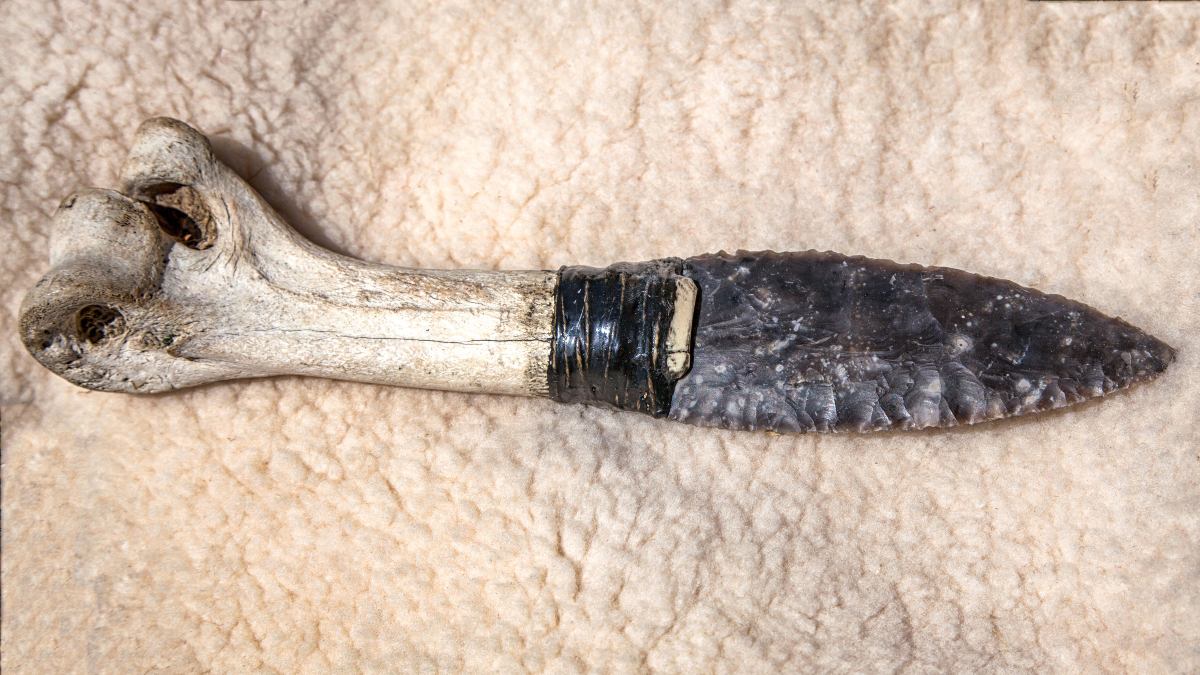
The surprising discovery in Africa that alters our understanding of prehistory reveals that the first blades manufactured by humans were not made of stone. Our ancestors manufactured bone knives 1.5 million years ago, which is significantly earlier than previously believed, according to a discovery unearthed in Tanzania. A surprising find in Tanzania has forced archaeologists to rewrite the history of human technology. A team from the Consejo Superior de Investigaciones Científicas (CSIC) has discovered in the Olduvai Gorge in East Africa that early hominins made bone knives 1.5 million years ago. Before this discovery, published in the journal Nature, it was believed that the systematic production of bone tools did not begin until a million years later.
It seems that mankind’s first knives in Africa were not made of stone as we thought
This discovery not only demonstrates our ancestors’ technological ingenuity but also a newly undiscovered capacity for experimentation and adaptation. This collection of bones was discovered in Tanzania’s fabled Olduvai Gorge, a crucial location in the evolution of humans. This area has long produced fossils and artifacts that have allowed for the reconstruction of the early hominins’ way of life. However, until recently, scholars believed that stone carving was the primary source of these communities’ technological advancement. Between 2015 and 2022, the excavation site—known as the T69 Complex—was the subject of multiple archaeological campaigns in Africa.
There, researchers have discovered 27 bone tools, the majority of which are fashioned from the bones of elephants and hippopotamuses. The carving markings on these tools resemble those found on lithic tools, indicating that hominins utilized the same method they had perfected for stone on bones. Most surprisingly, many of these instruments were carefully designed rather than being mere sharp fragments. While some are reminiscent of the distinctive hand axes of the Acheulean industry, others feature a notch at the end, most likely to improve their grip. Previously believed to have emerged considerably later in human development, this discovery suggests a sophisticated understanding of bone shattering and a purposeful process in tool production.
Indeed, examination reveals that these implements were fashioned using carving methods akin to those employed in the production of stone tools, suggesting that hominins employed the same process to manipulate other materials. The sharp edges and wear indicators of several of these instruments make them suitable for use as cutting blades. The discovery implies that in addition to using lithic tools to remove meat from animal corpses, hominins also processed meat and accessed resources like bone marrow using bone tools. An important shift in early humans’ technical advancement can be seen in this activity.
An unanticipated technological and cognitive advance in Africa
This recent finding in Africa is much more significant than the discovery of prehistoric tools. It suggests that 1.5 million years ago, hominins were already investigating novel materials for toolmaking, marking a significant turning point in the development of human intellect. Archaeology had already recorded the occasional usage of bones in considerably more modern sites. The Early Acheulean appearance of bone tools indicates that hominins were experimenting with various materials far earlier than previously believed. According to experts who discovered it in Africa, the capacity to apply an established technology—like lithic carving—to a novel material—like bone—is proof of abstract planning and thought. The development of human intelligence may have been significantly influenced by this degree of technological innovation.
Additionally, this discovery alters our understanding of how early hominins interacted with their surroundings. There has long been a belief that animals are exclusively considered competitors or prey. But the production of bone tools indicates that they were also seen as a source of technological resources, indicating a more nuanced interaction with the environment than was previously thought.




