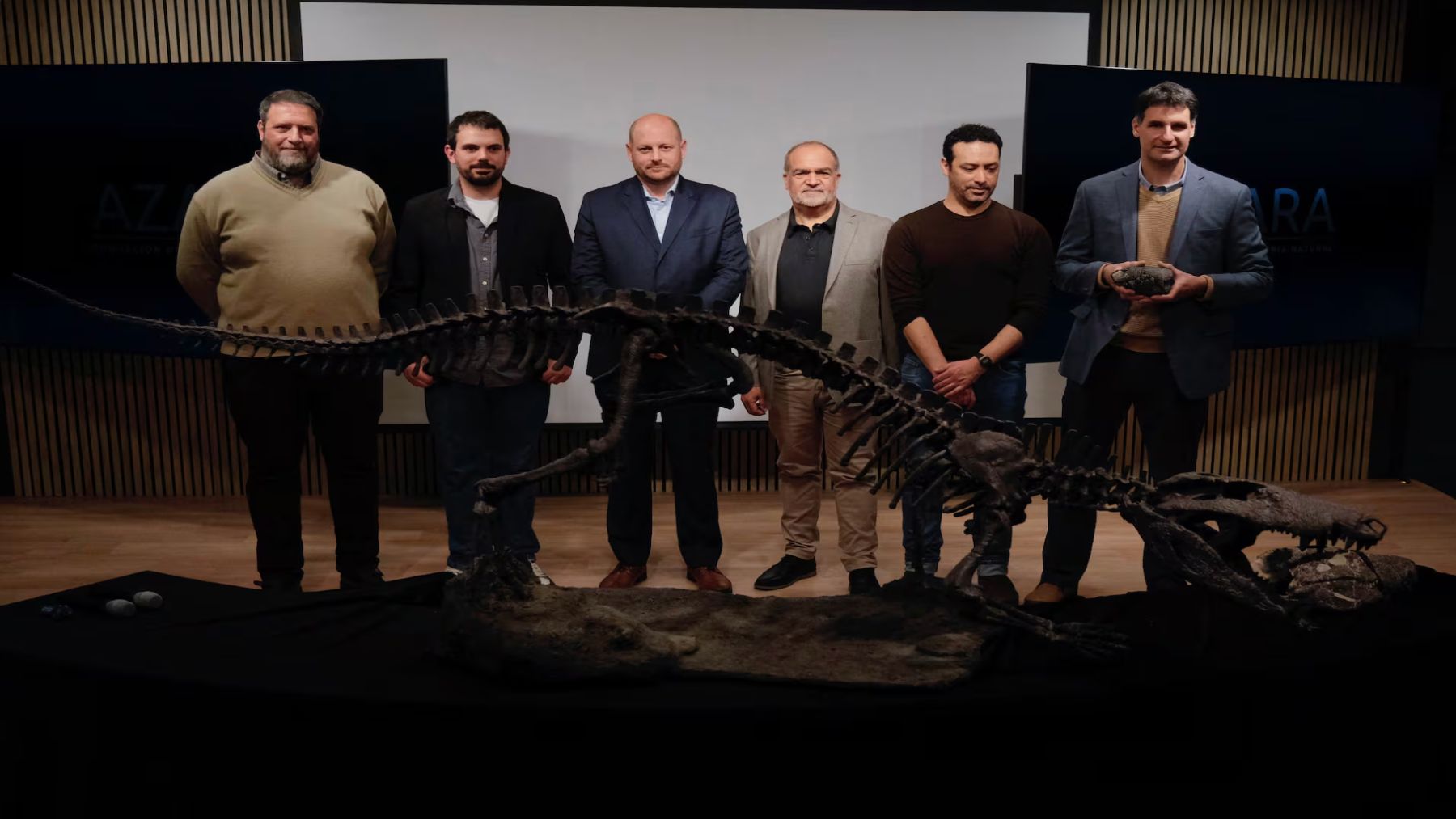
The discoveries scientists are making are shedding light on certain nuances of Earth’s history that are very illuminating. This is especially true for understanding the ancestors of animals that have lived millions of years and whose ancestors are still being found. This is what happened with Kostensuchus atrox, a peirosaurid crocodile, an extinct group of reptiles related to modern crocodiles and alligators. This specimen was unearthed near El Calafate in the Argentine province of Santa Cruz, in Patagonia.
When dinosaurs were the largest and most powerful animals, a relative of modern crocodiles was surprising with its presence
With this, paleontologists recently presented their latest discovery in the Chorrillo Formation. Seventy million years ago, when dinosaurs were the largest and most powerful animals in what is now Argentine Patagonia, a relative of modern crocodiles was surprising with its presence on riverbanks and plains. For the first time, researchers found fossils of a peirosaurid, a terrestrial crocodyliform.
It was a predator measuring nearly four meters and possessing a wide jaw and conical teeth
This is the most important discovery to date and demonstrates that this extinct ancestor of crocodiles likely survived until the end of the dinosaurs. It was a predator measuring nearly four meters and possessing a wide jaw and conical teeth capable of catching large prey.
The fossil has been described as “extraordinary” due to the integrity of the unearthed skeleton
To name it, scientists working at institutions in Argentina, Brazil, and Japan, led by paleontologist Fernando Novas, a Conicet scientist at the Félix de Azara Natural History Foundation, were the ones who discovered the fossil remains of this extinct relative of crocodiles. The fossil has been described as “extraordinary” due to the integrity of the unearthed skeleton, as finding it in such “good” condition tremendously facilitates research and understanding how this creature behaved practically during the time of the dinosaurs. It also provides a unique opportunity to compare its characteristics with those of other crocodyliforms to map how they evolved and spread throughout the world.
‘Kosten’, in the Aonikenk language, refers to the Patagonian wind
It was a “hypercarnivore.” Until then, the largest known predators in the area were carnivorous dinosaurs, but this extinct relative of crocodiles represents a new protagonist. As for the name, ‘Kosten’, in the Aonikenk language, refers to the Patagonian wind; and suchus, Latinized from the Greek souchos, refers to the crocodile-headed Egyptian god (Sebek). The specific epithet atrox means tough in Greek,” explained the team of researchers from the Argentine Museum of Natural Sciences in an article published in PLOS One.
Reveal: Kostensuchus atrox was a formidable creature measuring 3.5 meters and weighing 250 kilograms
Paleontologists recovered the complete skull, as well as significant sections of the skeleton. The study redefines the view of the Cretaceous Patagonian ecosystem and reveals a more complex interaction between different groups of large predators. They reveal that Kostensuchus atrox was a formidable creature measuring 3.5 meters and weighing 250 kilograms.
Using its muscular build and powerful jaws with blade-like ziphodont teeth, it would hunt medium-sized dinosaurs
Unlike modern-day crocodiles, this ancestor was more of a terrestrial creature, stalking prey across the floodplains that covered the late Cretaceous Patagonia. Kostensuchus atrox shares ancestors with modern-day crocodiles, but belongs to an extinct lineage that coexisted and competed with dinosaurs for dominance in aquatic and terrestrial environments. Using its muscular build and powerful jaws with blade-like ziphodont teeth, it would hunt medium-sized dinosaurs, scientists theorize. So, while we await the latest results, for now the discovery is revealing.