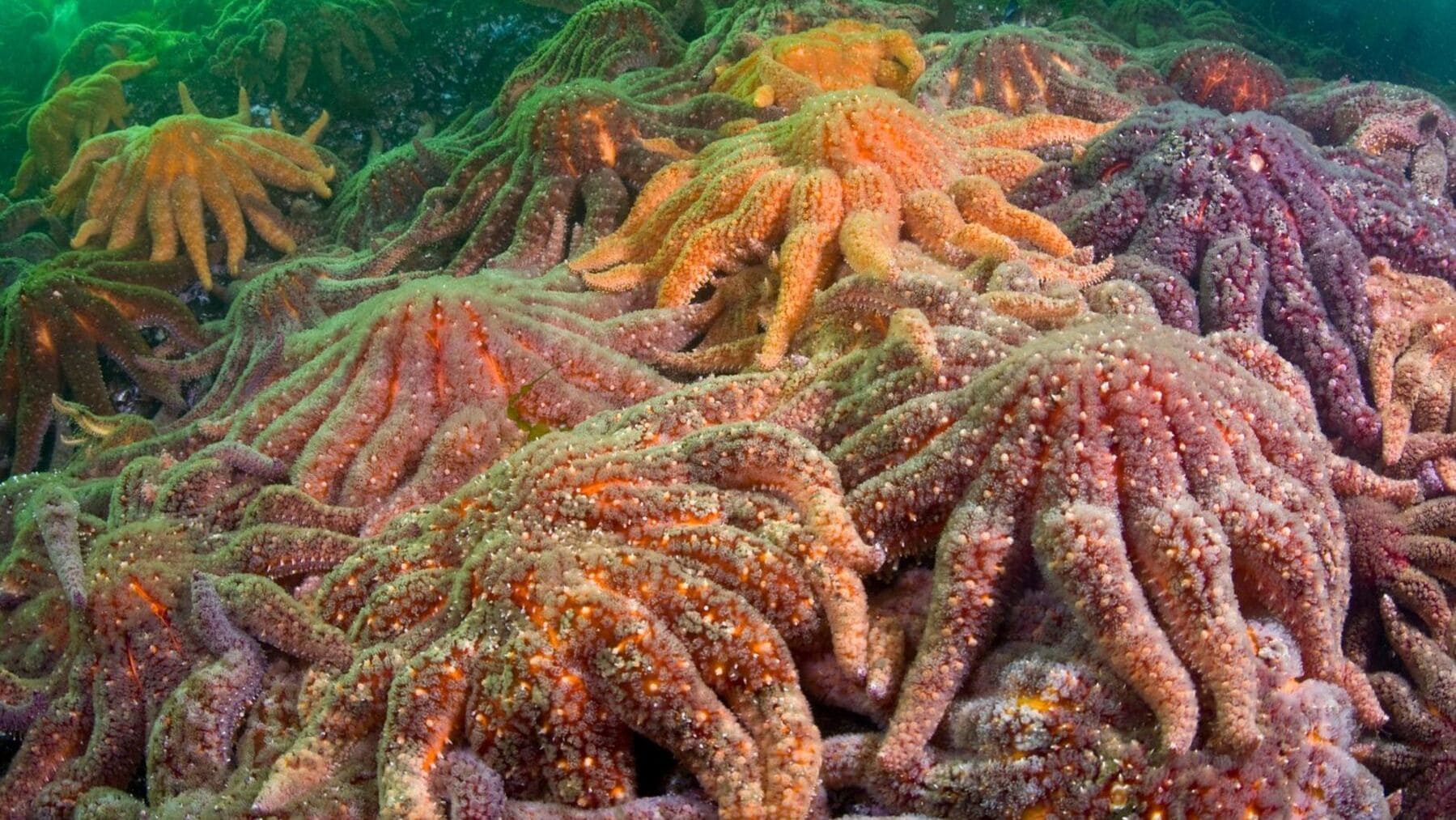
California and British Columbia are notable for their marine ecosystems and the research carried out in their waters. In one of its recent studies, the Hakai Institute identified Vibrio pectenicida, a bacterium that causes sea star wasting disease, which also affects starfish. Among starfish, the most affected species is Pycnopodia helianthoides, also known as the sunflower starfish. This bacterium, found in the coelomic fluid of some species, has posed a problem for the balance of marine ecology and kelp forests. Read on to learn more about this discovery.
Researchers believe they solved the mystery behind a devastating epidemic
In a major scientific breakthrough reported on August 4, 2025, investigators thought they have finally got the solution the mystery under a devastating epidemic that wiped out more than 5 billion sea stars along the Pacific coast of North America—from Mexico up to Alaska.
The decade‑long die-off struck hardest between 2013 and 2015, has affected over 20 species. Among the victims was the sunflower sea star (Pycnopodia helianthoides), which saw up to 90% population loss in its first five years of decline.
Not a virus, but a bacterium
The culprit appeared not to be a virus, as once suspected, but a bacterium: Vibrio pectenicida, discovered at the interior of the animals. This disease, named as sea star wasting syndrome, manifests with white lesions, swelling, limb detachment, and ultimately tissue decay. Victims can disintegrate into a mushy blob in mere days. As marine disease ecologist Alyssa Gehman explained it, the affliction is “really quite gruesome,” with arms literally falling off.
The ecological fallout has been stric. With the loss of sea stars to prey on sea urchins, urchin numbers raised—causing almost 95% kelp forest decline in parts of Northern California. Since kelp forests are the “rainforests of the ocean,” supporting fish, sea otters, seals, and more, the collapse has rippled all along the ecosystem.
“It’s incredibly difficult to trace the source of so many environmental diseases”
Microbiologist Blake Ushijima of the University of North Carolina, Wilmington said that “it’s incredibly difficult to trace the source of so many environmental diseases, especially underwater,” adding that the findings were “really smart and significant.”
“They’ve done a great job. They deserve much credit for trying to interpret very complex data,” added Ian Hewson, a marine ecologist at Cornell University who was not involved with the work.
Scientists discover cause of massive sea star die-off: more details about the discover
Researchers said that a bacteria related to cholera was responsible for the deaths of more than 5 billion sea stars off the Pacific Coast of North America since 2013. The discovery, reported in the journal Nature Ecology and Evolution, appears to solve a mystery that baffled marine biologists for more than a decade.