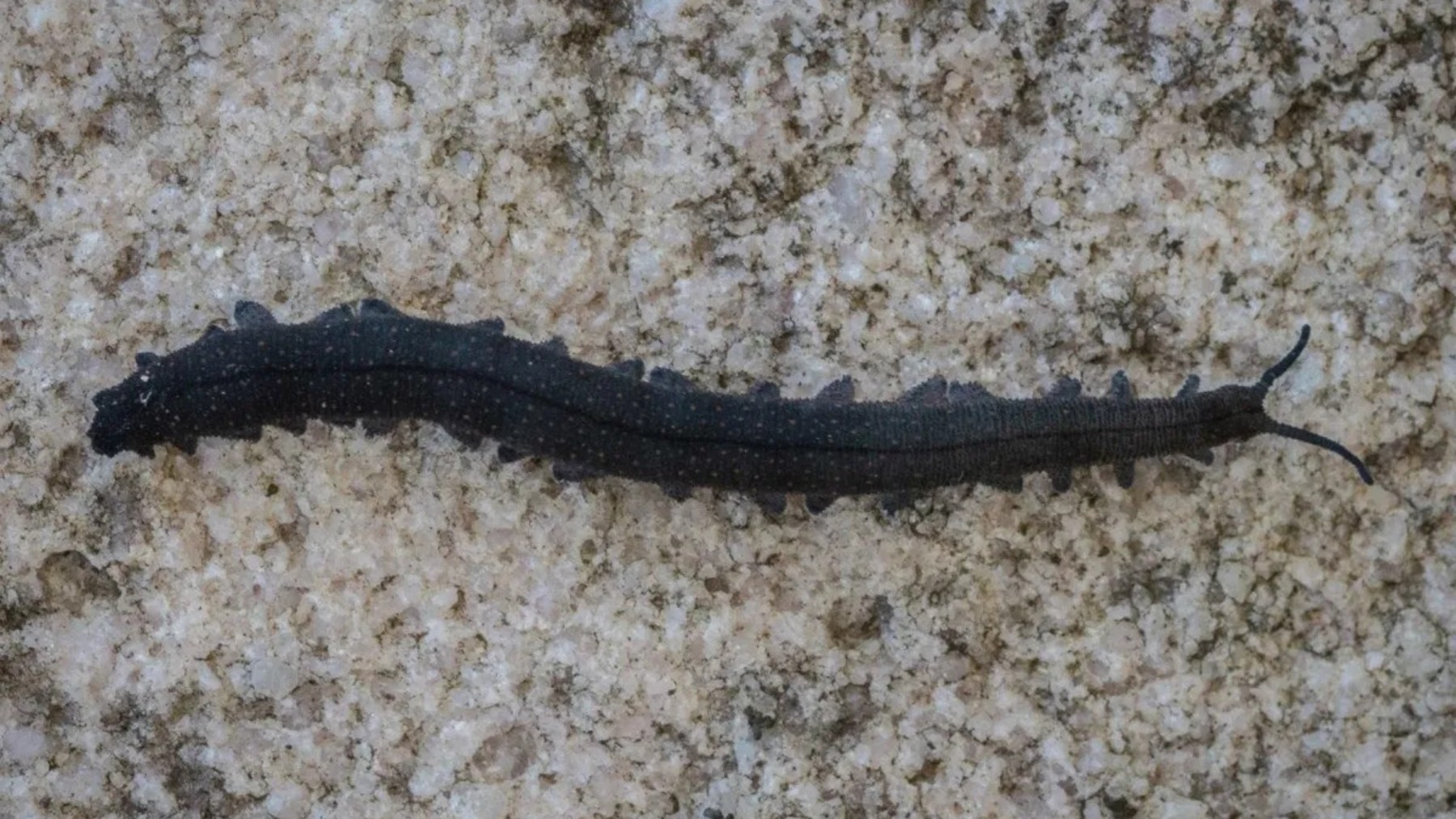
A new scientific discovery has taken place in South Africa, where a young student of Ecology and Entomology at the University of Stellenbosch found a fossil from the Cambrian era of burguess shale 500 million years ago. It is an unusual find in the world of Paleontology, since these are prehistoric creatures whose remains have survived almost intact over the years. It was found in an arid and high-temperature environment, which has surprised citizen science. There is much information that can be provided by the discovery of fossil extinct animals, both to continue discovering data on species that have passed through our planet, as well as biodiversity and existing ecosystems and their functioning.
Peripatopsis barnardi
Little Karoo is a semi-arid valley of approximately 217 miles, located in Southern Africa. It was there that last March 2022, Rohan Barnard, a 19-year-old student of Ecology and Entomology at the University of Stellenbosch, starred in the find. During his search for ants and reptiles, he found in an area of water stream and wet soil, an animal which was described as velvety, black, soft worm, with unarticulated legs and segmented body. Nothing that Rohan had not seen before, so he shared it on the social network iNaturalist, and it was ahi when the commotion began.
What was Peripatopsis barnardi doing there?
In honor of the young discoverer Rohan Barnard, the species found was named Peripaptosis barnardi. Up to that time, such worms had only been found in wet valleys of the Cape or Afro-temperate forest fragments. Nothing to do with the weather conditions of Little Karoo. Does all this change what was known so far about the ecological past of that South African region? The answer is yes.
The presence of a fossil of this species in the region of Karoo indicates that at some time, this area had a geological past much more wooded. Millions of years have passed and with them, climate changes that have affected the vegetation of the area, resulting in aridity that could have isolated the velvet worms in different areas. This is how the appearance of this new species is explained, although what is not yet understood is how it managed to survive such conditions.
How did this new species arise?
The onychophorus is a group of animals characterized by having a morphology that has not been modified for 500 million years. That is why they have been baptized as “living fossils”. They have no skeleton or articulated legs, and secreted a viscous liquid that served them in hunting. To this group it belongs, the found velvet worms. Both come from an animal called Hallucigenia, located in the Cambrian era.
15.2 million years ago, southern Africa suffered an intense climate change, witnessing the disappearance of rainfall by the Benguela Sea Current and the rise of the Cape Range. According to the researchers, it was then that Peripatopsis barnardi separated from its ancestor, when forest habitats fragmented, giving rise to this isolated species.
Why is this discovery so important?
It is a discovery that challenges the understanding of the region’s geological and biodiversity past. How could it have gone unnoticed for so long? Are there more species to discover? On the other hand, Peripatopsis barnardi collects testimony that once climate change had a direct impact on species of fauna and flora on our planet, and can help prevent major ills with current climate change.
After the discovery, Savel Daniels, an evolution expert at Stellenbosch University, traveled to the area to collect more specimens. With a sample of 10 individuals, a rigorous DNA analysis was carried out using mitochondrial and nuclear DNA sequencing techniques, along with morphological studies using scanning electron microscopy (SEM). This confirmed that it was a different species and six more were discovered! Rohan confessed, “It is amazing to realize that I have discovered a living fossil. It makes me think that there is still a lot to explore, but I also worry that we may lose species that we don’t even know exist”.
Find out that other creatures have been discovered lately!