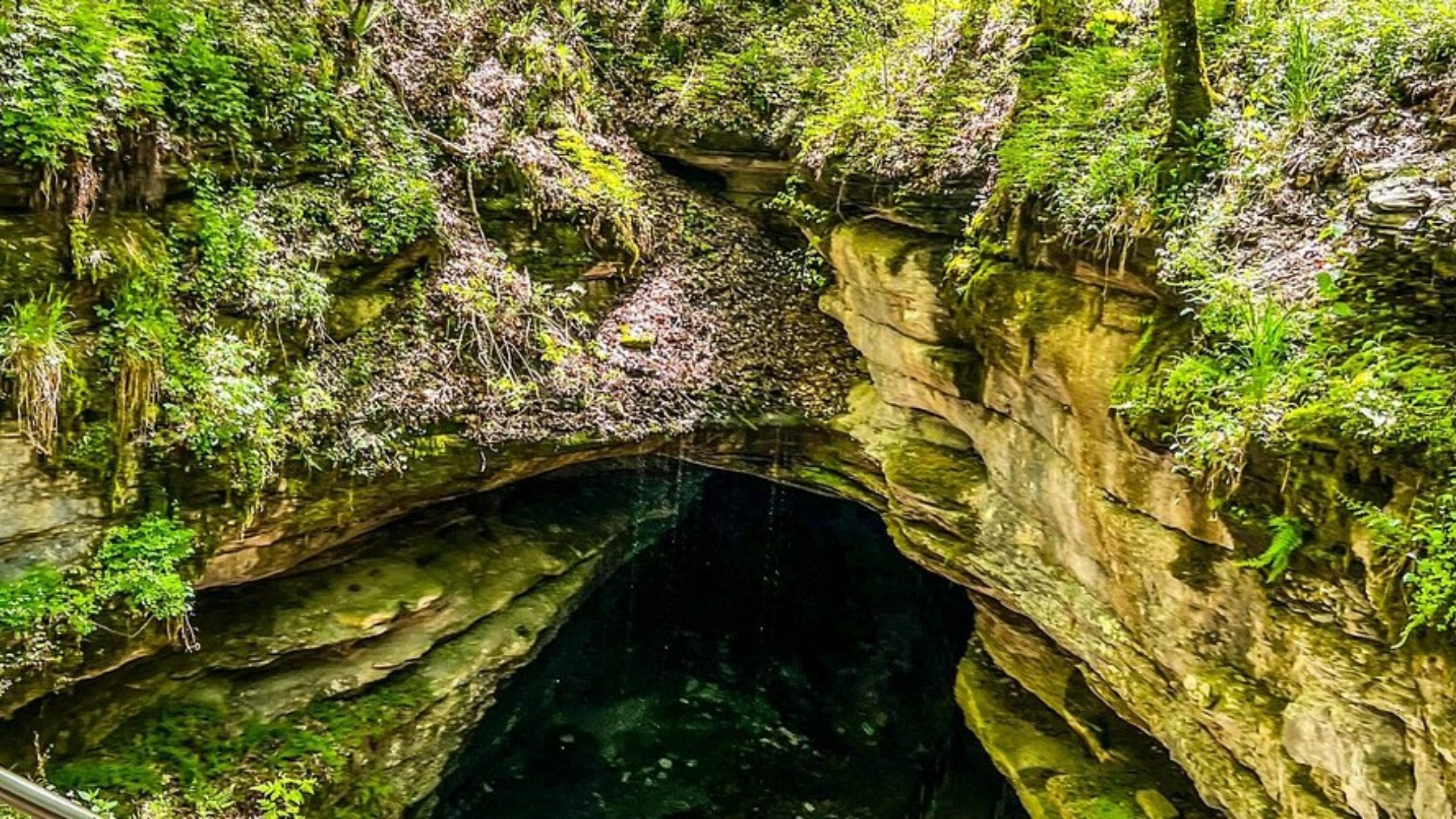
Mammoth Cave Mammoth Cave has been the scene where two extinct species of ctenacanth sharks. These species were easy to recognize by their numerous teeth, and also called the attention of their thorny spine and their 12 feet long. The seabed has been and will be a key player in scientific and archaeological discoveries. It is where shipwrecks and the remains of extinct species rest until they are found to tell us their story.
Mammoth Cave
According to its website, the Mammoth Cave is “the world’s longest known cave system […] is home of thousands of years of human history and a rich diversity of plant and animal life, earning it the title of UNESCO World Heritage Site and International Biosphere Region”. It currently offers guided tours to know the recesses of its caves, outdoor activities such as horse riding, hiking, canoeing on the lake, camping area among others. You can also look at the stars with or without a guide. Can you imagine how small you must feel under the huge starry sky of Kentucky?
New discoveries
This famous cave has housed multiple and different forms of animal and plant life throughout its history. Several investigations have found extinct specimens that once considered this cave their home. The latest findings from the latest excavations have revealed the remains of two shark species. Scientifically have been called Troglocladodus trimblei and Glikmanius careforum. In easier words, These are two predecessor shark species that today swim in our seabed.
Troglocladodus trimblei and Glikmanius careforum
The discovery of these extinct species is a great advance for paleontology, science and history. Their identification was favored by the characteristic teeth. With 10-12 feet long, another of its physical characteristics is that its spine resembles the tips of a comb. According to researchers, these shark species inhabited the waters of Kentucky and Alabama more than 325 million years ago.
Pangea
Does the Pangaea concept ring a bell? We would have to go back 335 million years ago, to the Paleozoic era, when there was a super continent that unified almost all regions of the planet. Some of the researchers stated this region was “an ancient seaway that connected what is now eastern North America, Europe, and northern Africa”. However, it disappeared with the formation of Pangaea.
The value of the discovery
The importance of maintaining and conserving natural areas is essential for several reasons. There are many natural sites on the planet that still host a very rich variety of native flora and fauna, which must be protected and safeguarded. In addition, they are also the cradle of many species already extinct, but whose discovery sheds light on the understanding, finding and study of the different ecosystems that existed and their impact today.
In the case of the Mammoth Cave, we are talking about a cave of more than 420 miles, full of passages and caves spread over different levels of depth. It is such the relevance of this place, that received the title of National Park in 1941, was declared World Heritage Site in 1981 bu UNESCO, and in 1990, recognized as a Biosphere Reserve.
This finding is a great step forward for the researchers, since they are faced with a new scenario, with different locations, physical and environmental characteristics. It is a very interesting challenge for the world of science to be able to fully immerse itself in these findings and to draw an increasingly clear line as regards the understanding of the marine ecosystems of then and their impact on those of today.
We must become aware of the importance of these places and not over-exploit them, giving their place to science, research and care, and less to selfishness that often ensnares the human being.
What other monstrous creatures have been found under the sea?