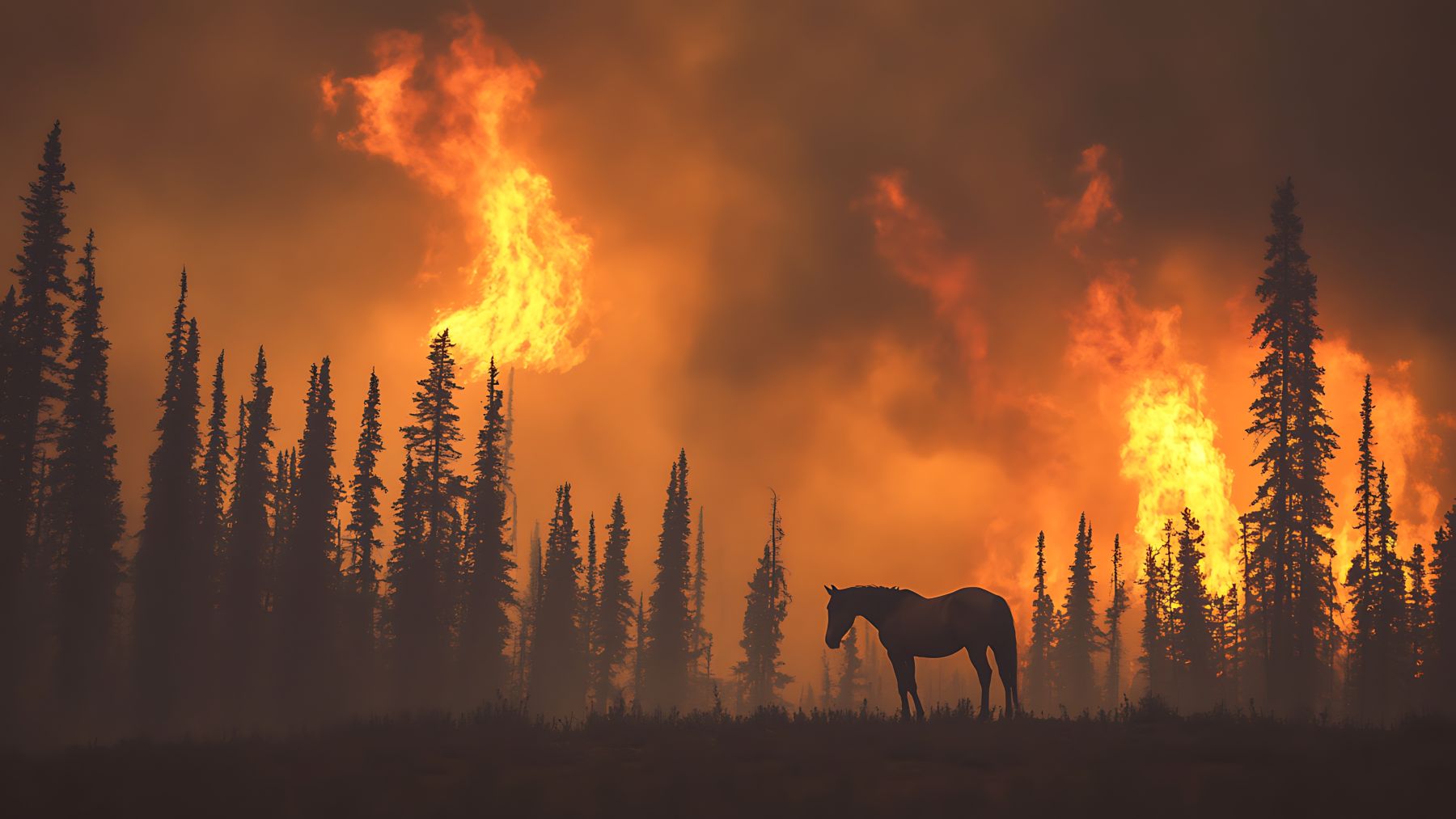
Fires in the Mediterranean are one of the main environmental problems in summer in Europe. According to scientists, horses have been shown to adjust their diet according to the landscape (i.e., the season) and could be key to preventing large forest fires in the Mediterranean. Although sheep and goats are commonly used, it has been discovered that horses can also help prevent the magnitude of forest fires.
The sample: Przewalski’s horses in controlled freedom in Boumort, a herd of Pottoka horses in Garraf Park, and a group of crossbred horses in another area
This study, published this year in Agroforestry Systems, led by Araceli Gort-Esteve and a group of researchers, compares three different scenarios in Catalonia: Przewalski’s horses in controlled freedom in Boumort, a herd of Pottoka horses in Garraf Park, and a group of crossbred horses in another area of the same park. The study focuses on the fact that when grazing, they not only consume dry grasses, but also reduce flammable shrubs and help maintain open spaces, key to limiting the spread of fires. Researchers from the Autonomous University of Barcelona, the University of Lleida, and organizations such as Boumort Wildland and the Miranda Foundation also collaborated on this research.
This study doesn’t promise the complete elimination of fires but they can be a great help in keeping forests healthier
Let’s remember that forest fires, if not started on purpose, develop due to the combination of high temperatures with dry grass, dense shrubs, and dead branches, which become extremely flammable, creating the spark that sparks the fires. Therefore, this study doesn’t promise the complete elimination of fires, but it does highlight dietary behaviors that, if well designed, could be integrated into prevention strategies.
Results: authors analyzed 50 fecal samples using microhistology and modeled dietary compositions using Dirichlet
One of the keys to horses’ habits lies in their ability to adapt. Observing what they eat, when they eat it, and how they change when grass is scarce is essential. The authors analyzed 50 fecal samples using microhistology and modeled dietary compositions using Dirichlet regression to obtain their results. Przewalski’s horses in Boumort (Catalan Pyrenees), for example, in near-wild conditions and at low density (one horse per 50 hectares), help maintain open meadows and reduce the continuity of dry grass, thereby limiting potential fire fronts.
The Garraf Natural Park (Barcelona) are a rustic and resilient breed that graze year-round in semi-freedom
On the other hand, the pottokas in the Garraf Natural Park (Barcelona) are a rustic and resilient breed that graze year-round in semi-freedom. They start with dry grasses and, when exhausted, incorporate woody shrubs such as rockrose, heather, and kermes oak. This behavior is key to containing areas with high fuel loads. As we can see, the results of the study have proven very direct in terms of what they eat and the effects of their diet on forests.
These horses consume everything from grass to shrubs and small trees
Finally, intensively grazed crossbred horses are kept in small spaces for short periods (6 weeks) at higher densities (one horse per hectare). Scientists have seen their rapid and visible impact. These horses consume everything from grass to shrubs and small trees, ideal for urgent interventions in areas at extreme risk.
The results, while not a clear and overwhelming solution, given that we’re talking about living beings interacting in living nature and what this entails, are encouraging. On the one hand, Przewalski’s can be used to maintain clearings; Pottoka’s for long-term management that links thin and then woody trees; and crosses for intensive “hits” where decompression is urgently needed. We’ll have to wait for the final results, which are expected to be a great help in keeping forests healthier for the season of higher temperatures.