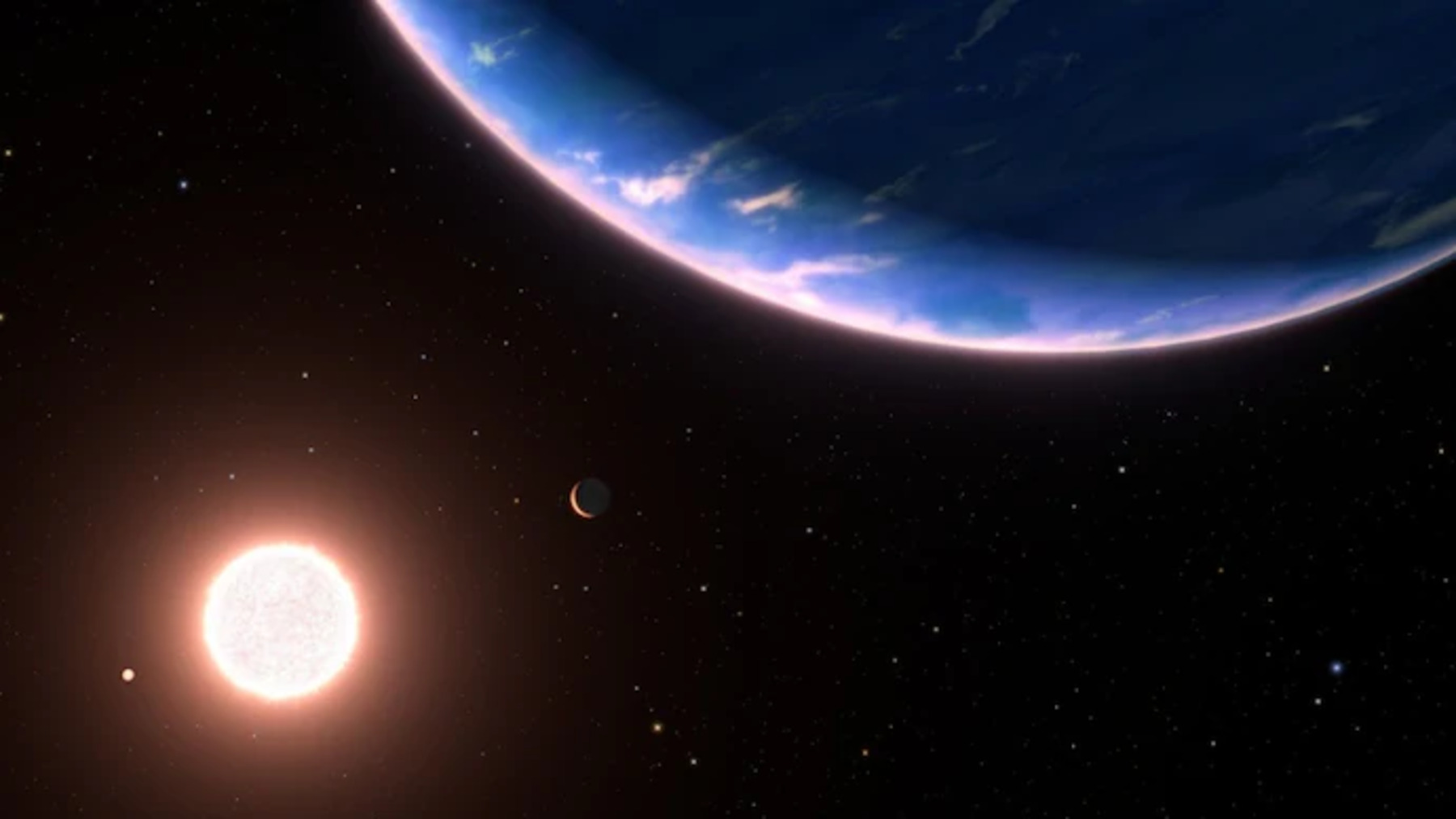
Confirmed by NASA—the Hubble telescope detects water vapor on the exoplanet GJ 9827d, a distant, scorching world that opens the door to understanding how Earth-like planets could form in the universe

August 31, 2025
The discovery that surprises NASA—a “quasi-moon” that has been orbiting Earth for 60 years—is 2025 PN7

NASA, thanks to the Hubble Space Telescope and the James Space Telescope, has detected the presence of water on exoplanets. The most recent case is GJ 9827d, located in the Pisces constellation. Researchers such as Björn Benneke, Laure Kreidberg, Io Crossfield, and Thomas Greene emphasize the significance of this discovery. We must also highlight the findings of K2-18b and TRAPPIST-1. Read on to learn more.

GJ 9827d: a steamy water-world

One such interesting achievement is the planet GJ 9827d. This exoplanet, no larger than twice the size of Earth, may contain a water-rich atmosphere. Nevertheless, with temperatures rising to 800 degrees Fahrenheit, like Venus, GJ 9827d is far from welcoming. It’s a world shrouded in steam rather than a potential home for life as we have in mind.

A recent observation by NASA’s Hubble Space Telescope marks a relevant discovery in exoplanet investigations. Hubble detected water vapor in the atmosphere of GJ 9827d, the smallest exoplanet where such a discovery has been made. This finding nudges us closer to recognize planets with environments akin to Earth.

“This would be the first time that we can directly show through an atmospheric detection, that these planets with water-rich atmospheres can actually exist around other stars,” said team member Björn Benneke of the Trottier Institute for Research on Exoplanets at Université de Montréal.

The reason of finding water on exoplanets is important

Laura Kreidberg of the Max Planck Institute for Astronomy in Heidelberg, Germany, explains with  enthusiasm that water on a planet this small is a landmark discovery. In addition, It pushes closer than ever to characterizing truly Earth-like worlds.

The Hubble observations, spearheaded by Ian Crossfield of Kansas University, motivated to not only discover atmospheric molecules but in specific to search for water vapor. Whether the detected water vapor is a dominant component or a minor component in a hydrogen-rich atmosphere, the finding is very important.

“Until now, we had not been able to directly detect the atmosphere of such a small planet. And we’re slowly getting in this regime now,” added Benneke.


Debating GJ 9827d’s atmospheric mysteries

Two principal theories emerge regarding GJ 9827d’s atmosphere. It could be a mini-Neptune, containing a hydrogen-rich atmosphere interspersed with water, or a larger version of Jupiter’s moon Europa, which harbors vast water preservs under its crust.

If the planet has kept a water-rich atmosphere, it probably formed farther from its star, where ice was abundant, before migrating to its current, warmer location. Alternatively, it may have its origin close to its hot star, with only traces of water in its atmosphere.

Future prospects: Beyond Hubble’s discoveries

The Hubble study implied monitoring the planet across 11 transits over three years. These transits, where the planet passed in front of its star, permitted Hubble to detect the spectral signature of water molecules in the atmosphere. In essential, any clouds on the planet are low enough not to obstruct Hubble’s view, helping the detection of water vapor up them.

Thomas Greene, astrophysicist at NASA’s Ames Research Center in California’s Silicon Valley explained that observing water is a gateway to finding other things.

GJ 9827d in the exoplanet pantheon

Originally founded by NASA’s Kepler Space Telescope in 2017, GJ 9827d orbits a red dwarf star, GJ 9827, whose location is 97 light-years away in the constellation Pisces, completing an orbit every 6.2 days.

This distant world, at the same time not a candidate for life as we have in mind, provides invaluable information into the diversity and nature of exoplanetary atmospheres, inching us closer to get to knoe the complexities of our universe.

As a result, the discovery of water vapor on the exoplanet GJ 9827d by NASA’s Hubble is a huge step forward in our understanding of the universe.

While the harsh, steamy conditions on this planet make it hard to life as we conceive it, this finding is a new way in the study of exoplanetary atmospheres. It tests and expands our knowledge of where and how planets with water-rich environments can exist.


