
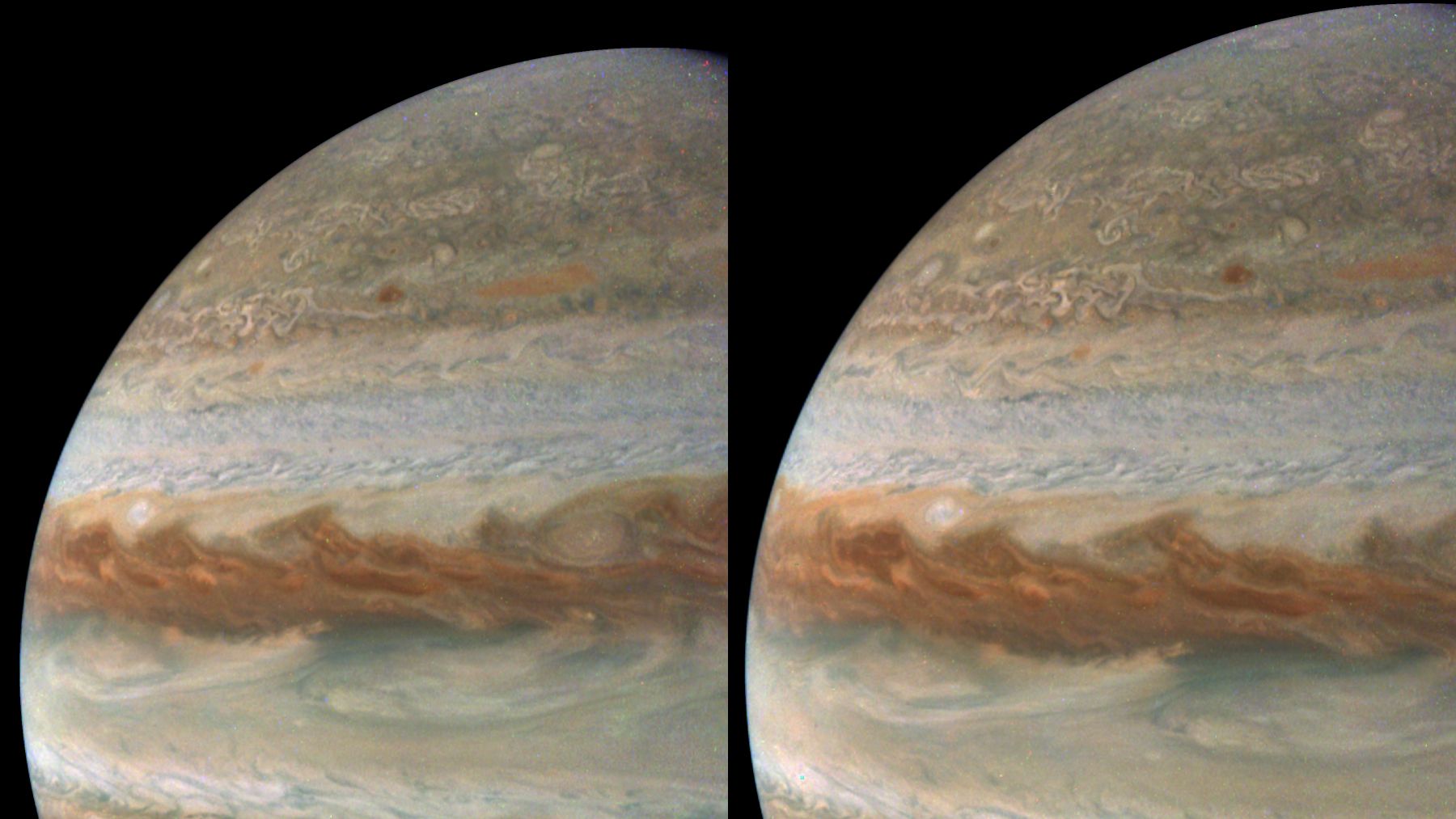
New images released by NASA, thanks to Juno, show that the Great Red Spot was key to obtaining images of Amalthea, one of Jupiter’s moons discovered by Edward Emerson Barnard. The moon, along with the volcanoes of Io, are part of the solar system. In the past, the Galileo spacecraft provided us with images of the surface, and now we want to investigate this satellite further. Read on to learn more.
Get to know Jupiter’s moon
This is not just another great picture of the largest storm in the solar system, Jupiter’s Great Red Spot. That’s not a speck of dust on NASA’s Juno spacecraft camera. That’s a proper moon, orbiting its enormous mother planet in space.
The tiny moon is known as Amalthea, and though it was caught zipping in front of the very ruddy eye of Jupiter’s long-lived high pressure zone, astronomers explain that this moon is in fact the reddest object in the entire solar system. Investigatos think its color is due to the sulfur from the nearby Jovian moon Io, a world with active volcanoes.
The pictures released this week were taken as the spacecraft swooped about 165,000 miles up Jupiter’s clouds in March during its 59th close flyby. Citizen scientist Gerald Eichstädt processed the probe’s raw camera data to improve pictures’s clarity.
Juno has an instrument, named JunoCam, that was planned not just to take great closeup images of Jupiter but to hold public’s attention. The science team permtis citizens to process the camera’s images and polls the crowd for what to focus on next.
In addition, Juno has been orbiting Jupiter for over seven years. The spacecraft is checking the origin and evolution of Jupiter, looking for its core, locating its magnetic field, sizing water and ammonia in the atmosphere, watching for its auroras, and homing in on Jupiter’s moons and dust rings.
What happened during its primary mission
During its primary mission, the spacecraft took data on the gas giant’s atmosphere and interior. Between its achievements was finding that the planet’s atmospheric weather layer extends way beyond its water clouds.
After completing 35 orbits, the spacecraft transitioned to investigate the whole system around Jupiter, along with its rings and moons. The extended mission will go on for another year or until the spacecraft dies. Juno will at some point burn up in Jupiter’s atmosphere as its trajectory erodes. The spacecraft is not at endanger of crashing into and possibly contaminating Jupiter’s moons, some of which may be habitable worlds.
When Amalthea was discovered
Amalthea, just one of Jupiter’s 95 official moons, was in first place found by Edward Emerson Barnard in 1892. It is about 100 miles wide and clumsily formed like a potato due to the fact of its requirement of the mass to form into a more symmetrical sphere. Almost 25 years ago, investigators got to see this little moon up close with the aid of NASA’s Galileo spacecraft, which showed a pell-mell world of craters, hills, and valleys. Amalthea is within the orbit of Io, the closest of Jupiter’s four large moons, along with three other oddly shaped mini moons.
This moon is a interesting little place in the solar system. Investigators have found that it gives off more heat than it gets from the sun — maybe a result of Jupiter’s magnetic field stimulating electric currents within its core or the planet’s gravity causing tidal stresses.
Elisha Sauers writes about space for Mashable, taking deep dives into NASA’s moon and Mars missions, chatting up astronauts and history-making discoverers, and jetting up the clouds. Through 17 years of reporting, she’s covered several topics. Druing the past, she worked for The Virginian-Pilot in Norfolk, Virginia, and The Capital in Annapolis, Maryland. Her work has got some state awards, including the Virginia Press Association’s top honor, Best in Show, and national recognition for narrative storytelling. For each year she has covered space, Sauers has won National Headliner Awards, including first place for her Sex in Space series. Send space tips and story ideas to elisha.sauers@ziffmedia.com or text 443-684-2489. Follow her on X at @elishasauers.




