
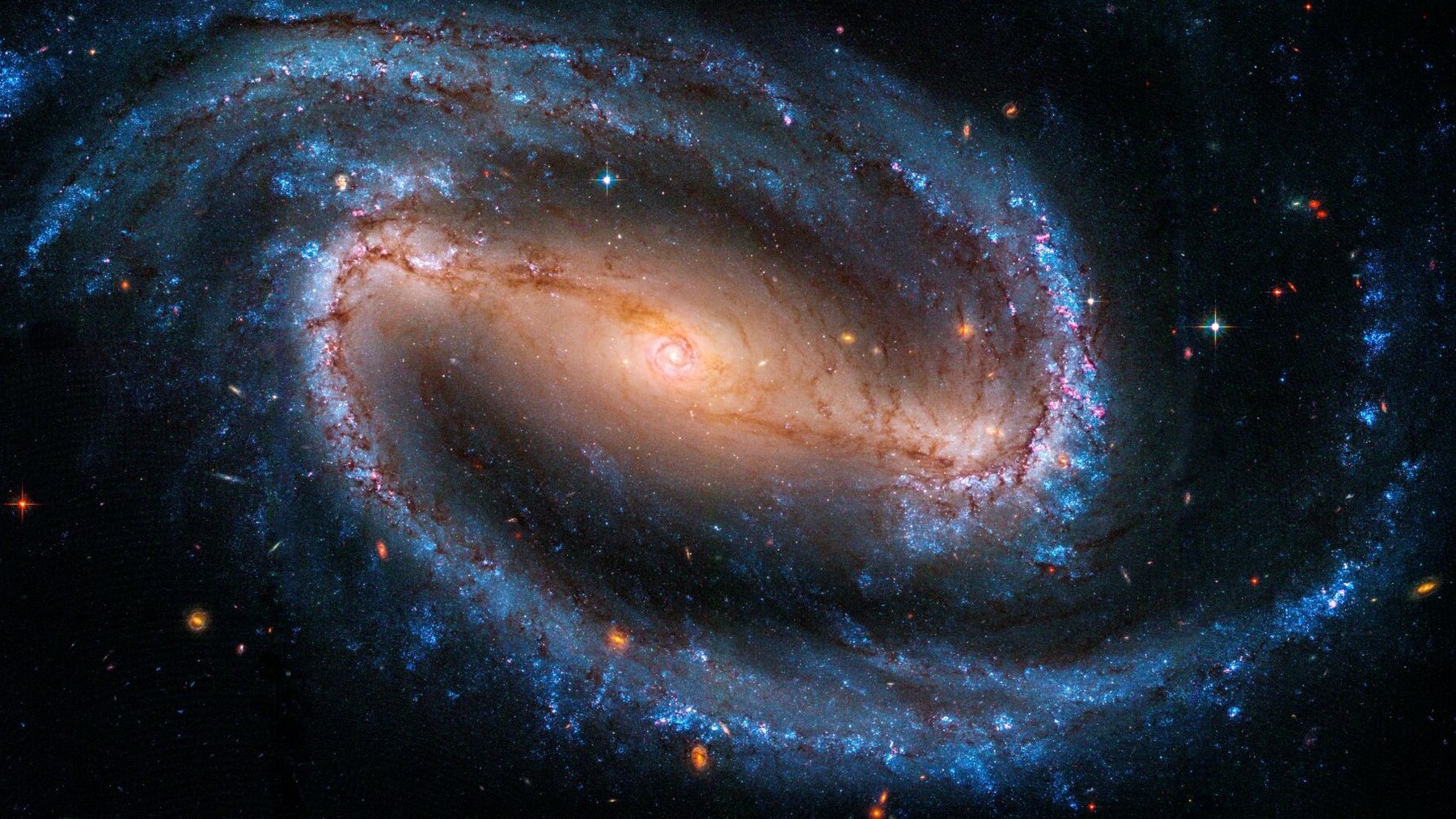
Nasas´s latest news about focus on a collision between two galaxies, which they have dubbed as “Cosmic Joust”. The timing of the collision has been observed, an event never previously detected by researchers. Such collisions are thought to play an important role in the development of the galactic system.
Thanks to this historic event, the effects of this collision and its potential consequences, including new life forms, have been studied.
The “Cosmic Joust”
It has been possible to capture the moment when one galaxy “attacked” another with a beam of radiation from its black hole. The consequences for the affected galaxy have been catastrophic, as it has cleared the clouds where stars are born, preventing their formation.
When galaxies are close enough to each other, they become trapped by the gravity of each galaxy until they form a single galaxy.
Who discovered it?
This research project has been co-led by the astronomer from the Ioffe Institute of Russia, Sergei Balashev, and Pasquier Noterdaeme, from the Institut d’Astrophysique de Paris in France. According to both, “Here we see for the first time the effect of radiation from a quasar ((one of the brightest objects in the universe), directly on the internal structure of gas in a regular galaxy”. It is not new for astronomers to devote their research to understanding galaxy collisions, as this has been a topic of study for years, but this event has never been captured before.
Galaxies and new stars
Galaxies are not known to be an inchoate mixture of matter, but they relate to each other in a network that keeps them interconnected. Researchers believe that the growth of supermassive black holes, and the growth and evolution of the galaxy are caused by these collisions so they play an essential role.
Destroying the formation of stars
Currently, the “cosmic joust” is at the moment of union of both galaxies, with the difference that one of them is a quasar. This happens when a galaxy’s black hole feeds on the surrounding material cloud. In this case, the quasar’s speed reaches 500 km per second (310 miles) as it passes through the other galaxy, causing dust and gas clouds to tear apart. In addition, the quasar galaxy absorbs some of the gas released by the galaxy. The gas´s purpose is to feed the black hole centre and thus increase its intensity. Quasars are not particularly useful in star creation either, due to the process called quenching. The power of its nucleus creates air currents that dissipate star-forming material.
Is there any hope for stars?
Despite the aforementioned collisions, dissipations, and “stealings” of matter, there is still experience in this collision. We cannot forget that they also collide the nuclei, which means that their gas deposits also fuse, creating regions of super density. This is how the process for the birth of new stars begins.
Main facts
Let´s make this all clear and keep the most important facts. If we gather all this information and summarize it, we can say that this event has been a before and after in astronomy and that astronomers have a new line of research open. Although the consequences of cloud dispersal of stellar material and other consequences of a collision between a quasar and a regular galaxy still need to be analyzed in depth, researchers claim that it could be talking about a new way of arriving at the creation of new forms of life. It seems that George Lucas was not too far off and, perhaps, there is a star war.
If you want to learn more about galaxies and their behaviour´s, check out this article!




