
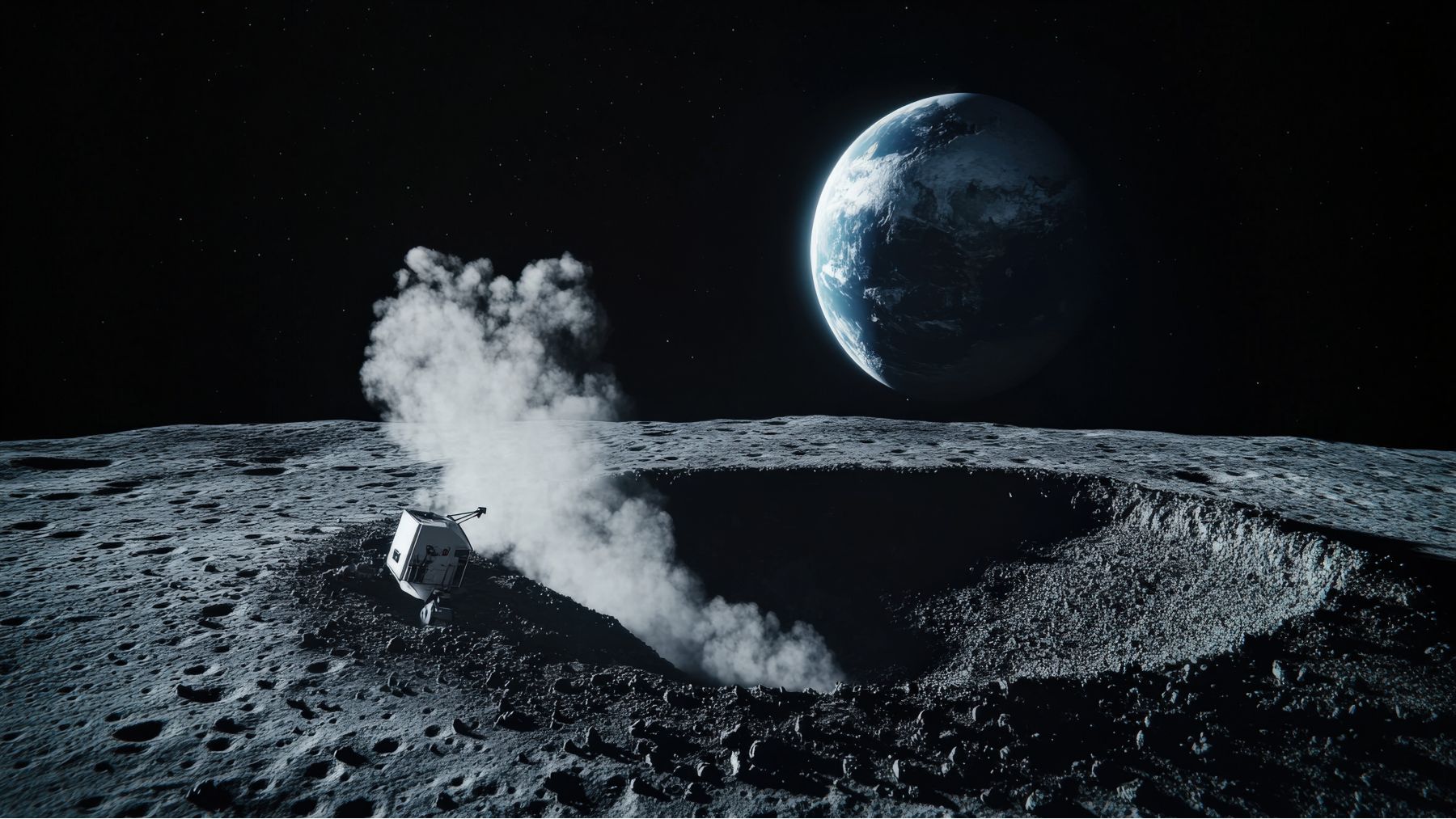
NASA’s new data on possible water on the moon is, to say the least, interesting. Year after year, experts have thought there was no water on the moon. Well, that seems to be changing with the new results. Apparently, the moon has been impacted for thousands of years by particles released by the sun. Lunar regolith, which is dust and rocks, contains a lot of oxygen and some hydrogen. The fact is that the mixture of a series of particles makes it possible to think that the existence of water on the moon is a reality. Specifically, the study says that chemical reactions triggered by the solar wind hitting the lunar surface can produce water. This is a breakthrough that could have enormous implications for future manned missions to the moon.
The thought that the lunar surface could be constantly creating water is so intriguing
Continuing with the explanation, the solar wind is composed of protons, hydrogen nuclei. So when these protons reach the surface, they capture electrons from the minerals and transform them into complete hydrogen atoms. These atoms then bond with the oxygen present in the regolith, forming hydroxyl groups (OH) and even water molecules (H₂O). In short, water. It may seem complex to understand, but it is very important for scientific advancements.
According to NASA’s official statement, “The finding, the researchers wrote in a paper published March 17 in JGR Planets, has implications for NASA’s Artemis astronaut operations at the lunar south pole. Much of the lunar water, a crucial resource for exploration, is thought to be frozen in permanently shadowed regions at the poles.” The thought that the lunar surface could be constantly creating water from dust and sunlight is so intriguing that researchers are continuing to investigate this line of research.
Scientists have long suspected that the solar wind could carry the ingredients for water formation on the Moon. “The exciting thing here is that with only lunar soil and a basic ingredient from the Sun, which is always spitting out hydrogen, there’s a possibility of creating water,” Li Hsia Yeo, a research scientist at NASA’s Goddard Space Flight Center in Greenbelt, Maryland, explained. One example of the solar wind’s effect is the generation of auroras on Earth, when these charged particles impact our planet’s atmosphere.
When protons smash into the Moon’s surface, they collide with electrons and recombine to form hydrogen atoms
“The exciting thing here is that with just lunar soil and a basic ingredient from the Sun, which is always releasing hydrogen, there is the possibility of creating water,” says Li Hsia Yeo, a researcher at NASA’s Goddard Space Flight Center, who led the study. As NASA explains on its website, “most of the solar particles don’t reach the surface of Earth because our planet has a magnetic shield and an atmosphere to deflect them. But the Moon has no such protection,” and continues: “As computer models and lab experiments have shown, when protons smash into the Moon’s surface, which is made of a dusty and rocky material called regolith, they collide with electrons and recombine to form hydrogen atoms.”
To finish, Many researchers think the solar wind is the main reason the molecules are there, although other sources like micrometeorite impacts could also help by creating heat and triggering chemical reactions. To test whether this is true, Yeo and his colleague, Jason McLain, a research scientist at NASA Goddard, built a custom apparatus to examine Apollo lunar samples. You can reach all the details at NASA.gov.
In conclusion, while they can’t conclusively say if their experiment made water molecules, the researchers reported in their study that the shape and width of the dip in the wavy line on their graph suggests that both hydroxyl and water were produced in the lunar samples.




