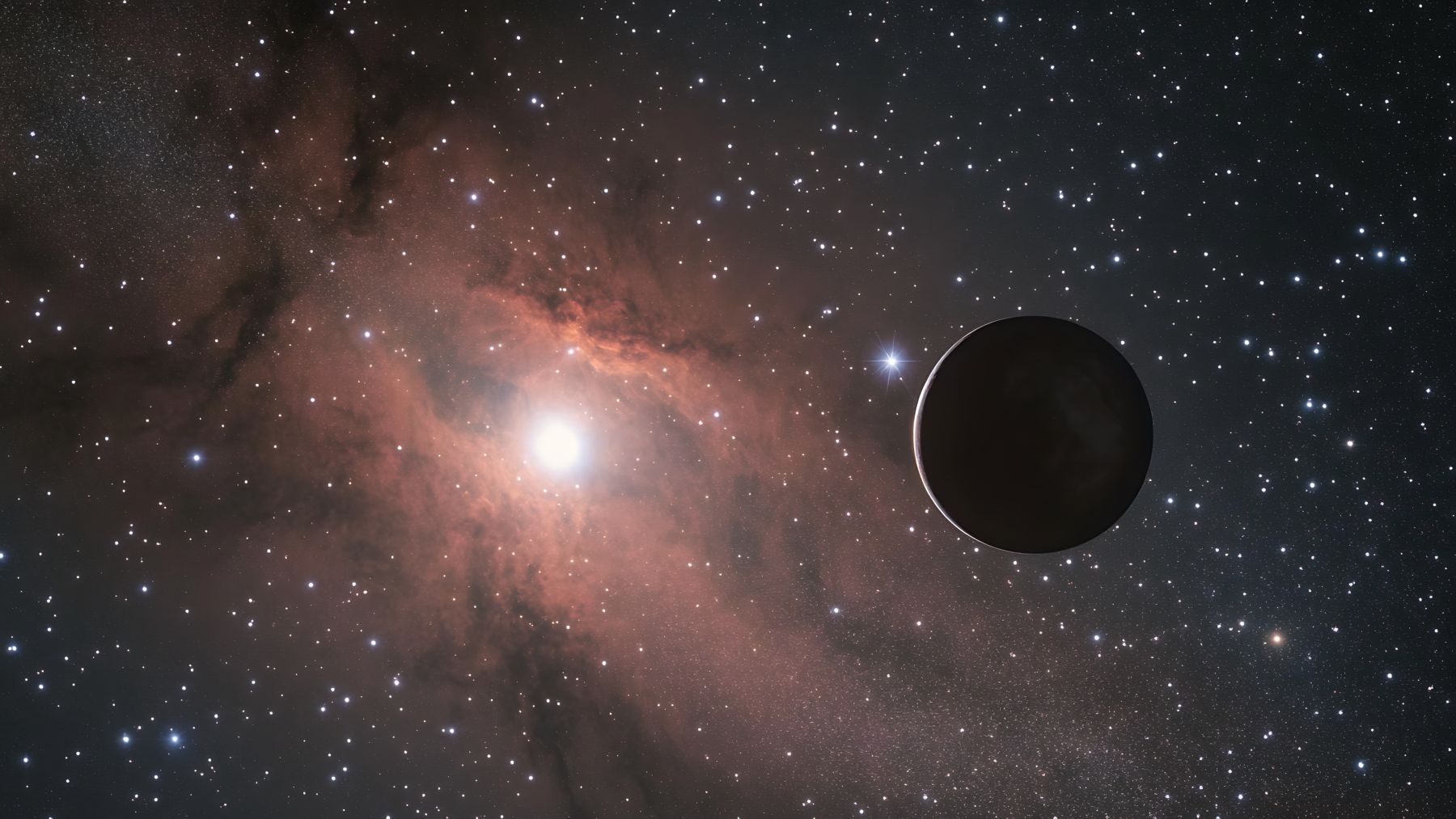
Information continues to emerge about new discoveries from NASA’s James Webb Space Telescope. In two separate articles published Monday in the Astrophysical Journal Letters, astronomers focused on the TRAPPIST-1 system, composed of seven rocky planets orbiting a single star. The object being studied is an Earth-sized planet 40 light-years away that could harbor oceans or icy surfaces.
The possibility that liquid water could also exist is high
According to a study that analyzed observations from the James Webb Space Telescope for more than a year, a rocky, Earth-sized planet in our Milky Way galaxy could have an atmosphere around it. This means the possibility that liquid water could also exist is high. And as we know, if there’s water, there’s life, which would be great news for the scientific community. Recent studies presenting initial results from observations by NASA’s James Webb Space Telescope suggest that the planet, known as TRAPPIST-1e, could have a nitrogen-rich atmosphere similar to Earth’s.
The note we make about the atmosphere is very important. Keeping water in a liquid state, which is the minimum way to create life, requires the atmosphere, that layer that protects it from evaporation. This makes the search for exoplanet atmospheres one of the most fascinating and important activities in the field of astronomy. “TRAPPIST-1e has long been considered one of the best habitable-zone planets to search for an atmosphere,” said Dr. Ryan MacDonald, Professor of Extrasolar Planets in the School of Physics and Astronomy at the University of St Andrews.
The JWST doesn’t directly detect the atmosphere (if there is one) around TRAPPIST-1e
Therefore, to continue their studies, astronomers used NASA’s James Webb Space Telescope to observe four “transits” of TRAPPIST-1e, or moments when the planet passed in front of its star. The telescope, powerful as it is, doesn’t directly detect the atmosphere (if there is one) around TRAPPIST-1e, but instead measured how the exoplanet absorbed light to determine its surroundings.
The goal now for researchers is to obtain more JWST observations of TRAPPIST-1e to enable a deeper search of the atmosphere. With each additional transit, the atmospheric content becomes clearer. “In the next few years, we’ll go from four JWST observations of TRAPPIST-1e to nearly 20. We finally have the telescope and tools to search for habitable conditions in other star systems, making today one of the most exciting times in astronomy,” MacDonald said.
Finding an atmosphere isn’t so simple for astronomers. Researchers must carefully account for starspots, as they are created by local magnetic fields on the surfaces of stars. The team spent more than a year carefully correcting the data to remove star contamination—the visual noise around TRAPPIST-1e.
“If we see no variation in color, then the planet is probably just a bare rock”
How can they do this? Scientists use colors. Like a prism, light can be separated into different color bands in a rainbow-like spectrum. In this way, the way colors are blocked, or how they filter out certain colors, can be signals of specific atoms or gas molecules. “If we see no variation in color, then the planet is probably just a bare rock,” MacDonald said.
As for current discoveries and data, NASA has stated that Titan (one of the moons orbiting Saturn) likely harbors a vast subsurface ocean, which could make it habitable, but the moon’s methane-rich environment would mean that any life existing there would be very different from that on Earth. This is an example of how far-reaching research can go. In other words, what we know about TRAPPIST-1e is still very limited; we’ll have to wait to learn more about the details of this discovery.