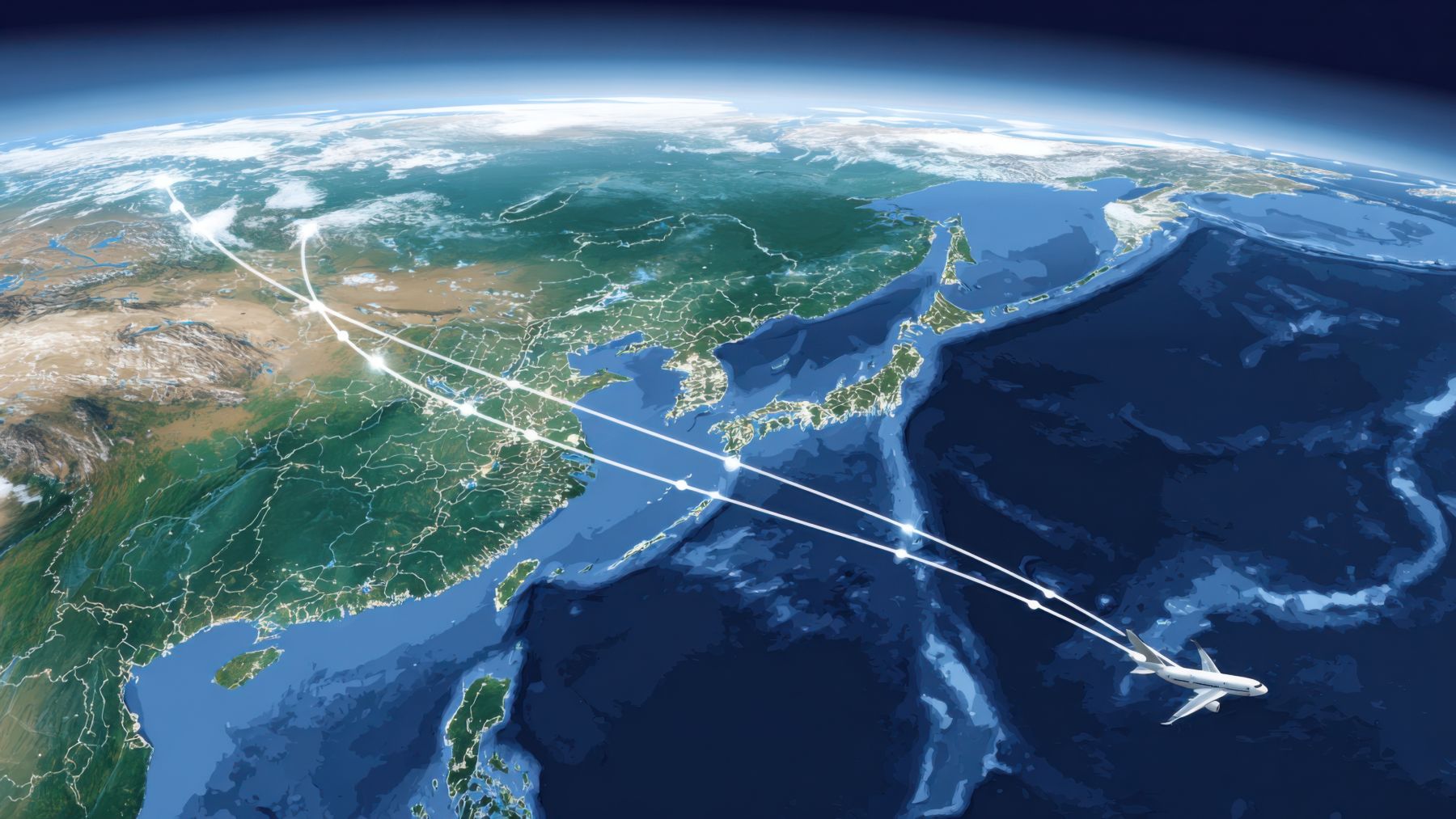
From Shanghai to Buenos Aires in 29 hours, billed as “the world’s longest air route,” could become a reality by the end of this year. According to official data, the flight departing from Shanghai Pudong International Airport (PVG) is scheduled to take approximately 25.5 hours to reach Ministro Pistarini International Airport (EZE) in the Argentine capital, while the return flight is scheduled to last 29 hours, according to the Shanghai-based airline.
Both routes include a two-hour stopover in Auckland, New Zealand
As reported earlier this month, China Eastern announced the launch of the 12,500-mile direct service, which will carry passengers between the Chinese city of Shanghai and the Argentine capital, Buenos Aires. In any case, it’s a flight with a stopover—it’s direct, but with fine print, to put it mildly. Both routes include a two-hour stopover in Auckland, New Zealand, during which passengers can deplane for a rest break. In other words, it’s “direct,” but not nonstop.
In terms of advertising, several airlines have attempted to claim the title of “longest” as part of their marketing campaigns, but most experts agree that the top spot belongs to Singapore Airlines. In this case, seemingly set to run twice weekly, the flights are due to begin on Thursday, December 4, the Chinese carrier said in a statement on September 15.
The airline is opting for an unusual route south
The route, operated with a wide-body Boeing 777-300ER, will be making headlines around the world when it begins operating: “Soaring 20,000 km in 25 hours, linking the antipodal cities across the globe,” China Eastern declared. The airline is opting for an unusual route south, through some of the most remote waters on the planet and close to Antarctica, a choice the company claims will save at least four hours on the total journey.
So far, according to flight search engines, the fastest flight between Shanghai and Buenos Aires, offered by Air France and Lufthansa, takes almost 31 hours, with a stopover in Paris or Amsterdam. Regarding the flight being direct but with stopovers, the company explains it this way: the term ‘direct’ only means “you do not change planes and you have only one flight number.” A flight that doesn’t include a layover between origin and destination is known as ‘non-stop.’ That said, the route is gaining importance due to its route and its interests. “The Shanghai Pudong-Auckland-Buenos Aires route is seen as an important measure to build a new ‘Silk Road Air Channel’ between Asia-Pacific and South America,” the company added.
The airline has long pursued the goal of flying nonstop between Sydney and London
Let’s keep in mind that since these are such long flights, the idea of making a stopover doesn’t seem so crazy. Spending 29 hours on a plane isn’t everyone’s cup of tea. For the passengers on one hand, and for the crew and pilots on the other. Even if there are breaks, it’s like working more than a full day without a break. In this regard, other airlines are working on the topic of ultra-long-haul flights. Australia’s flagship carrier, Qantas, is working on a plan known as “Project Sunrise,” aimed at developing aircraft better adapted to passengers’ rest patterns during ultra-long-haul flights. The airline has long pursued the goal of flying nonstop between Sydney and London, cities separated by some 16,000 kilometers. So, although the route between Shanghai and Buenos Aires plans to break records, this has long been a challenge, especially for airlines operating in Australia and New Zealand.
Let’s remember that Shanghai Airlines is already in the running for the world’s longest flight. This airline’s nonstop flight between Singapore’s Changi Airport and New York’s JFK Airport covers a distance of 15,349 kilometers (9,537 miles) in over 18 hours. These are certainly essential routes, especially for those who live in these cities, while keeping in mind commercial and economic interests, but also a challenge for those working on these projects.