
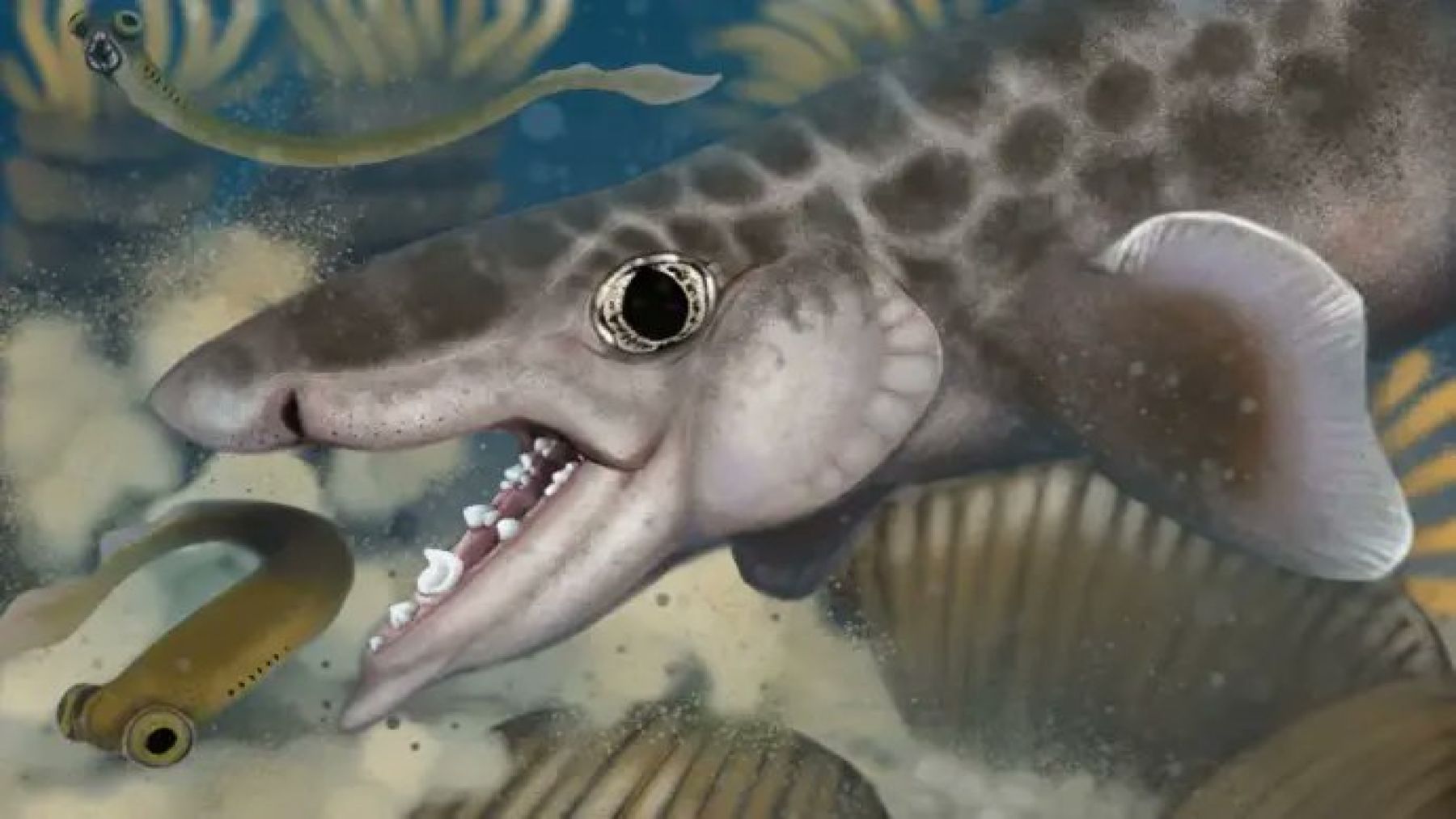
This specimen, called Macadens olsoni, fed on small marine invertebrates thanks to its peculiar spiral teeth. The animals, Troglocladodus trimblei and Glikmanius careforum, come from an ancient clade called ctenacanths. Kentucky was a coastal area at that time. During the middle to late Mississippian, broad carbonate platforms extended across what is now the eastern United States. These seas left behind limestone (St. Louis, St. Genevieve, Haney) that now runs through Mammoth Cave.
The fossil was foun from when part of present-day North America was covered by a warm, shallow sea
The discovery is part of a series of investigations that have uncovered a wide variety of fossil sharks in this park. Among them is Clavusodens mcginnisi, nicknamed the “squirrel shark” for its small size and powerful bite.
The fossil was found in the Ste. Genevieve Formation, an ancient limestone layer dating back to the Carboniferous Period, when part of present-day North America was covered by a warm, shallow sea. That’s where the National Park Service paleontology program and collaborators, led by ancient shark specialist J.-P. Hodnett, mapped, collected, and identified the new species. Despite being hundreds of miles from the sea today, this area once hosted a diverse marine ecosystem that included mollusks and worms, the main prey of this small shark.
The morphological study suggests that another known species, Helodus coxanus, may not belong to the genus Helodus
Alongside dozens of diagnostic teeth, teams recovered a partial jaw and gill arch from a juvenile Glikmanius, giving anatomists a 3-D glimpse at structures usually lost to decay. The morphological study suggests that another known species, Helodus coxanus, may not belong to the genus Helodus, but to an entirely new one that experts have named Rotuladens.
“This discovery is a remarkable contribution to our knowledge of ancient marine life and underscores the importance of preserving our natural history,” said Barclay Trimble, superintendent of the national park. It wasn’t a single lucky find. Volunteers and scientists traced fossil layers across thousands of passages and matched them to surface exposures, then cross-checked with correlative rocks in Alabama—evidence that these sharks ranged widely as shorelines shifted.
These fossils allow for a more precise reconstruction of the evolution of Paleozoic marine ecosystems
Another important breakthrough has been the identification of a new species of ctenacanth, a primitive shark whose existence delays the known appearance of its lineage by 50 million years. These fossils allow for a more precise reconstruction of the evolution of Paleozoic marine ecosystems.
The same study documented material from northern Alabama’s Bangor Limestone
The new species has been named in honor of Rickard Olson, a retired park scientist, whose work was essential in documenting fossils in the area. Ctenacanths generally carried prominent dorsal fin spines, different tooth architectures, and skeletal details that mark them off from modern neoselachians. Kentucky isn’t alone in yielding these time capsules. The same study documented material from northern Alabama’s Bangor Limestone, and comparable Mississippian shark faunas are known from parts of Europe and the American Midwest.
Every new fossil that fits into this story helps calibrate shark evolution. By projecting the Glikmanius lineage 50 million years older than previously thought, the Mammoth Cave species redefines the chronology paleontologists previously had for an entire branch of shark diversity. Therefore, these kinds of discoveries are tremendously important for understanding even past studies in the same area.




