
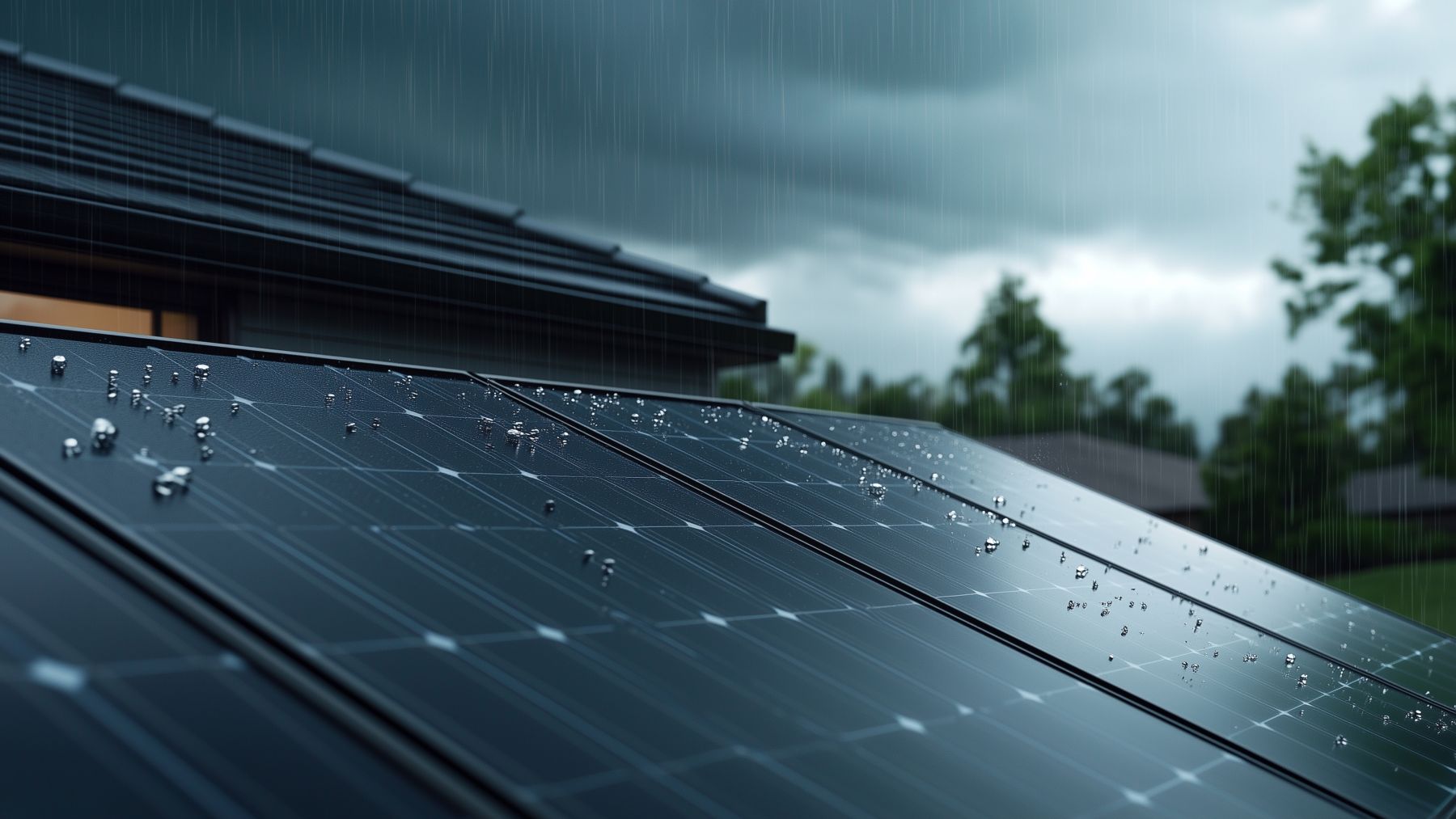
Technology evolves almost at the speed of light. Solar panels, which until recently represented a major revolution in renewable energy, now appear to be taking a back seat to ‘new’ panels that are far more effective. An international team led by King Abdullah University of Science and Technology (KAUST) in Saudi Arabia has developed an innovative composite material that significantly improves the performance and longevity of solar panels.
These revolutionary spherical solar cells are transforming energy harvesting thanks to their ability to absorb all direct
What’s innovative about this new technology is that the material absorbs moisture at night and releases it during the day, allowing for passive cooling without the need for electricity. These revolutionary spherical solar cells are transforming energy harvesting thanks to their ability to absorb all direct, diffuse, and reflected solar radiation from all directions without requiring mechanical solar tracking systems. This alternative can solve several problems, such as the critical limitation of overheating in current solar panels.
Over 75% of the world’s installed solar power capacity relies on solar cells that convert only 20% of the light into electricity
The fact that this technology can convert sunlight scattered inside a building into energy makes it especially viable indoors, in cities with little direct sunlight, and for devices that require a constant power supply. To put it in perspective, over 75% of the world’s installed solar power capacity relies on solar cells that convert only 20% of the light into electricity. This means the rest is lost as heat or reflected light, drastically reducing efficiency and accelerating degradation. Therefore, scientists have invented a new corrugation method that allows them to transform hard monocrystalline silicon into a soft material, and then mold a flexible material into a sphere.
This material is made of inexpensive acrylic polymer and lithium chloride, and it has hygroscopic properties
Solar cell spheres represent a new technology that unlocks the potential for integrating solar power into small devices, portable electronics, and overcomes the challenges of using large, flat panels in space. This material is made of inexpensive acrylic polymer and lithium chloride, and it has hygroscopic properties: it absorbs moisture from the air at night and releases it during the day, cooling the panel without requiring energy. This revolutionary technology, incorporated into the manufacturing process, retains the high-efficiency properties of traditional silicon and allows for the creation of previously unattainable three-dimensional formations.
This translates to a 12% increase in electricity production, over a 200% increase in lifespan
The results of the initial tests have been met with enthusiasm. During weeks of operation in the Saudi desert, the panels with the new coating were 9.4°C cooler than conventional panels. This translates to a 12% increase in electricity production, over a 200% increase in lifespan, and a 20% reduction in electricity generation costs. Furthermore, the downward-facing spherical cell design provides an inherent advantage in dust resistance compared to conventional flat panels. This means reduced maintenance and greater long-term operational consistency.
This new practice demonstrates that, by improving traditional materials, they can be made more practical and efficient
In short, the advantages so far seem almost overwhelming. The introduction of this material can reduce the frequency of solar panel replacement, which means less electronic waste, reduced use of raw materials, and lower emissions associated with manufacturing. This new practice demonstrates that, by improving how traditional materials are innovated, they can be made more practical and efficient, generate more energy, and require less maintenance. Furthermore, this new material allows for the expansion of solar energy in regions with extreme climates; it minimizes reliance on cooling systems and reduces the use of polluting materials, such as asbestos. We now await the real-world, practical applications of this new system.




