
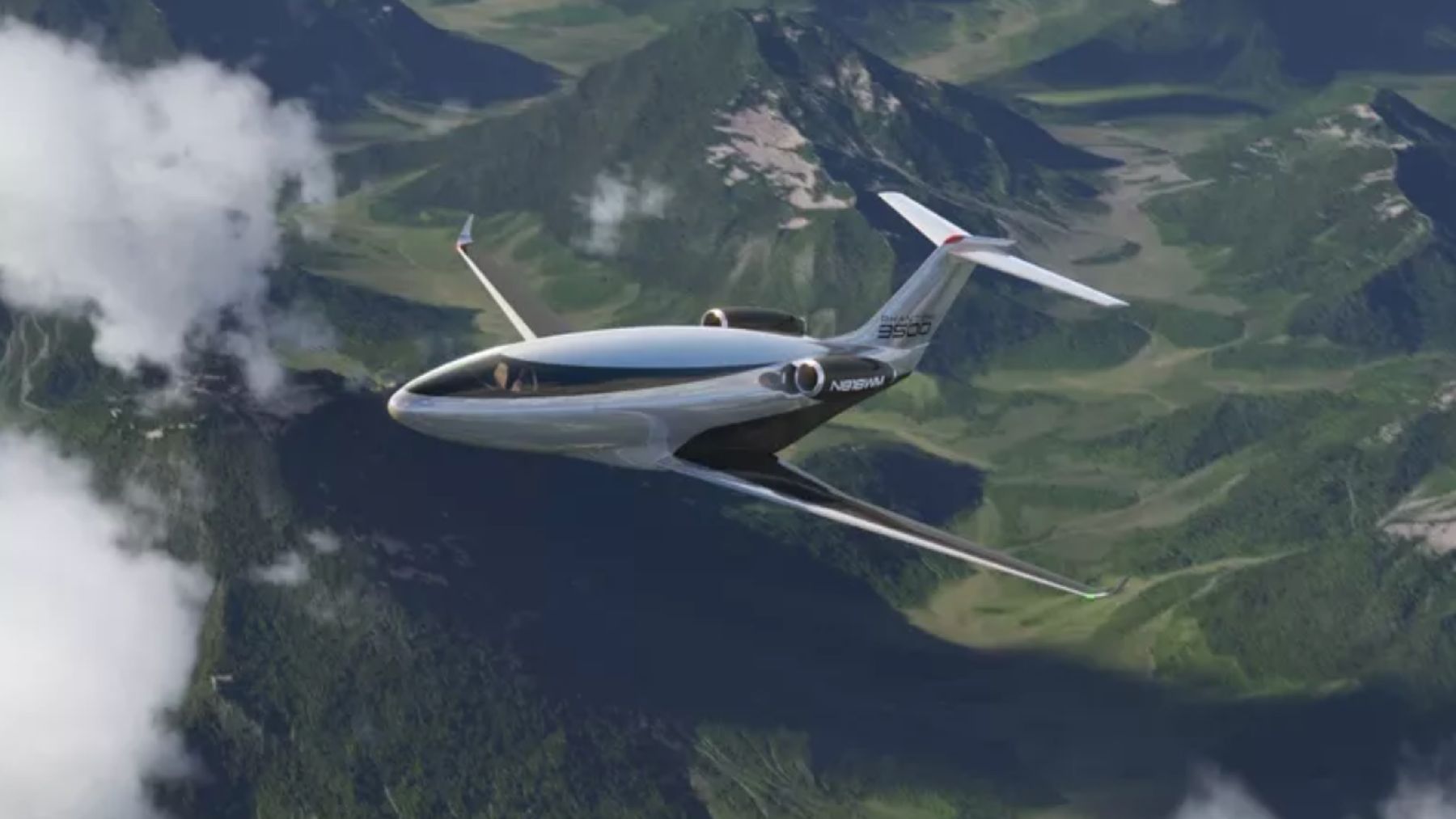
Technological advances in aviation continue to amaze. Otto Aviation, an American company specializing in advanced aeronautical technology, has officially unveiled the Phantom 3500, a revolutionary executive jet that completely eliminates traditional windows and replaces them with high-definition digital screens. It also promises to reduce fuel consumption by 60% and revolutionize corporate flying with its futuristic design.
One of the Phantom 3500’s design features lies in its mastery of laminar flow, an aerodynamic principle that allows air to move over the fuselage surface
This aircraft, which represents the evolution of the Celera 500L technology demonstrator, aims to radically transform efficiency standards in business aviation. Furthermore, one of the Phantom 3500’s design features lies in its mastery of laminar flow, an aerodynamic principle that allows air to move over the fuselage surface in ordered, parallel layers, eliminating the turbulence that creates additional drag. This project utilizes fully laminar flow technology and is expected to be ready between 2027 and 2030.
This system uses high-resolution digital screens that cover the walls and ceiling of the cabin
One of the main features that draws the attention of future customers is the replacement of windows with screens. This system uses high-resolution digital screens that cover the walls and ceiling of the cabin, transmitting real-time views of the exterior captured by cameras strategically mounted on the aircraft’s fuselage. A reinvention that seems futuristic, even though today we are already in the future, as far as technology and AI are concerned.
Its AI-assisted aerodynamic design reduces fuel consumption by 60% and, when powered by sustainable fuels
This aircraft is capable of flying up to 3,700 nautical miles (almost 7,000 kilometers) with significantly lower fuel consumption than comparable aircraft. Paul Touw, CEO of Otto Aviation, explains that this approach triggers what the company calls a “virtuous cycle” in aircraft design. Furthermore, according to the company, its AI-assisted aerodynamic design reduces fuel consumption by 60% and, when powered by sustainable fuels, could reduce carbon emissions by up to 90%. This could be one of the most important breakthroughs considering the urgency of climate change.
“When drag decreases, fuel consumption decreases. When fuel consumption decreases, less fuel is required”
Speaking of the aircraft’s interior, it offers a spacious and futuristic cabin designed for maximum comfort, with seating for nine passengers in a two-meter-high interior, ideal for both private and corporate travel. “By applying laminar flow, drag decreases. When drag decreases, fuel consumption decreases. When fuel consumption decreases, less fuel is required, allowing for smaller engines and lighter structures,” Scott Drennan, president and COO of Otto Aviation, recently said.
The aircraft reaches a cruising altitude of 51,000 feet (15,544 meters), well above conventional commercial traffic
Technically, the Phantom 3500 incorporates two Williams FJ44 turbofan engines mounted in the rear of the fuselage. This technological evolution, combined with larger wing surfaces and a T-tail configuration, considerably optimizes aerodynamic performance. This cascading effect results in a significantly more efficient aircraft, according to experts. Furthermore, the aircraft reaches a cruising altitude of 51,000 feet (15,544 meters), well above conventional commercial traffic, ensuring smoother flights and greater route flexibility.
Times and distance: Test flights are planned for 2027, and certification and entry into service are expected by 2030
Finally, the aircraft’s projected maximum range is 3,500 nautical miles (6,482 kilometers), enough to connect cities like Madrid and New York nonstop. The first Phantom 3500 will be assembled at a new manufacturing facility at Cecil Airport in Jacksonville, Florida. And, as mentioned above, test flights are planned for 2027, and certification and entry into service are expected by 2030; with distances that could connect European cities like Paris or Madrid with New York nonstop.




