
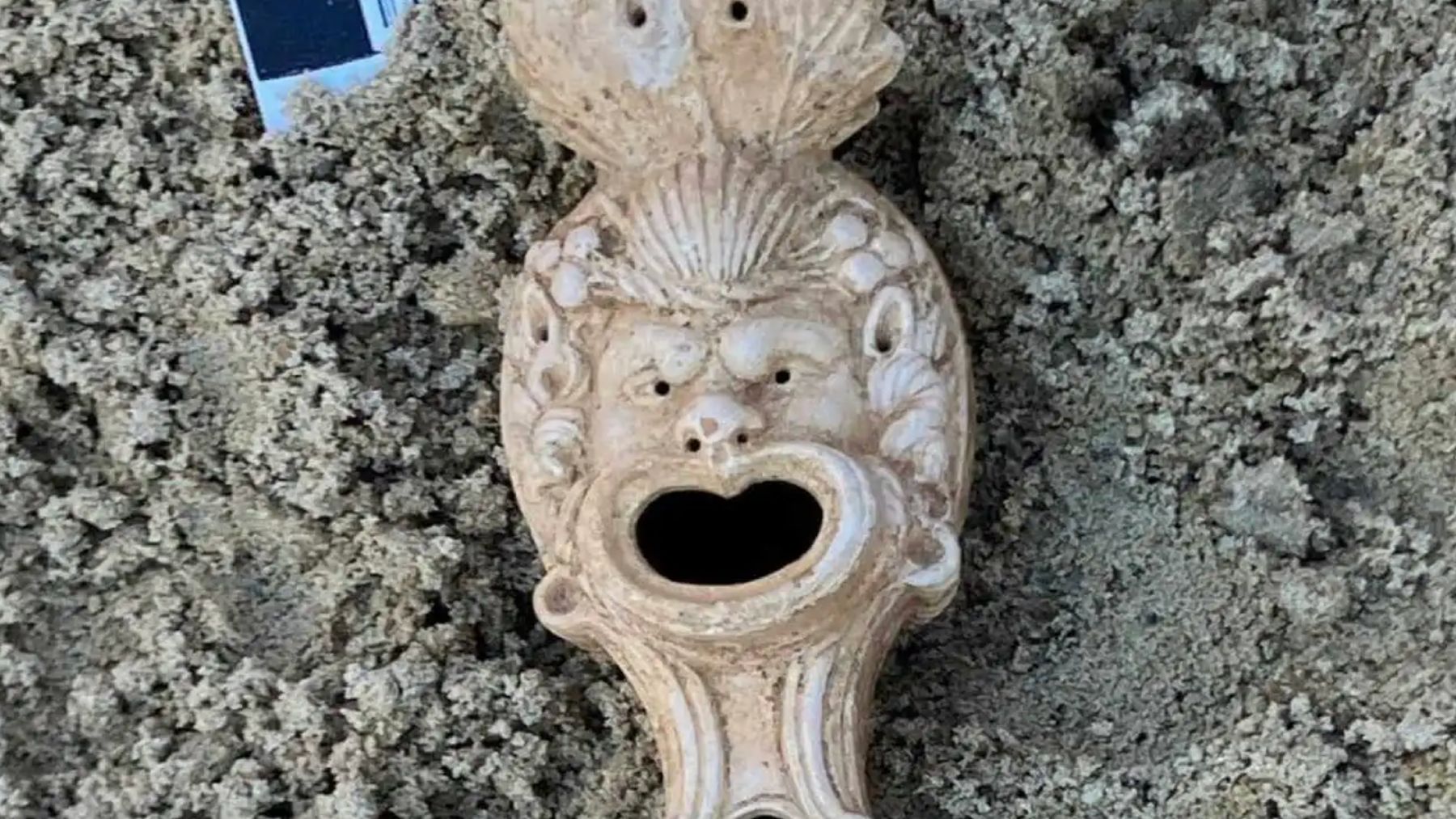
Today, we continue to witness discoveries that astonish humanity, and even more so those who find them. In this case, it is the discovery of a Roman oil lamp (lucerna), approximately 1,800 years old, shaped like a theatrical mask representing comedy. The discovery was made by a team of archaeologists excavating the ancient Roman settlement of Ceuclum, in the present-day Dutch town of Cuijk.
The oil lamp was found in one of more than 85 previously documented graves
The discovery took place on the former site of the Nutricia factory, where land is currently being prepared for a future urban development. “Its exceptional state of preservation and intricate design make it a unicum (a unique object),” said municipal archaeologist Johan van Kampen. The oil lamp was found in one of more than 85 previously documented graves, within a burial area estimated to extend to 6 hectares.
According to official information from the municipality of Land van Cuijk, the piece is so unusual that it has been deemed of museum value and an exceptional find. The lamp, which is in perfect condition, has pleasantly surprised archaeologists, who consider it one of the most extraordinary finds in the Netherlands. Going into detail, the lamp, dating from the 2nd century AD, was designed not only with functionality but also with symbolic intent.
“Since excavations began in June, more than seventy graves have been unearthed containing coins, vases, jewelry…”
The lamp was found in what archaeologists consider the largest Roman cemetery ever discovered in the Brabant region, located between the Netherlands and Belgium. In this case, the find takes the form of a dramatically expressive face, with exaggerated eyes and mouth, evoking the masks used in Greek theater, which were later absorbed into Roman culture. “Since excavations began in June, more than seventy graves have been unearthed containing coins, vases, jewelry, and other objects that accompanied the deceased in the afterlife. However, this lamp is the centerpiece, both for its artistry and its symbolic significance,” said Van Kampen.
The lamp worked as follows: Oil was poured through the mouth, which became a filling hole, and light emerged from the end of what could be interpreted as a neck. The figure appears to represent a satyr, a mythological creature that was half-man, half-goat, associated with the god of wine and theater, Bacchus (or Dionysus).
The experts were surprised to find that almost all of the artifacts found are virtually intact
Symbolism, therefore, is a fundamental part of the meaning of this type of find. In this case, the Romans believed that death was not the end, but rather a transition to another form of existence. “Its purpose, both literally and figuratively, was to bring light into the darkness. The intricate decorations on the piece, which include motifs uncommon in the Low Countries, underscore its uniqueness,” says one of the archaeologists.
The researchers conclude that the archaeological evidence in the region, ranging from farms and villas to military outposts, points to a thriving Roman presence, according to the researchers. The experts were also surprised to find that almost all of the artifacts found are virtually intact. The researchers suggest this could be due to the careful arrangement of the grave goods and the fact that they were covered with sand almost immediately.
All of this, combined with the objects with which the dead were buried, suggests that this was a Roman community with access to consumer goods distributed through the Empire’s trade networks, and suggests a settled population with well-established funerary customs. Researchers believe this type of lamp dates back to the second century and was placed in tombs to guide the deceased on their journey to the afterlife.




